 News.Ycombinator
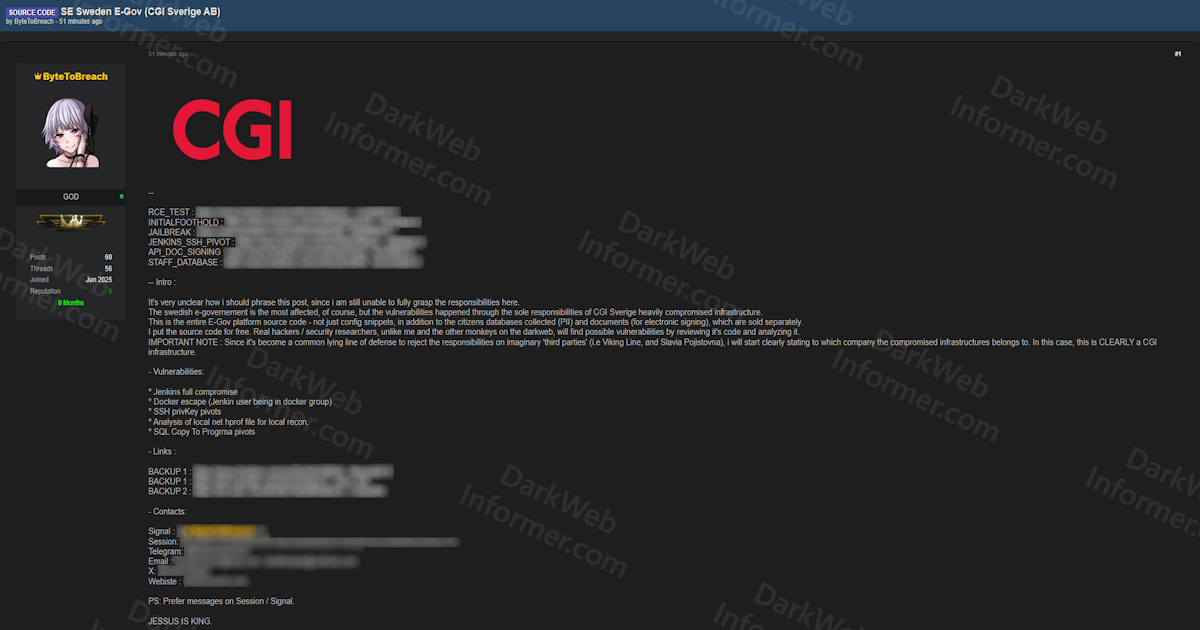
 Sweden's E-Government Platform Source Code Leaked by ByteToBreach
Article Content

- •ByteToBreach leaked the entire source code of Sweden's E-Government platform.
- •Sensitive citizen data, including PII databases, is being sold separately.
- •The breach exploited multiple vulnerabilities, including Jenkins and Docker issues.
The threat actor ByteToBreach has leaked the complete source code of Sweden's E-Government platform, claiming it was acquired through a compromised CGI Sverige AB infrastructure. This breach also includes sensitive citizen PII databases and electronic signing documents, which are being sold separately. The attack exploited vulnerabilities such as a full Jenkins compromise, Docker escape, and SSH private key pivots. The actor has listed various sensitive components, including a staff database and RCE test endpoints. They assert that the Swedish e-government is the primary victim and criticize companies blaming third parties for breaches. The source code is available for free download, while the citizen databases are for sale. This incident follows a previous breach involving Viking Line, indicating a pattern of attacks by the same actor.
Ask AI about this cluster
Answers cite the sources they use
Timeline
More articles in this cluster (7)
Following this threat?
Track ByteToBreach and CGI Sverige AB in your own feed — you're alerted when they show up in new reporting, leak sites or exploitation.
Free account · no card needed
Continue Reading
 Critical Citrix NetScaler Zero-Day Vulnerabilities Exploited In late September 2026, two critical zero-day vulnerabilities (CVE-2026-88771 and CVE-2026-88772) in Citrix NetScaler ADC and Gateway were actively exploited, allowing remote code execution. The Cybersecurity and Infrastructure Security Agency (CISA) added these CVEs to its Known Exploited Vulnerabilities catalog on…
  Critical Authentication Bypass in Rejetto HFS Exploited Within 24 Hours Anthropic's Mythos model identified a critical authentication bypass in Rejetto HTTP File Server (HFS), tracked as CVE-2026-61500, allowing remote code execution. Discovered by Horizon3 researcher Zach Hanley, the flaw was revealed on September 27, 2026, and exploitation began within 24 hours, with attacks traced to…