 Socket.Dev
 Tensorlake npm Package Compromised by Shai-Hulud Worm
Article Content

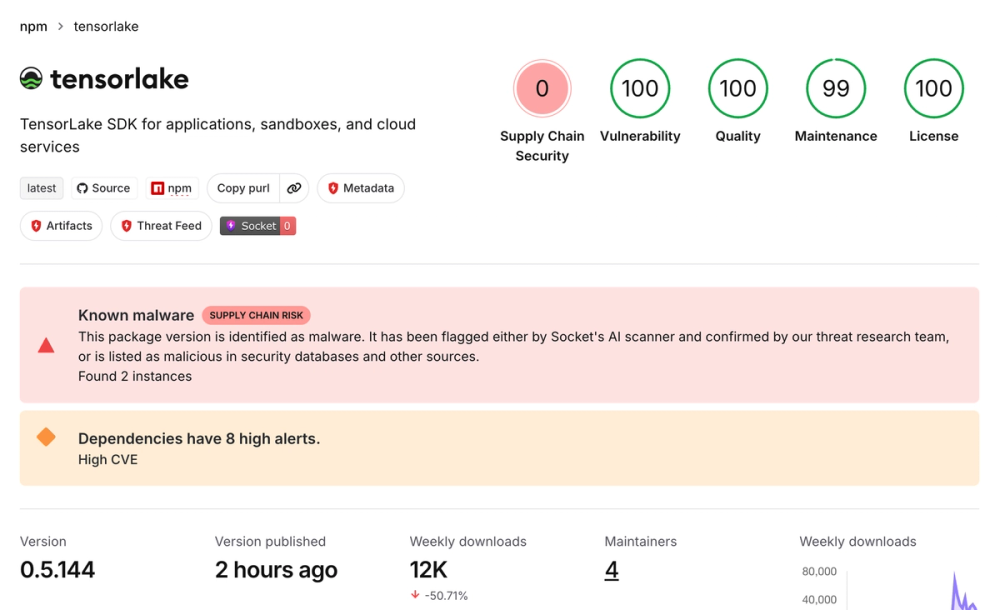
- •Version 0.5.144 of Tensorlake contains a credential-stealing worm that executes on install.
- •The malware uses a preinstall hook to run an obfuscated loader that harvests sensitive credentials.
- •Users are advised to treat any machine that installed the compromised version as fully compromised.
On October 8, 2026, the Tensorlake npm package version 0.5.144 was compromised, delivering a credential-stealing worm known as Shai-Hulud. The malware, which was published through a compromised maintainer account, executes a preinstall hook that runs an obfuscated loader to harvest credentials from local files and CI environments. It also establishes persistence and attempts to propagate through connected supply chains. The malicious version was flagged shortly after publication, and npm has since removed it. Users who installed this version are advised to treat their machines as compromised and rotate all credentials. The attack is part of a broader trend of supply chain vulnerabilities affecting popular development tools.
Ask AI about this cluster
Answers cite the sources they use
Timeline
More articles in this cluster (7)
Following this threat?
Track Shai-hulud and Tensorlake in your own feed — you're alerted when they show up in new reporting, leak sites or exploitation.
Free account · no card needed
Common questions
Which versions are affected?
Is this being exploited?
What should I do if I installed this version?
Continue Reading
 North Korean Hackers Deploy Mac Backdoors via Fake Job Tests Targeting IT Firms North Korean threat actor Jade Sleet, also known as TraderTraitor, has been linked to a breach of an Indian IT services provider using macOS backdoors named FLATROOF and ROOFDECK. The attack involved social engineering tactics, where fake job interview assignments were used to lure DevOps engineers into executing…
  Shai-Hulud npm Payload Resurfaces After 111 Days Dormancy A known malicious npm payload, associated with the Shai-Hulud attack on @AntV, has resurfaced after 111 days of inactivity. The original attack occurred on May 19, 2026, when a compromised maintainer account published 639 malicious versions of @antv packages. On September 7, 2026, four new packages containing the same…