Skip to content
Product
Use it
Threat intelligence API
Free key, 70+ endpoints, OpenAPI. The product.
Get started
Pick your stack, make your first call.
Live feed
The console: incidents, filters, entities, search.
Recipes
Runnable examples for the free key.
Free feeds
RSS, ransomware feed, IOC blocklist, MISP — no key.
CLI & agents
tc from a terminal; agent keys with scoped budgets.
The data
Incident records
900 articles a day become ~70 scored incidents.
Dark web
First-party leak-site collection: victims, groups, markets.
Validated IOCs
Indicators with a false-positive gate; STIX, MISP, CSV.
Vulnerabilities
CVEs with EPSS, KEV and exploit status.
Entity graph
Actors, malware, CVEs, companies — pivotable.
For teams
For service providers
Per-client feeds, alerts and branded digests.
Use cases
How teams and builders use the corpus.
About ThreatCluster
What it is and how it is built.
Pricing
Docs
Reference
OpenAPI (Swagger)
Every endpoint, parameter and response model.
ReDoc
The same reference, long-form.
Examples on GitHub
curl, Python and Node quickstarts; daily spec snapshot.
Guides
Quickstart & plans
Key, scopes, budgets, tiers.
Integrations
Splunk, Sentinel, Elastic, agents and terminals, step by step
Export formats
STIX 2.1, MISP, CSV, text.
CLI setup
Install, log in, wire an agent.
No results found
Sign in
Get a free key
No results found
Product
Threat intelligence API
Get started
Live feed
Recipes
Free feeds
CLI & agents
The data
Incident records
Dark web
Validated IOCs
Vulnerabilities
Entity graph
For teams
For service providers
Use cases
About ThreatCluster
Docs
OpenAPI (Swagger)
ReDoc
Examples on GitHub
Quickstart & plans
Integrations
Export formats
CLI setup
Pricing
Contact
Get a free key
Sign in
Back
DirtyFrag
Vulnerability
Threat entity extracted from intelligence sources
Entities
›
vulnerability
›
DirtyFrag
Frequency
7
occurrences
First Seen
May 12, 2026
Last Seen
September 15, 2026
API
Overview
Recent Events
Profile
Profile
MITRE ATT&CK
1 / 2
Associated Malware
Katana
Kataru
Mirai
Tools Used
BusyBox
Chrome
GhostLock
wget
Related CVEs
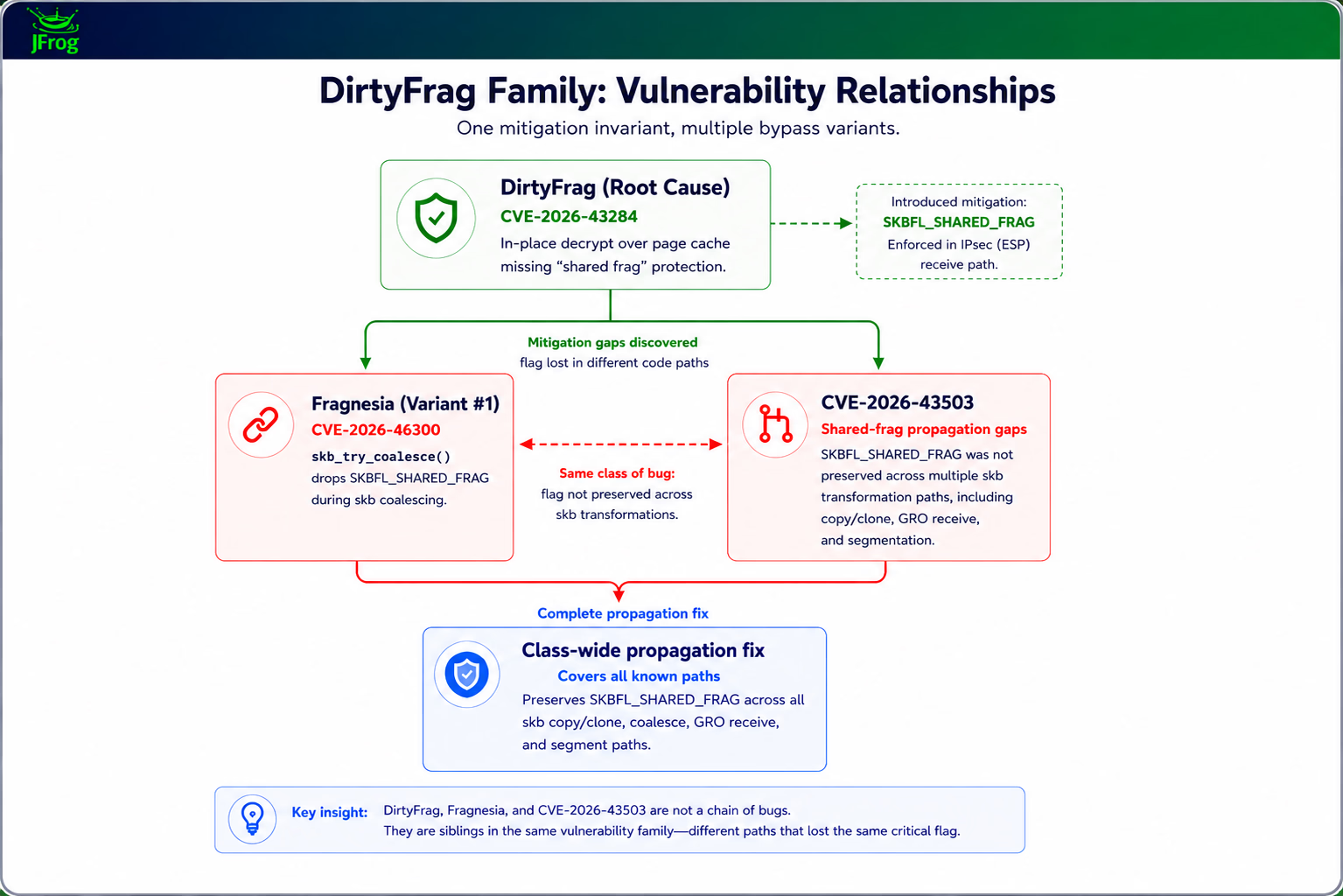
CVE-2026-43503
CVE-2026-43284
CVE-2026-46300
CVE-2026-46331
CVE-2026-53362
CVE-2026-31431
CVE-2026-43500
MITRE Techniques
T1068 - Exploitation for Privilege Escalation
T1053 - Scheduled Task/Job
T1059 - Command and Scripting Interpreter
T1105 - Ingress Tool Transfer
T1110 - Brute Force
T1547 - Boot Or Logon Autostart Execution
T1071 - Application Layer Protocol
Affected Platforms
Linux
Android
HAProxy
KVM
OpenWrt
Regions
South Korea
Vietnam
Sectors Affected
Automotive
Media
-
REC
Recon
No techniques detected
-
RD
Resource Dev
No techniques detected
-
IA
Initial Access
No techniques detected
2
EX
Execution
T1053 - Scheduled Task/Job
T1059 - Command and Scripting Interpreter
1
PE
Persistence
T1547 - Boot Or Logon Autostart Execution
1
PE
Priv Esc
T1068 - Exploitation for Privilege Escalation
-
DE
Defense Evasion
No techniques detected
1
CA
Cred Access
T1110 - Brute Force
-
DI
Discovery
No techniques detected
-
LM
Lateral Mov
No techniques detected
-
CO
Collection
No techniques detected
2
C2
C2
T1105 - Ingress Tool Transfer
T1071 - Application Layer Protocol
-
EX
Exfil
No techniques detected
-
IM
Impact
No techniques detected
7
techniques detected across
5
tactics
Related Clusters (4)
New DirtyClone Vulnerability in Linux Kernel Enables Local Privilege Escalation
Jun 26
·
10 sources
74
Tails 7.7.3 Emergency Update Addresses DirtyFrag Vulnerability
May 12
·
2 sources
72
Tails 7.8 Released: Critical Kernel Vulnerabilities Patched and Thunderbird Updated
May 21
·
1 sources
71
$1 Million Sandbox Challenge Reveals Linux Kernel Vulnerabilities
Sep 15
·
2 sources
43
Related Articles (7)
$1 Million Sandbox Challenge Uncovers Linux Kernel Flaws
Securityweek
·
Sep 15
Nozomi said in a report shared with GBhackers
www.nozominetworks.com
·
Sep 11
DirtyClone: Fourth Linux Kernel Flaw in Six Weeks Escalates to Root
Securityaffairs.Co
·
Jun 27
2 Linux kernel flaw PoCs published, enabling local privilege escalation
Feeds.Feedburner
·
Jun 26
Anonymizing Linux: Tails 7.8 makes Thunderbird an add-on
Heise.De
·
May 21
Fragnesia: Linux Kernel Local Privilege Escalation via ESP-in-TCP
Wiz
·
May 13
Anonymizing Linux Tails: Emergency update 7.7.3 fixes DirtyFrag vulnerability
Heise.De
·
May 12
Prev
1 / 2
Next
Related Entities
Zero-day Exploit
Brute Force
DDoS
Remote Code Execution
Cursor
JFrog
Vercel
South Korea
Vietnam
CVE-2026-43503
CVE-2026-43284
CVE-2026-46300