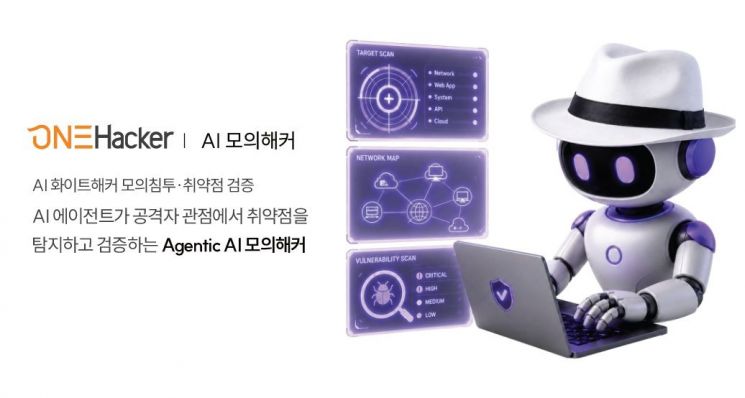
As cyberattacks using artificial intelligence (AI) become more sophisticated, AI white-hat hacking technology, which uses AI to identify hacking threats, is rapidly gaining traction. As attackers use AI to expand the speed and scope of their intrusions, awareness is growing that defenders also need to use AI for continuous penetration testing and vulnerability validation.
AI white-hat hacking technology identifies system vulnerabilities and verifies the possibility of intrusion from the perspective of an actual attacker. Unlike conventional methods, which check for security vulnerabilities at set intervals, AI continuously explores attack paths and can identify potential risks of real-world intrusion in advance, drawing attention as a new security tool.
In South Korea, RaonSecure has entered the market with OneHacker, an AI-powered autonomous penetration testing platform. Built on agentic AI, OneHacker analyzes intrusion paths and identifies security weaknesses in systems.
Once a system to be tested is specified, the AI independently devises and executes complex attack scenarios. A recently released demonstration video showed the platform completing in minutes tasks that might take a security expert a week. It also supports on-premises environments, targeting organizations that handle sensitive data, such as financial institutions.
As the risk grows that AI-based penetration techniques could be misused in real-world attacks, the importance of safeguards is also coming into focus. One example is ARTEX, an AI penetration tool reportedly used in recent attacks on the financial sector. ARTEX was originally developed to test the security of authorized systems, but concerns were raised that it was difficult to control users' permissions and the scope of testing. Its developer later made the source code private on GitHub, but the risk of misuse through copies that had already been distributed remains.
Unlike ARTEX, AI penetration testing solutions developed by specialized security companies focus on reproducing attacks within authorized boundaries and managing the execution process. RaonSecure says it has combined AI's automation capabilities with the analytical expertise of professional white-hat hackers in OneHacker to deliver "controllable autonomous penetration testing."
In particular, the company says it has adopted Agent Harness technology to manage the tools used by AI and its execution process, while adding analysis by professional white-hat hackers to ensure not only autonomy but also expertise and safety.
"As AI has changed the speed and scale of attacks, defenses must also evolve by using AI," said Yoon Wonseok, director of RaonSecure's WhiteHat Center. "It is important to establish a system that combines AI's autonomous vulnerability-discovery capabilities with the expertise of experienced white-hat hackers to identify and validate risks before attackers can exploit them."
The spread of AI white-hat hacking technology is not limited to South Korea. Overseas, companies that use AI to proactively identify security vulnerabilities and verify the potential for real-world attacks are also growing rapidly.
U.S. AI security company Horizon3.ai raised $250 million in investment this August, promoting its autonomous penetration testing platform, NodeZero. Its valuation has surpassed $2 billion, and its customer base has grown to more than 7,000 organizations worldwide.
XBOW, founded by a person who led the development of GitHub Copilot, has also leveraged autonomous hacking technology to become a unicorn with a valuation of more than $1 billion just two years after its founding. Israel-based Pentera has entered more than 60 countries with its automated penetration testing validation solution.
The market itself is also expected to grow rapidly. Market research firm MarketsandMarkets forecasts that the global penetration testing market will grow from $1.98 billion (approximately 2.6587 trillion won) in 2025 to $4.39 billion (approximately 5.89 trillion won) in 2031. The compound annual growth rate is projected to reach 14.2%. Analysts expect demand for penetration testing to expand alongside the rise in new security threats as AI adoption spreads, driving the need to validate the potential for real-world attacks.
In South Korea, the adoption of AI-based security technology is expected to accelerate, particularly in the financial sector. Following a series of recent hacking incidents, major banks have moved to increase their information security budgets and expand their specialist workforces. They are also stepping up efforts to establish new security systems, including continuous vulnerability checks using AI, automated penetration testing, and attack simulations.
Financial regulators are also working to establish an AI security validation framework. On October 7, the Financial Security Institute introduced new assessment criteria consisting of 17 checklist items across six areas to address security threats that may arise when AI agents act autonomously. It plans to conduct pilot validations through the end of this year and officially implement the criteria starting in 2027. Earlier, the Financial Supervisory Service and the Financial Security Institute also decided to increase the frequency of blind penetration testing exercises from once to twice a year.
Industry observers say that in the AI era, security competitiveness will depend not merely on responding after an incident but on how quickly organizations can reproduce and block actual attacks. Hot Picks Today "If You Don't Apply, My KRW 1.7 Million Will Be Gone"... Unclaimed National Pension Refunds Vanish After 'This Deadline' "I order out of habit, then regret it when I check my wallet"... Gen Z caught in 'delivery guilt' "When I get from Work, This Is All I Do, and It's Making Me Stupid"... Short-Form Craze Sparks 'Electronic Drug' Debate in China Lee Juwan, Who Forecast Samsung at 70,000 Won and SK hynix at 200,000 Won, Says They're "Still Overvalued"; Others Counter: "Fundamentals Are Solid, Correction Is Excessive" "King crab is 3,000 won per 500 grams; just eating it makes the trip worthwhile"... Chinese flock to North Korea on 'fake business trips' "In an era when AI-driven attacks are becoming commonplace, regular vulnerability checks alone are not enough to address increasingly sophisticated threats," an industry official said. "A system that continuously validates the potential for real-world intrusions by combining AI's rapid scanning capabilities with the analytical expertise of professional white-hat hackers will become a new source of competitive advantage in corporate security."
Industry observers say that in the AI era, security competitiveness will depend not merely on responding after an incident but on how quickly organizations can reproduce and block actual attacks.
"I order out of habit, then regret it when I check my wallet"... Gen Z caught in 'delivery guilt'
"When I get from Work, This Is All I Do, and It's Making Me Stupid"... Short-Form Craze Sparks 'Electronic Drug' Debate in China
Lee Juwan, Who Forecast Samsung at 70,000 Won and SK hynix at 200,000 Won, Says They're "Still Overvalued"; Others Counter: "Fundamentals Are Solid, Correction Is Excessive"
"King crab is 3,000 won per 500 grams; just eating it makes the trip worthwhile"... Chinese flock to North Korea on 'fake business trips'
"In an era when AI-driven attacks are becoming commonplace, regular vulnerability checks alone are not enough to address increasingly sophisticated threats," an industry official said. "A system that continuously validates the potential for real-world intrusions by combining AI's rapid scanning capabilities with the analytical expertise of professional white-hat hackers will become a new source of competitive advantage in corporate security."
The full story
This article is one source in a clustered incident — the cluster page carries the summary, timeline and every other outlet covering it.
