 Back Zawya
 Al-Sager: Sustainability, operational resilience and cybersecurity will shape the next phase ...
At Global Finance’s Kuwait Banking and Finance Roundtable, bringing together the Central Bank of Kuwait and Kuwaiti Bank CEOs
Managing geopolitical risk and advancing responsible innovation are key to banking growth going forward
Data quality is as important as technology in shaping the future of banking
AI and sustainability are key drivers of banking sector competitiveness
Strong capital and liquidity, together with disciplined risk management, form the foundation for absorbing shocks
The most resilient institutions are those that build their preparedness and business continuity plans during stable periods
Growth and financial stability should not be viewed as competing objectives
Global challenges require the banking sector to redefine what constitutes strength
Human capital is a critical strategic resource that requires collective efforts across stakeholders to develop a generation capable of leading the transformation ahead
AI should strengthen the quality and speed of decision-making, but human judgement must remain central
More diversified and resilient sources of growth are essential to strengthening banking sector competitiveness
Sustainability is increasingly being treated as a financial and strategic discipline
Integrating sustainability into risk management and capital allocation has become a strategic imperative
Banks have an important role in financing the transition towards a more sustainable economy
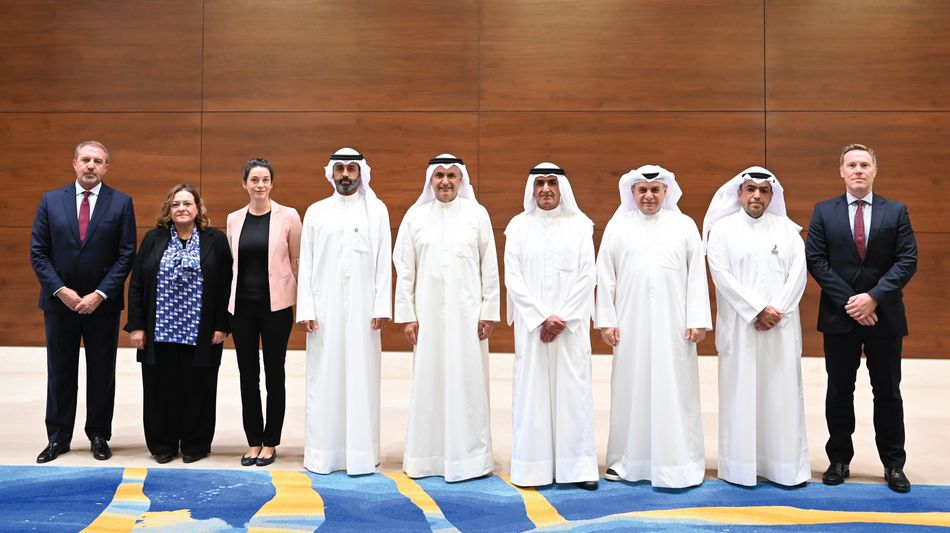
Mr. Isam Al-Sager, Vice Chairman and Group CEO of National Bank of Kuwait (NBK), participated in a roundtable on the future of Kuwait’s banking and financial services sector. During the discussion, he shared his perspective on the key challenges and opportunities facing the sector, emphasising the importance of establishing institutional resilience before crises emerge, accelerating digital transformation and strengthening sustainability practices to support sustainable growth and long-term financial stability.
Organised by Global Finance, the roundtable convened Mr. Basel A. Al-Haroon, Governor of the Central Bank of Kuwait, alongside the CEOs of Kuwaiti banks for a discussion on the key challenges and structural shifts reshaping the banking sector in Kuwait and globally.
Building Resilience Before Crises Emerge
Al-Sager highlighted that one of the most important lessons from recent geopolitical and economic volatility is that resilience must be established before a crisis emerges. This requires maintaining strong capital and liquidity, applying disciplined risk management and strengthening operational agility.
Risks rarely arise in isolation and are becoming increasingly interconnected. Geopolitical tensions can trigger market volatility, disrupt supply chains, heighten cyber threats and create funding pressures, making it essential for institutions to assess the wider indirect effects of global developments.
Growth and financial stability should not be viewed as competing objectives, but as mutually reinforcing. Resilient financial institutions can absorb shocks while continuing to finance economic activity and support development, even during challenging periods.
Strengthening resilience, however, should not come at the expense of the banking sector’s role in the real economy. This calls for a balanced approach to risk-taking rather than a broad withdrawal from, or reduction in, financing activity.
Strengthening Coordination and Institutional Readiness
Al-Sager called for greater cooperation and coordination among banks, regulators and public institutions, noting that information sharing, stress testing, and contingency and crisis response arrangements are key to strengthening confidence and reinforcing stability across the financial sector.
He explained that NBK embeds geopolitical risk across strategic planning, risk management and scenario analysis, in line with the Central Bank of Kuwait’s emphasis on strengthening operational readiness and business continuity.
Moreover, he added that the Bank has developed and implemented best-in-class business continuity and crisis management practices, supported by regular testing, which have enabled it to maintain operational efficiency and service continuity across different conditions and crises.
Modernising Infrastructure and Diversifying Sources of Growth
Turning to the banking sector’s priorities over the three to five years, Al-Sager said that modernising the sector’s underlying infrastructure is a strategic priority. This includes upgrading core banking systems, strengthening data management capabilities and selectively expanding cloud adoption to support business needs and improve operational efficiency.
He highlighted the need for more diversified and resilient sources of growth through further expansion in transaction banking, capital markets, Islamic finance and advisory services. This would support sustainable growth and reduce reliance on traditional revenue sources.
Furthermore, Al-Sager emphasised the banking sector’s important role in expanding private-sector participation and advancing the objectives of Kuwait Vision 2035 by financing SMEs, infrastructure, strategic projects and emerging economic sectors.
Investing in Human Capital
Al-Sager explained that sustainability, operational resilience and cybersecurity should form part of the same strategic agenda as the banking sector’s future growth.
He added that successful execution will ultimately depend on developing talent and human capabilities. Human capital has become a critical strategic resource, requiring collective efforts among financial institutions and educational and regulatory bodies to develop a generation capable of leading the transformation ahead.
AI Moves From Applications to the Core of Banking Operations
Turning to digital transformation, Al-Sager said that the greatest opportunity lies in embedding AI into core banking workflows rather than limiting its use to isolated or narrowly focused applications.
He explained that AI can drive meaningful transformation across customer service, credit assessment, fraud detection and risk analysis, helping improve efficiency and the quality of banking services.
Data availability and quality, Al-Sager noted, will be as important as the technology itself. AI should strengthen the quality and speed of decision-making, while human judgement must remain central to banking.
Innovation and control must also advance together, supported by appropriate governance and oversight covering data protection, cybersecurity, model validation and third-party risk management.
Broader Partnerships to Advance Responsible Innovation
Al-Sager noted that greater collaboration among banks, fintechs, technology providers, universities and regulators is essential to accelerating responsible innovation across the financial sector.
NBK’s strategy, he explained, follows a dual-track approach: continuously transforming its core business and operations while building digital-first business models that leverage AI, data and fintech ecosystems. This approach strengthens the customer experience and enhances institutional performance.
Across the organisation, the Bank focuses on integrating technology, data, talent and customer insight to support the customer experience, improve efficiency and deliver stronger business performance. Successful digital transformation, Al-Sager noted, depends not on technology alone, but on integrating these elements within a unified operating model capable of responding to change and capturing future opportunities.
Sustainability Becomes a Financial and Strategic Pillar
Turning to sustainability and sustainable finance, Al-Sager said that perceptions of sustainability have undergone a fundamental shift in recent years. It is increasingly being treated as an integrated financial and strategic discipline rather than simply a reporting and disclosure obligation.
Sustainability is now integral to credit assessment, risk management, capital allocation, product development and client engagement. The strongest opportunities for sustainable finance in Kuwait, he noted, are closely linked to national priorities, particularly energy efficiency, renewable energy, water security and low-emission transportation.
Financing Economic Transition and Advancing Development
Significant potential also exists to support the sustainable transition of key economic sectors, including oil and gas, petrochemicals, construction and real estate development, and manufacturing.
Banks play an important role in helping clients identify credible sustainable projects, structure appropriate financing and establish clear, measurable performance indicators to ensure the intended outcomes are achieved.
At NBK, sustainability is fully integrated into the decision-making process through an established governance framework that starts at the Board level. Sustainability considerations inform how the Bank assesses risk, finances clients and allocates capital. The Bank also works closely with clients to understand their needs and challenges and support their transition towards more sustainable and efficient business models.
$6 Billion in Sustainable Assets
Al-Sager noted that NBK issued a $500 million green bond in 2024 and fully allocated its proceeds to eligible projects. The Bank’s sustainable assets have reached approximately $6 billion, representing 60% of its 2030 target.
These achievements have contributed to significant improvements in NBK’s environmental, social and governance ratings, strengthening its position among the region’s leading financial institutions. The Bank will continue supporting the sustainable transition and creating long-term value for the economy and society.
Disclaimer: The contents of this press release was provided from an external third party provider. This website is not responsible for, and does not control, such external content. This content is provided on an “as is” and “as available” basis and has not been edited in any way. Neither this website nor our affiliates guarantee the accuracy of or endorse the views or opinions expressed in this press release.
The press release is provided for informational purposes only. The content does not provide tax, legal or investment advice or opinion regarding the suitability, value or profitability of any particular security, portfolio or investment strategy. Neither this website nor our affiliates shall be liable for any errors or inaccuracies in the content, or for any actions taken by you in reliance thereon. You expressly agree that your use of the information within this article is at your sole risk.
To the fullest extent permitted by applicable law, this website, its parent company, its subsidiaries, its affiliates and the respective shareholders, directors, officers, employees, agents, advertisers, content providers and licensors will not be liable (jointly or severally) to you for any direct, indirect, consequential, special, incidental, punitive or exemplary damages, including without limitation, lost profits, lost savings and lost revenues, whether in negligence, tort, contract or any other theory of liability, even if the parties have been advised of the possibility or could have foreseen any such damages.
The full story
This article is one source in a clustered incident — the cluster page carries the summary, timeline and every other outlet covering it.
