 Back Techtimes
 Calix GigaSpire Flaw Lets Strangers Control Your Home Firewall: No Patch
The Carnegie Mellon CERT Coordination Center disclosed the flaw, tracked as CVE-2026-75501, on August 21 after independent researcher Brian Khan Quintana followed responsible disclosure procedures for more than two months and Calix, the device's manufacturer, never substantively responded. No patch exists. No firmware update timeline has been announced. Calix has issued no public statement. CERT/CC VU#756733 documents the full disclosure timeline and vendor status.
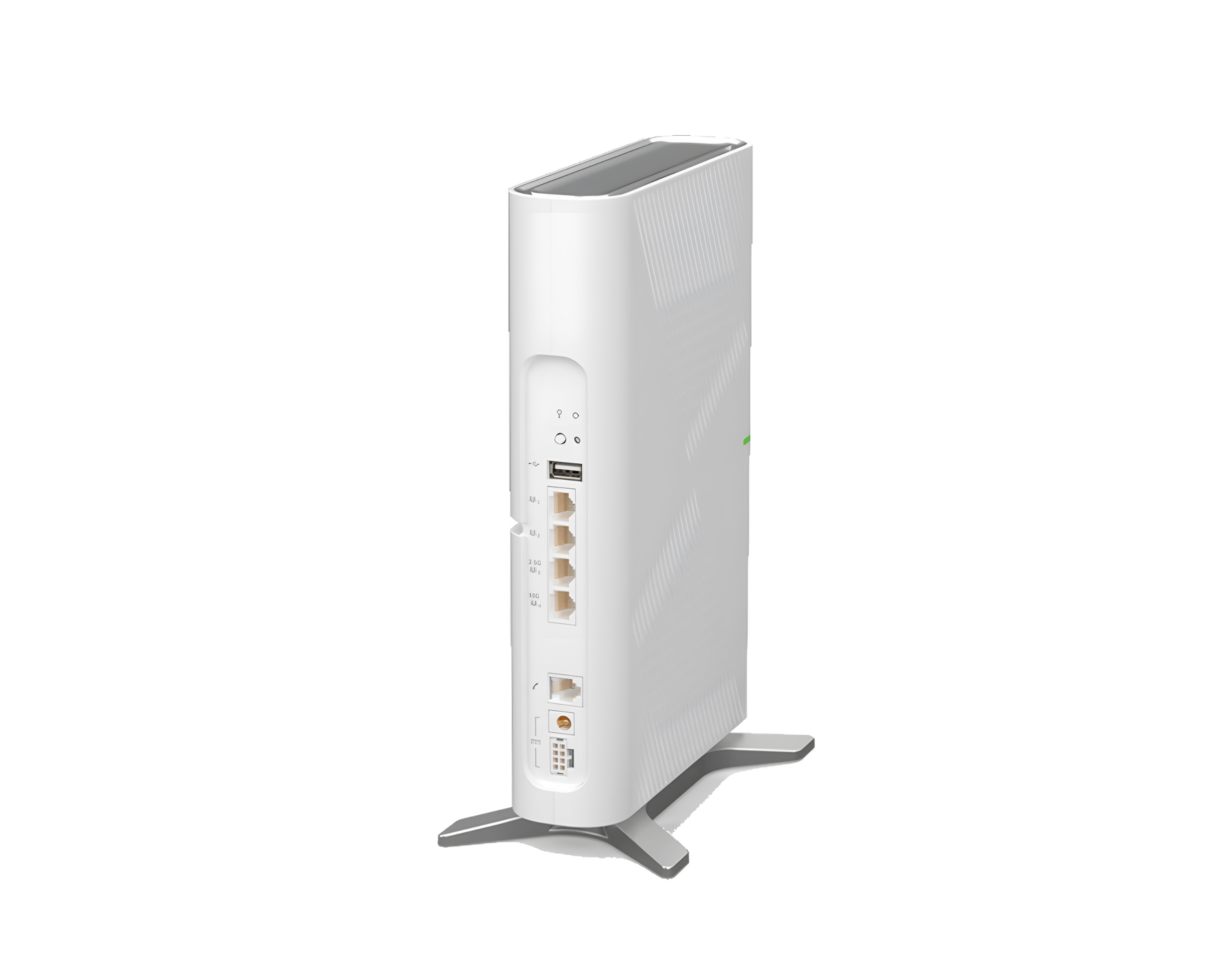
The vulnerable device is the Calix GS5239XG, marketed under the product name GigaSpire 7u10txg. It is Calix's flagship Wi-Fi 7 residential gateway, combining tri-band wireless with an integrated XGS-PON fiber terminal — positioned as a premium device for high-performance fiber deployments. The GigaSpire 7u10txg product page lists full specifications.
The affected firmware version is EXOS/6.6.47. CERT/CC states the device is "typically provisioned with its default UPnP-enabled configuration," which means virtually every deployed unit is vulnerable out of the box.
If you are a broadband customer of any of these providers and receive a device that looks like the GigaSpire 7u10txg — check the label or your router's admin panel for the model number GS5239XG.
To understand why this vulnerability is serious, it helps to understand what UPnP is supposed to do — and what the Calix firmware got wrong.
Universal Plug and Play (UPnP) is a protocol designed to let devices inside your network automatically request firewall exceptions from your router. When your game console needs an incoming connection, it asks the router from inside the network, and the router opens a specific port for it. The security of this arrangement rests entirely on one assumption: that the UPnP control service is only reachable from inside your network. A device on the outside of the router cannot make UPnP requests, because the outside of the router is the untrusted internet.
On the Calix GS5239XG running EXOS/6.6.47, that assumption is violated. The router runs MiniUPnPd 2.3.7 — a widely used, lightweight open-source UPnP daemon — but configures it to listen on the public WAN interface on TCP port 5000, not just the internal LAN. The CERT/CC advisory confirms the SOAP control service at /ctl/IPConn accepts commands without authentication , without checking who is sending them.
This is not a complex exploit requiring specialized tools. Quintana's technical writeup demonstrates it is a straightforward HTTP request to a standard endpoint.
Quintana, who describes himself as a physician who teaches human physiology and conducts security research independently, discovered the flaw while doing a routine inventory of his own ISP-supplied router.
Scanning his own public IP address from outside his network, he found TCP port 5000 responding. Requesting the device's UPnP description document — available at /rootDesc.xml — worked. And then the control endpoint worked too.
"I expected a rejection," he wrote in his public disclosure. "What I got back was a cheerful confirmation that my firewall had just been reconfigured by a stranger, and that stranger happened to be me." The full Quintana disclosure writeup documents this and all subsequent testing.
Without any credentials, anyone who can reach an affected router can perform four actions, as CERT/CC VU#756733 confirms in detail :
Quintana tested his findings by sending a port-mapping request from outside his own , using a lease duration of zero — which requests a permanent, never-expiring rule. That rule survived a power cycle , documented in his writeup.
"One unauthenticated request from anywhere in the world is enough to open a permanent hole through the router's firewall to any device inside the house," he wrote. "No password. No prompt. Nothing on screen. The rule survives a reboot."
The vulnerability carries a CVSS 3.1 score of 9.1 (Critical) and is classified as CWE-306: Missing Authentication for Critical Function, as Quintana's writeup documents the scoring.
The reason this matters for ordinary residents is what sits on the LAN side of a router in 2026. Security cameras. Baby monitors. Network-attached storage drives with tax documents, family photos, and work files. Smart hubs. A work laptop that might also connect to a corporate VPN. The administrative interface of the router itself.
The ISP-provisioned router model introduces a structural complication that the advisory only gestures at. When you buy a router from a retail store, you control it entirely. You can change any setting, install new firmware, or replace the device if it has a critical unpatched flaw.
This is not the first time a UPnP service exposed to the WAN interface has been used against networks at scale.
In a campaign documented by Akamai researchers and known as EternalSilence, attackers found UPnP services exposed on the WAN side of more than 3.5 million routers worldwide. Of those, 277,000 were confirmed vulnerable to NAT injection, and 45,113 had already been compromised — with attackers mapping internal ports 445 and 139 (Microsoft SMB) to facilitate further attacks using EternalBlue and EternalRed exploits against devices inside those networks. BleepingComputer's EternalSilence coverage documented the campaign in full.
The Mirai botnet compromised IoT devices in part through exposed UPnP ports. The Satori botnet exploited CVE-2014-8361, a command injection vulnerability in a Realtek SDK UPnP miniigd implementation. Flash-based attacks used malicious web content to send UPnP SOAP requests from a victim's own browser — targeting the very same WANIPConnection service exposed in the Calix flaw. SecurityScorecard's UPnP security analysis covers this attack history in detail.
No exploitation of CVE-2026-75501 specifically has been confirmed as of August 25, 2026. But the attack surface is a single unauthenticated HTTP request to a known port, and a proof-of-concept SOAP request was published alongside the CERT/CC advisory.
Quintana followed responsible disclosure procedures. On June 7, 2026, he sent a complete technical writeup to Calix's published security address, to the ISP deploying the hardware, and to CERT/CC — simultaneously and on the same day. He included the affected model and firmware version, reproduction steps, full SOAP request examples, and a severity assessment.
What happened is documented in his timeline:
On June 26, he filed a formal CERT/CC vulnerability report. CERT/CC opened case VU#756733 on June 27 and began its own vendor coordination efforts. Through July, CERT/CC made repeated outreach attempts through Calix's stated security channels.
On July 29, Quintana also submitted directly through Calix's product security web form. The site displayed a "thank you" on-screen. No reference number was issued. No confirmation email arrived. No human follow-up occurred.
CERT/CC ultimately listed Calix's vendor status as "Unknown" — the designation used when a vendor cannot be reached or has not engaged — and published the advisory on August 21.
Calix has not issued a public statement, a patch, a workaround acknowledgment, or a patch timeline as of the publication of this article.
This pattern — researcher discloses, CERT/CC coordinates, vendor does not respond, coordinated public disclosure proceeds without a patch — has become a recurring feature of the residential router security landscape. Earlier this year, TechTimes reported on a structurally identical situation involving Tenda router firmware, in which CERT/CC disclosed a critical authentication bypass seven weeks after the company failed to respond to a May notification.
Calix hardware has attracted prior security research attention. In 2025, Fluid Attacks researcher Danilo Erazo published five CVEs affecting Calix GigaCenter ONT devices — including CVE-2025-7635, Telnet root access — which described unauthenticated Telnet root access to the 844E, 844G, 844GE, and 854GE GigaCenter ONT models, and CVE-2025-53914, describing excessive privilege vulnerabilities in Broadcom SoC modules on those same devices.
Those findings affected a different product line — the GigaCenter ONT family — and were unrelated to the UPnP flaw in the GS5239XG. However, they are part of the same vendor's security posture history, and the GigaCenter ONT disclosure also went through Fluid Attacks rather than through a Calix-initiated security process. A vendor whose security function does not engage on incoming disclosures across multiple product lines and multiple researcher contacts is exhibiting a systemic pattern, not an isolated oversight.
Check your router's port-forwarding table now, under whatever settings section your admin panel calls it — "Port Forwarding," "Virtual Servers," or similar. Any entry you did not explicitly create is a candidate for investigation.
Step 2 — Check for UPnP settings. Navigate to Admin Panel → Advanced → Security → UPnP. If you see the toggle and can set it to Disabled, do so and save.
Step 3 — If the setting is locked or greyed out, your ISP directly and specifically request that UPnP be disabled on your device. Reference CVE-2026-75501 and CERT/CC VU#756733 to give the support agent a searchable reference.
Step 4 — Review your port-forwarding table. Look for any rules you did not create. Rules with a zero or blank lease duration are permanent and will survive reboots.
Step 5 — Monitor for a firmware update. A correct fix requires Calix to change the firmware so MiniUPnPd is bound only to the LAN interface — a change that, as Quintana noted in his disclosure, "someone will fix in an afternoon once they decide to." That decision has not yet been made.
your ISP — Cox Communications, Brightspeed, ALLO, CityFibre, or Conexon — and ask them to disable UPnP on your device or push a configuration update that closes TCP port 5000 on the WAN side. Reference CVE-2026-75501. ISPs can push configuration changes remotely to the same devices they provision remotely. If they are not already aware of this vulnerability, sending the CERT/CC advisory URL (kb.cert.org/vuls/id/756733) gives them a government-sourced reference. You can also filter inbound traffic to TCP port 5000 at the ISP level if the ISP will cooperate — but this is a secondary mitigation, not a fix.
UPnP is a protocol that lets devices inside your network automatically ask your router to open specific incoming connections for them. Game consoles, streaming devices, and some video-calling software use it. The reason disabling it matters here is that the Calix firmware exposes the UPnP control service not just to your devices but to the entire internet — meaning anyone, anywhere, can send the same commands your game console would send. CERT/CC's advisory mitigation section confirms disabling UPnP removes the control service entirely. Applications that relied on it for automatic port opening will stop working for that purpose, but you can manually open specific ports you need through the router's standard port-forwarding interface.
Most router attacks require either a vulnerability in the router's web interface, credentials obtained through phishing, or a device on the local network already compromised. CVE-2026-75501 requires none of those things. An attacker only needs your router's public IP address — which is often discoverable through basic internet scanning — to send a plain HTTP request that permanently reconfigures your firewall. Nothing is installed on your network. No account is compromised. The attacker does not need to stay connected. The rule they create persists until you delete it or factory-reset the device. This is a qualitatively lower barrier to network intrusion than most residential router vulnerabilities.
As of August 25, 2026, Calix has not issued a public statement, a patch, a patch timeline, or any acknowledgment of CVE-2026-75501. CERT/CC's advisory lists the vendor's status as "Unknown" after more than two months of disclosure attempts. The only currently available mitigation — disabling UPnP through the admin panel — was identified by the researcher, not by the vendor.
The full story
This article is one source in a clustered incident — the cluster page carries the summary, timeline and every other outlet covering it.
