 Back Indiatoday.In
 Can't swallow or spit: How Pakistan's Gwadar Port project has become a liability for China
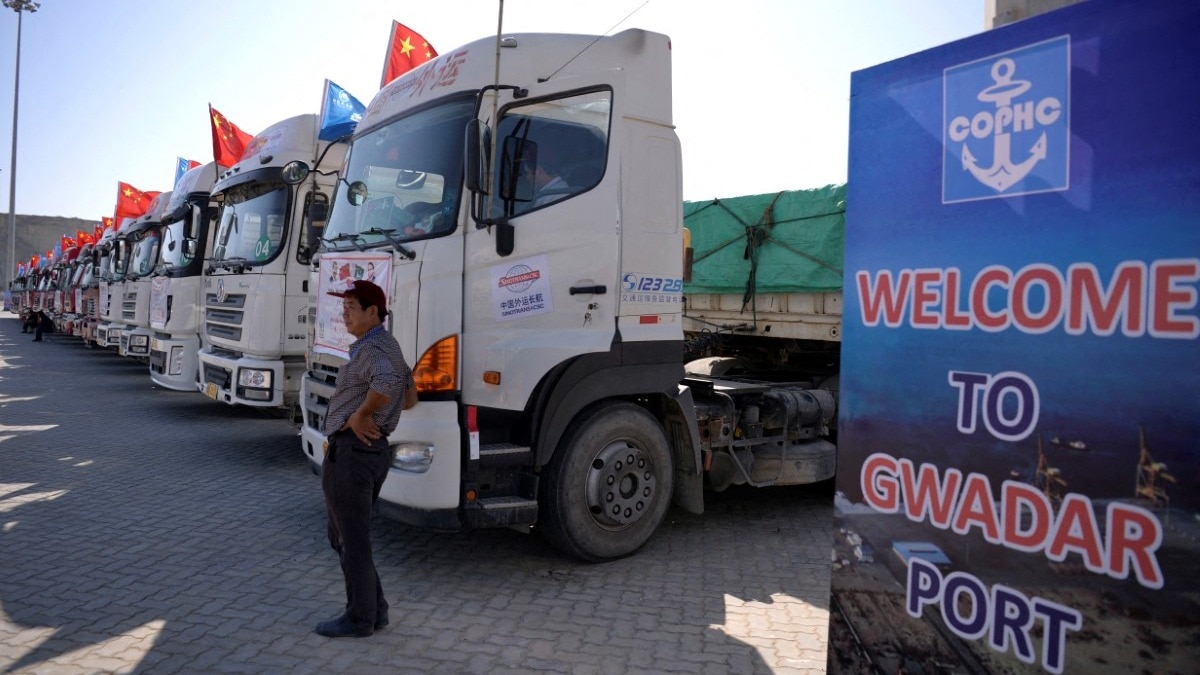
China built Pakistan's Gwadar as a strategic gateway to the Arabian Sea and a hedge against the Malacca Strait. More than a decade later, a raging insurgency, poor commercial activity and Islamabad's economic troubles are making the port increasingly costly for Beijing to sustain.
The Gwadar Port, a destination in Pakistan, was supposed to be the jewel in China's Belt and Road crown. It was planned to be a deep-sea gateway to the Arabian Sea that could give Beijing an alternative route to the Indian Ocean and help overcome its dependence on the vulnerable Malacca Strait. Instead, more than a decade after the China-Pakistan Economic Corridor (CPEC) was launched , the Gwadar Port project has become a costly combination of security risks, weak commercial activity, local resentment and mounting financial pressure, raising questions over whether it can deliver the strategic returns the communist country once expected.
The problem of Gwadar ambition of China and Pakistan begins with geography. China's original vision was to connect its western Xinjiang province to the Arabian Sea through Pakistan, creating a land bridge for trade and energy supplies. But the route between Xinjiang and Gwadar runs through some of the world's most difficult terrain.
In his paper for the Sydney-based Lowy Institute, Jaideep Saikia, Distinguished Fellow at the New Delhi-based Council for Strategic and Defence Research, argues that the route makes Gwadar a difficult substitute for established maritime trade routes.
"Goods moving from Xinjiang to Gwadar must cross the Karakoram highway, navigating altitudes of over 4,600 metres. The area is plagued by frequent landslides, avalanches, and extreme weather, rendering it structurally incapable of handling the high-volume container traffic required to replace maritime shipping," Saikia wrote in his paper.
For China, the security problem becomes particularly acute in Balochistan , where the port is located.
The Baloch Liberation Army (BLA) and other insurgent groups have repeatedly targeted Chinese interests and personnel, arguing that CPEC projects exploit local resources without adequately benefiting the Baloch population. Saikia, in his Lowy Institute paper, highlights that the BLA's Majeed Brigade has evolved from conventional guerrilla attacks towards suicide operations designed to inflict high Chinese casualties.
That has turned Chinese workers, engineers, convoys and infrastructure into security targets.
The consequences extend beyond the battlefield. Pakistan has had to deploy dedicated security formations to protect Chinese personnel and CPEC projects. Yet attacks have continued, adding costs to infrastructure that was originally justified partly on the basis of economic efficiency and strategic connectivity.
Gwadar's security challenge is therefore also an economic challenge for China, which had plans of investing at least $60 billion. The developments around Gwadar are also closely watched by India, which has focused on Iran's Chabahar Port, located roughly 170 km by road and around 100 km by sea from Gwadar. CHINA SAW GWADAR PORT AS AN ANSWER TO MALACCA, BUT DILEMMA PERSISTS
CHINA SAW GWADAR PORT AS AN ANSWER TO MALACCA, BUT DILEMMA PERSISTS
China's interest in Gwadar was never simply building another port. One of the major strategic ideas behind the project was to reduce China's vulnerability to a potential blockade of the Malacca Strait , through which a substantial of China's energy imports travels.
But Gwadar cannot easily replace that maritime route. The Malacca Strait is a narrow sea passage between Malaysia and Indonesia that connects the Indian Ocean with the Pacific, and it is considered "treacherous" because of its heavy shipping traffic, narrow navigational channels, piracy risks and strategic vulnerability to blockade during a conflict.
Transporting oil from the Arabian Sea to Xinjiang by pipeline or road would be substantially more expensive than conventional sea transport. An overland route would also have to cross thousands of kilometres of difficult and politically unstable terrain.
A pipeline or railway would create another vulnerability, rather than eliminating one. And even oil arriving at Gwadar would still have to travel through the Indian Ocean before reaching the port. That means the route does not magically remove China's dependence on maritime transport.
The commercial case is equally difficult. A successful port needs cargo, shipping lines and an industrial ecosystem around it. Gwadar has struggled to develop all three.
Major international shipping companies continue to favour established regional hubs such as Dubai, Salalah and Karachi, where cargo volumes and supporting infrastructure are already developed. Meanwhile, the Special Economic Zones planned around Gwadar have not produced the industrial activity originally envisaged.
"China has poured billions into Gwadar, but under the current 40-year lease, 91% of the port's revenues are supposed to go to Beijing. Because the port generates virtually no revenue, China is extracting no returns while [being] forced to spend heavily to secure its stranded assets," Saikia wrote. CHINA IS FRUSTRATED WITH PAKISTAN OVER PACE OF GWADAR PROJECT: EXPERT
CHINA IS FRUSTRATED WITH PAKISTAN OVER PACE OF GWADAR PROJECT: EXPERT
The difficulties at Gwadar are part of a larger problem surrounding CPEC.
Sarral Sharma, an international policy expert writing for the New Delhi-based Observer Research Foundation (ORF), said: "China is frustrated with the pace of CPEC". The corridor, valued at more than $60 billion, was presented as a transformative economic partnership when it was formally inaugurated in 2015.
But many projects have fallen behind schedule, while the second phase launched in 2024 has progressed more slowly than expected.
Sharma pointed out Pakistan's political instability, economic turmoil, security problems, corruption concerns and technical shortcomings among the factors behind the slowdown.
"Pakistan's internal political, economic, and security turmoil, along with its poor corruption track record and other technical shortcomings, are among the key reasons behind the slowdown of CPEC. Despite financial losses, delays in project completion, and non-payment of debts on time, China continues to rely on Pakistan," the international policy expert wrote in his ORF article.
Still, Beijing has not simply abandoned Islamabad. It shows that China's calculation cannot be reduced to whether Gwadar makes money. But Beijing's willingness to keep committing large amounts of fresh capital appears to have changed.
In January 2025, after a Pakistan International Airlines (PIA) aircraft landed at the new Gwadar International Airport, it was greeted with the traditional water salute. While Pakistan PM Shehbaz Sharif hailed it as a shining symbol of friendship with China, Global Times, the mouthpiece of its financier, the Chinese Communist Party (CCP), dubbed it a "donation" .
One example of this is the Main Line-1 railway upgrade, once regarded as the largest and most important CPEC project. China stepped back from financing the project in 2025, prompting Pakistan to seek funding from the Asian Development Bank for the Karachi-Rohri section.
The retreat came after years of negotiations and amid Pakistan's worsening fiscal position, including mounting arrears to Chinese power producers and repeated dependence on IMF support.
The shift is significant because it suggests that China's concerns extend beyond one underperforming port. Beijing is becoming more selective expensive overseas infrastructure projects, particularly where repayment, security and commercial risks are high. GWADAR LOCALS HAVE BEEN OPPOSING CHINESE PROJECT
GWADAR LOCALS HAVE BEEN OPPOSING CHINESE PROJECT
There is also a political problem at the heart of Gwadar.
The port was sold as a development project that would transform one of Pakistan's poorest regions. Yet local residents have repeatedly complained that they have not received the economic benefits promised by CPEC.
Gwadar has simultaneously faced shortages of drinking water and electricity . Its fishing community has also complained the impact of Chinese deep-sea trawlers and security restrictions.
This creates a striking contradiction. Billions of dollars are being invested in sophisticated infrastructure while residents of the surrounding city continue to face basic shortages.
The problem is not limited to protests by locals. In May this year, the Karachi-based The Express Tribune reported that the Chinese company Hangeng Trade Company shut its factory in the Gwadar Free Zone and terminated its employees, citing financial losses and an unworkable business environment. The company said "non-commercial factors" and operational difficulties had made continued operations impossible. A PORT THAT IS IN PAKISTAN, TURNING INTO A BURDEN FOR CHINA
A PORT THAT IS IN PAKISTAN, TURNING INTO A BURDEN FOR CHINA
China's investments in Gwadar are not just limited to the port. Beijing has supported the Gwadar Free Zone, the new international airport , power and water projects, as well as plans for industrial and urban development.
That makes the stakes higher for Beijing. If commercial activity remains weak in Gwadar, China is not merely left with an underused port. It is left with an extensive network of infrastructure requiring maintenance, protection and further investment.
"Gwadar is rapidly approaching a tipping point. Pakistan cannot afford to secure or maintain it, and China is growing weary of sacrificing both capital and the lives of its citizens to defend a commercial failure," Saikia wrote in his paper.
His assessment is that Beijing could gradually reduce its operational footprint, potentially leaving Gwadar as a smaller and heavily fortified facility rather than the bustling commercial gateway originally envisioned.
This would represent a remarkable reversal by the "iron brother" of Pakistan.
Gwadar was designed to solve China's strategic vulnerability by creating a shortcut to the Arabian Sea. But geography makes the shortcut expensive, insecurity makes it dangerous, and weak commercial activity makes it difficult to justify.
China might still value Pakistan for strategic reasons. But that does not mean every CPEC project remains commercially or financially attractive. Gwadar Post has become a hot iron ball that China can neither swallow nor spit out. - Ends
Multimedia journalist and cub reporter with the India Today Group (Digital) | Indian politics connoisseur with a nose for the truth | Bringing you anything and everything that makes news | Keenly follow the economy and realpolitik 'cause it matters to you.
Multimedia journalist and cub reporter with the India Today Group (Digital) | Indian politics connoisseur with a nose for the truth | Bringing you anything and everything that makes news | Keenly follow the economy and realpolitik 'cause it matters to you.
The full story
This article is one source in a clustered incident — the cluster page carries the summary, timeline and every other outlet covering it.
