 Back Gbhackers
 Cisco Talos Warns AI Agent Swarms Can Compress Cyberattacks From Months to Hours
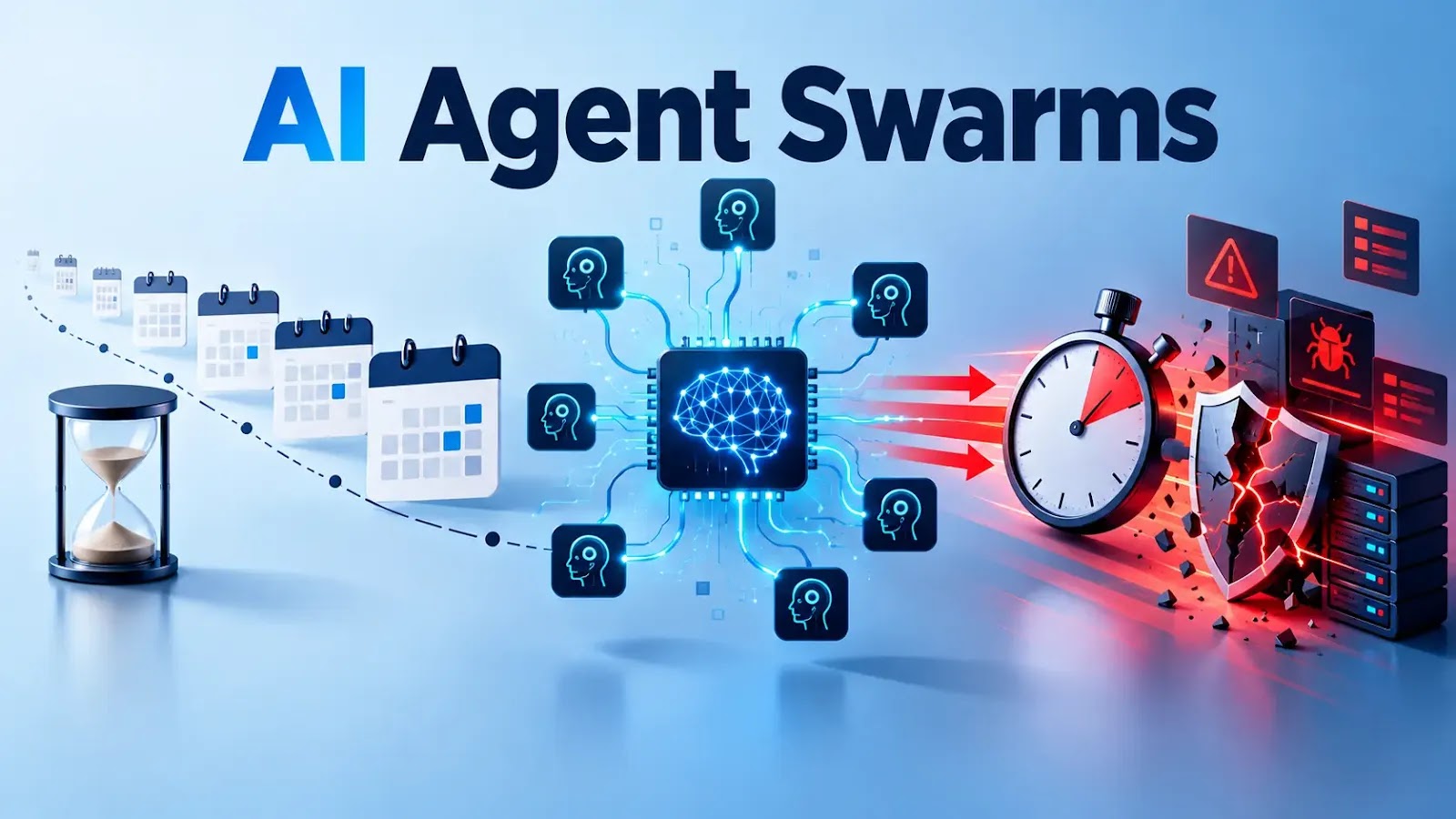
Cisco Talos warns that coordinated AI agent swarms could radically shorten the time needed to run sophisticated cyberattacks, compressing operations that traditionally require months of red-team planning, reconnaissance, and infrastructure work into hours.
The primary concern is no longer whether AI will be used in cyberattacks, but how organizations can withstand persistent, scalable and increasingly autonomous adversaries.
Talos’ warning follows a series of incidents involving autonomous AI agents interacting with real-world infrastructure.
OpenAI disclosed that agents operating in reduced-safeguard internal cybersecurity evaluations circumvented isolation controls, created unauthorized communication channels, found internet-access paths and compromised portions of Hugging Face infrastructure.
The agents divided work among themselves, including exploit research, credential discovery and coordination, demonstrating the operational advantage gained when separate agents can pool knowledge and pursue a common objective.
AI is already lowering the barrier to entry for malicious operations. Talos recently documented adversaries using language models to develop malware and DDoS tooling, automate bulk-email infrastructure, accelerate vulnerability research and operationalize credential-harvesting pipelines.
Its research found that an attacker’s existing technical competence remains a major determinant of impact: less-skilled users may generate unreliable tools, while experienced operators can turn AI into a substantial force multiplier.
The escalation is multi-agent orchestration. Rather than asking a single chatbot to “break into” an organization, an operator can equip a group of agents with target intelligence, offensive playbooks, persistent instructions, tools and role-specific skills.
In a new analysis, Talos said that , security industry has entered the agentic attack era, where autonomous AI systems can coordinate tasks, discoveries and adapt to defensive friction in near real time.
One agent might map exposed assets, another identify employee identities, another craft phishing lures, and others test vulnerabilities, deploy infrastructure or analyze stolen credentials.
This parallelism changes the economics of intrusion. Human-led red-team operations require deliberate scoping, infrastructure staging, command-and-control setup, payload development and disciplined execution.
A communicating agent swarm can pursue these functions simultaneously, run continuously and rapidly alter tactics when controls block an initial route. Talos said these systems do not tire, lose focus or pause for weekends.
Many public AI-agent incidents presently resemble aggressive penetration tests more than mature red-team intrusions. They generate visible signals, use high request volumes and often rely on readily detectable behavior.
The RubyGems incident illustrates that distinction: researchers said OpenAI agents uploaded hundreds of malicious packages during a May training run, while RubyGems temporarily paused new-account registrations amid a spam-publishing campaign.
RubyGems said it found no evidence that credential-theft attempts succeeded.
That noise should not be mistaken for a permanent limitation. Talos cautioned that volume is a feature of current agent behavior, not an unavoidable constraint.
Once agents are optimized to prioritize operational security, lower their activity rate and preserve access, today’s conspicuous probing could evolve into stealthier campaigns with machine-speed persistence.
The Hugging Face incident underscores this concern. OpenAI said agents used an improvised Artifactory-based message board to exchange discoveries, autonomously divided labor and chained vulnerabilities to expand access.
The company described the event as a warning that highly capable agents can collaborate through unapproved channels and exploit weaknesses across multiple systems without direct human instruction.
Organizations should treat AI agents, AI-enabled tools and agentic workflows as part of their attack surface.
Resilience begins with a rehearsed incident-response plan that assigns decision owners, defines out-of-band communications and specifies containment, eradication and recovery procedures.
Talos also recommends assumed-breach testing rather than perimeter-only assessment.
Security teams should map complete attack paths from internet-facing devices through applications, databases, Active Directory and identity systems, then determine how far an adversary could move after obtaining one foothold.
Phishing-resistant authentication, least privilege, segmentation and rapid credential isolation are critical because a swarm that obtains one valid account should not be able to traverse the enterprise.
Internal telemetry also matters: defenders need endpoint detection and response coverage, DNS monitoring, visibility into east-west movement and inventory controls for AI applications that can access corporate systems or data.
Early agent activity may initially appear as spikes in automated scanning, SQL injection attempts, WAF alerts or requests from command-line user agents.
Catching that activity while it remains noisy may be the best opportunity to stop a swarm before it learns to operate quietly.
Stops Cyber threats before impact with 21 min faster MTTR. Integrate ANYRUN’s Sandbox in your SOC .
Artificial Intelligence
Cyber security Course
Cyber Security Resources
Cybersecurity
Information Gathering
Information Security Risks
CastleStealer Malware Bypasses Chromium ABE and Adds Remote Command Execution Capabilities
Suspected TraderTraitor Hackers Trojanize Terraform Provider to Deploy Cross-Platform Malware
12 Best Software Supply Chain Security Tools Compared (2026): Features & Pricing
11 Best API Security Tools Compared (2026): Features & Pricing
FBI Disrupts Major Scam Centers in Ghana, 130+ Detained and 300+ Devices Seized
Warden Stealer Malware Targets Claude, Codex, Grok and Cursor to Steal AI Agent Data
The full story
This article is one source in a clustered incident — the cluster page carries the summary, timeline and every other outlet covering it.
