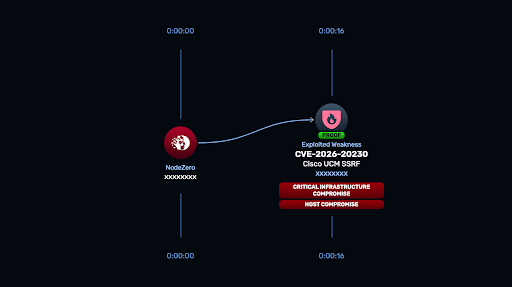
Cisco Unified Communications Manager (Unified CM) and Cisco Unified Communications Manager Session Management Edition (Unified CM SME) contain a critical server-side request forgery (SSRF) vulnerability that could allow an unauthenticated remote attacker to write files to the underlying operating system and ultimately escalate privileges to root. Tracked as CVE-2026-20230, the vulnerability stems from improper input validation of specific HTTP requests processed by the WebDialer service. Cisco assigned the vulnerability a CVSS score of 8.6 and rated it Critical due to the potential for root-level compromise. Public proof-of-concept exploit code is available, and exploitation has been observed in the wild.
CVE-2026-20230 affects Cisco Unified CM and Unified CM SME deployments where the WebDialer service is enabled. An unauthenticated attacker can send crafted HTTP requests that exploit an SSRF condition, enabling file writes to the underlying operating system. Successful exploitation can then be leveraged to gain root-level access.
This vulnerability is particularly concerning because:
The vulnerability exists because affected systems improperly validate specific HTTP requests handled by the WebDialer service. An attacker can abuse this weakness to force the application to make unintended requests and write files to the underlying operating system.
According to Cisco, exploitation requires the WebDialer service to be enabled. WebDialer is disabled by default, reducing exposure for organizations that do not use the feature.
Once arbitrary files can be written to the operating system, attackers can leverage the access to escalate privileges and obtain root-level control of the appliance.
A NodeZero Rapid Response test has been developed to safely validate whether this server-side request forgery vulnerability can be exploited in your environment. The test executes real attack techniques without causing damage, giving teams immediate clarity on exposure.
Affected versions include:
The full story
This article is one source in a clustered incident — the cluster page carries the summary, timeline and every other outlet covering it.
