 Back Research.Checkpoint
 From Stars to Upvotes: Fake Reputation Fueling a Crypto Clipboard Hijacker
In this research, we analyze a clipboard hijacker campaign that is hidden inside a collection of “solutions” and “tools” that claim to give users an unfair advantage. These offers include Solana and Pump.fun sniper bots (automated tools that try to buy new tokens or meme coins faster than other traders), Aviator Predictor (software that claims to predict the outcome of the popular “Aviator” multiplier game), and several crash‑game “predictors” (programs that supposedly forecast when online betting games will stop and “crash”). The operation mainly targets users who are looking for shortcuts and quick profits—particularly crypto owners and online crash‑game gamblers and traders who are attracted by promises of automated gains and “predictable” outcomes.
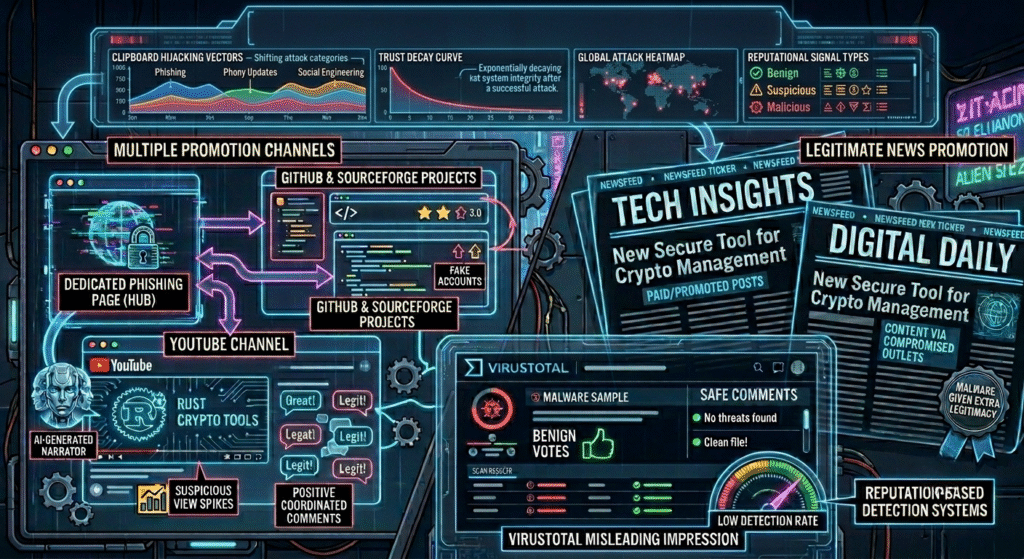
To make this operation look legitimate and attractive, the threat actor has built an ecosystem across several platforms. A WordPress phishing site serves as the main landing page, while GitHub and SourceForge projects are used to host and distribute the files. These repositories show inflated engagement—such as high numbers of stars, forks, ratings, and downloads—likely generated by “Ghost Networks” of fake accounts. A YouTube channel, featuring AI‑generated narrators and suspicious spikes in views, promotes the same tools and adds another layer of social proof. In addition, the actor abuses sentiment and reputation signals on VirusTotal , where some samples from this campaign receive benign votes and “safe” . Combined with the already low detection rate, this creates a misleading impression of safety that can influence both end users and reputation‑based detection systems.
Behind this social‑engineering and promotion layer, the actual payloads delivered to victims are Rust‑based clipboard hijackers for both Windows and macOS. These binaries install persistence, continuously monitor the clipboard for strings that look like cryptocurrency wallet addresses, and replace them with attacker‑controlled wallets from large, embedded lists. The attacker‑controlled cryptocurrency wallets appear to have received multiple transactions, providing the actor with notable illicit gains.
This phishing website promotes a mix of “edge” tools that all promise easy, unfair advantages. On one side, Solana / Pump.fun / DEX sniper bots claim they can automatically buy and sell new meme coins faster than other traders. On the other, Aviator Predictor and several Crash Predictors pretend to “decode” or “predict” crash‑game results so users can supposedly win more often. In most cases, victims are funneled to this site through links shared on social media, crypto forums, and Telegram channels. The clear targets are crypto owners, gamblers, and traders who are already looking for shortcuts and quick, automated gains.
The WordPress author is @JoseCmanXD , and the same name is used for the Telegram provided on the website.
From the website, the actor provides links to GitHub, SourceForge, and YouTube. Across these platforms, the associated content shows inflated engagement , including likely manipulated views and interactions, making the tools appear more popular and trustworthy than they really are.
This inflated engagement appears to be driven by the threat actor’s use of multiple Ghost Networks on each platform. These Ghost Networks consist of fake or low-quality accounts and channels that repeatedly promote his tools, boost view counts, and generate likes or , thereby creating a false sense of credibility and social proof for potential victims.
The actor appears to operate at least six GitHub accounts to promote and distribute his malicious software. These accounts also seem to collaborate with each other, as they are sometimes listed as contributors to one another’s repositories.
The main accounts attributed to the threat actor are Decryptor-j , crash-predictor1 , roblox-script1 , hack-scripts , and stake-mines . Many of their repositories have received multiple stars and forks from various accounts. This activity appears to be the result of the threat actor’s use of GitHub Ghost Networks , where controlled or fake accounts repeatedly star and fork the repositories to create an illusion of popularity and trustworthiness.
In total, just from GitHub, there appear to be just over 5,000 downloads and potential infections originating from the accounts mentioned above. Of these, over 1,250 downloads are associated with the macOS version of the software “Aviator Predictor” , also indicating an impact on Mac users. When we also consider downloads originating from other platforms and the phishing website itself, the overall number of downloads and potential infections significantly exceeds the figures observed on GitHub alone.
In addition to GitHub, the threat actor also promotes another similar platform on the phishing page, SourceForge. SourceForge allows users to rate projects and leave . On this platform, we again observe fake or coordinated accounts posting highly positive feedback, similar to the behavior seen on other platforms that support user engagement. This activity further reinforces a misleading impression of legitimacy and reliability around the malicious tools.
In general, SourceForge appears to have a smaller number of ghost accounts operating on its platform compared to other services observed in cases. Although we see relatively few or reviews, the download statistics seem highly manipulated, with a total of 44,485 downloads , the majority of which appear to originate from Pakistan and India.
It is interesting to note that the majority of downloads ( 37,460 ) appear to come from devices running Android. This is highly suspicious, as the developer currently offers only Windows and macOS versions. We cannot fully confirm this hypothesis, but a plausible explanation is the use of an Android farm to artificially inflate the download count on SourceForge.
Another platform through the phishing site is a YouTube channel showcasing the advertised “software” solutions. The videos have a relatively high number of views and likes, which likely helps attract additional victims and convinces them of the supposed effectiveness of these tools. Some older videos appear to target a Russian-speaking audience, suggesting that the threat actor initially focused on Russian-speaking user communities. More recent videos, however, appear to target a broader, global audience by using English.
Through the actor’s YouTube account, we again observe details that link the channel back to the WordPress site and the Telegram account @JoseCmanXD , further strengthening the attribution between these platforms and the same threat actor.
The videos have a substantial number of views, however, their view counts do not show organic growth. Instead, we observe suspicious spikes in views, which is consistent with the use of YouTube Ghost Networks , where bot accounts artificially engage with the videos to inflate view numbers and make them more attractive to potential viewers.
In the section, we observe highly positive engagement that is likely used to lure potential victims and make them trust the effectiveness of the showcased solution. Many of these accounts appear to be Ghost Accounts that are used to generate fake views and artificial engagement. We also observe from potentially real users complaining the actual effectiveness of the tools, which further indicates that the software does not work as advertised.
The YouTube video is styled to look like a genuine personal tutorial. It shows a desktop screen with visible mouse movements, as if a real user is demonstrating the “software” in real time. At the same time, an AI-generated narrator appears in the bottom-right corner, providing continuous instructions. This combination of on-screen activity and synthetic presenter is likely used to build trust and make the demonstration appear more authentic and convincing to potential victims.
The use of AI by cybercriminals is not limited to AI-assisted malware. Threat actors are constantly trying to incorporate these new technologies throughout the entire attack chain, including phishing, social engineering, content generation, and delivery mechanisms.
Check Point Research has observed that some VirusTotal accounts post community and cast benign votes in an attempt to portray clearly malicious Indicators of Compromise (IOCs) as harmless. When this sentiment manipulation coincides with low antivirus detection rates, reputation-based detection systems may be more likely to misclassify these IOCs as benign, potentially allowing them to bypass security controls.
Reputation-based detection allows security teams to make fast, risk-informed decisions files, URLs, and other network indicators by leveraging global threat intelligence, rather than relying solely on local detections. A key contributor to this intelligence ecosystem is VirusTotal, which aggregates malware and phishing indicators from dozens of security engines and community submissions. This shared visibility helps security vendors rapidly identify emerging threats and malicious infrastructure, strengthening reputation models when combined with their own telemetry and behavioral detection capabilities.
This specific threat actor has incorporated multiple Ghost Network services across GitHub, SourceForge, YouTube, and even VirusTotal. We systematically observed samples downloaded from the phishing site that not only had a low detection rate, but also showed positive engagement on VirusTotal, including upvotes and describing the binary as safe. This coordinated activity is likely intended to reduce suspicion and increase victims’ trust in the malicious files.
While the low detection rate itself is not caused by the positive engagement, the combination of low detections and seemingly positive community feedback creates a strong, but false, impression of safety.
Such posts could potentially be used to further legitimize the tool and make it appear trustworthy, as its capabilities are being advertised on legitimate news websites. This kind of exposure can mislead users into believing the solution is safe and reputable, when in reality it is part of a malicious campaign.
Beyond using news outlets, the actor also promotes the malicious tool on various forums, particularly those frequented by the targeted audience, such as cryptocurrency-focused communities.
The actor posted on BitcoinTalk.org a long-running online forum founded in the early days of Bitcoin, where users cryptocurrencies, blockchain technology, mining, and related projects. While the site itself is legitimate and historically significant in the crypto community, anyone can post content, including promotions, investment opportunities, and potential scams.
Early signs of the actor’s activity were found on a hacking forum where the user has been active since 2019. In 2022, the user created a post titled BLACKHAT | Bitcoin Stealer | Advanced Builder | Tutorial | Clipper [Address Changer]+Re-Fud method , in which he shared a malicious crypto-related tool.
In addition to providing this malicious tool, the same account has shown interest in other topics such as GET UNLIMITED YOUTUBE VIEWS FREE . This activity could help explain the unusually high view counts and abnormal view spikes observed on the associated YouTube content.
The ‘solutions’ are downloaded as a ZIP archive and contain multiple files, the majority of which are unused throughout the execution of the malicious program. While the threat actor updates the main malicious sample every few weeks, the rest of the unused samples remain untouched.
The victim needs to trigger SniperBot_Premium(Free).exe (or other related name depending on the “solution” ). This file is a simple .NET loader which executes the file located in src/config/silkebin.exe .
This Windows executable is a Rust-built cryptocurrency clipboard hijacker (clipper). It installs itself for persistence and then continuously monitors the user’s clipboard for cryptocurrency wallet addresses. When it detects a supported address format, it replaces the clipboard contents with an attacker‑controlled wallet address taken from an internal list. The sample achieves persistence by copying itself to %APPDATA%\\silke\\silke.exe and creating a shortcut in the Startup folder so it will automatically run at logon.
The malware creates a hidden window and registers as a clipboard listener using Windows APIs such as AddClipboardFormatListener , OpenClipboard , GetClipboardData , EmptyClipboard , and SetClipboardData . Each time the clipboard changes, it checks whether the new text matches the pattern of a cryptocurrency wallet address (for example, Bitcoin, Ethereum/EVM, Litecoin, Tron, XRP, Cardano, and others) using regular expressions.
If a match is found, the malware replaces the clipboard text with an attacker‑controlled address from a large internal list. This list contains over 15,500 wallet addresses : 15,000 are Bitcoin-related (5,000 Bitcoin bech32, 5,000 Bitcoin legacy, and 5,000 Bitcoin P2SH), roughly 500 are Ethereum addresses, and the remaining entries include Bitcoin Cash/Gold, Monero, Dogecoin, Cardano, Litecoin, and other cryptocurrencies.
The attacker’s wallets appear to be replaced quite frequently. In many cases, it seems that once a malicious transaction is completed, the attacker swaps the used wallet for a new, “clean” one. Older samples of this variant contain fewer attacker-controlled wallets—typically only one per targeted currency—and also target fewer cryptocurrencies overall. The latest version expands this list to include additional cryptocurrencies that were not previously targeted, such as Bitcoin Gold, Stellar (XLM), Cardano legacy/Byron, and Dogecoin. At the same time, the attacker has removed support for one cryptocurrency in the new variant, Binance Chain.
Below is an example of how victims are tricked into sending money to the attacker’s wallet.
Through his website, GitHub-controlled repositories, and SourceForge projects, the threat actor is also targeting macOS users. The “solutions” provided for macOS are aimed at the same audience as the Windows versions, with the same ultimate goal of stealing cryptocurrency from victims.
The victim downloads a ZIP file from one of the sources mentioned above and finds, among other items, an instruction file named !!! READ THIS - RUN UNLOCKER IF APP IS BLOCKED.txt .
The instruction file tells the user to run unlocker.command , which automates the process of “fixing” the blocked application. The script searches for .app bundles in the same folder (or uses an app dragged onto it), removes the macOS quarantine attribute using xattr -cr , and then launches the chosen application with open . By wrapping this logic in simple dialogs and messages, the attacker makes it easy for non-technical users to bypass Gatekeeper warnings and run the malicious app.
Similar to its .NET Windows variant, the main program on macOS is also just a loader that executes another file located in nested folders.
The executed file is a malicious macOS executable written in Rust that acts as a cryptocurrency clipboard hijacker (clipper). Its main loop monitors the macOS pasteboard, detects wallet-like strings using embedded regular expressions, and replaces them with hardcoded attacker-controlled wallet addresses bundled inside the binary.
To maintain persistence, the malware writes a shell script wrapper to ~/launch.sh and installs a RunAtLoad and KeepAlive LaunchAgent plist at ~/Library/LaunchAgents/com.example..plist , causing launchd to silently re-execute the binary on every login and restart it if it dies. A 30-second watchdog loop ( mw_watchdog_copy_and_relaunch ) continuously re-writes both files and clones the binary via fcopyfile , making the persistence self-healing against manual removal without first killing the process.
The macOS variant appears to be closer in design to the older Windows version, where each regular expression pattern is associated with only a single attacker-controlled wallet address, rather than multiple addresses per currency.
In conclusion, this operation combines simple but effective malware with strong social engineering and aggressive cross‑platform promotion. A WordPress phishing site , manipulated engagement on GitHub and SourceForge , AI‑driven YouTube videos , VirusTotal sentiment abuse , and even posts on news outlets and crypto forums all work together to make the tools appear popular, legitimate, and safe. The updated Ghost Networks model is designed to repeatedly expose the victim to positive signals (stars, , votes, “safe” labels) so that, by the time they run the tool, it feels like a normal, benign application rather than a threat.
From a user’s perspective, the ability to manipulate sentiment and reputation on platforms like VirusTotal marks an important evolution in how threat actors shape trust. Even if this campaign is not primarily aimed at large enterprises, it shows that attackers no longer rely only on classic malware distribution techniques to reach victims. Instead, they can manipulate reputation systems, crowd‑sourced feedback, and cross‑platform promotion to lower suspicion and attract more users.
These techniques can also be abused by other types of actors distributing and promoting information stealers or other malware families, which can eventually lead to full ransomware compromises in more mature environments. In other words, the same playbook of fake reputation and broad promotion can be reused to deliver more damaging payloads over time.
The full story
This article is one source in a clustered incident — the cluster page carries the summary, timeline and every other outlet covering it.
