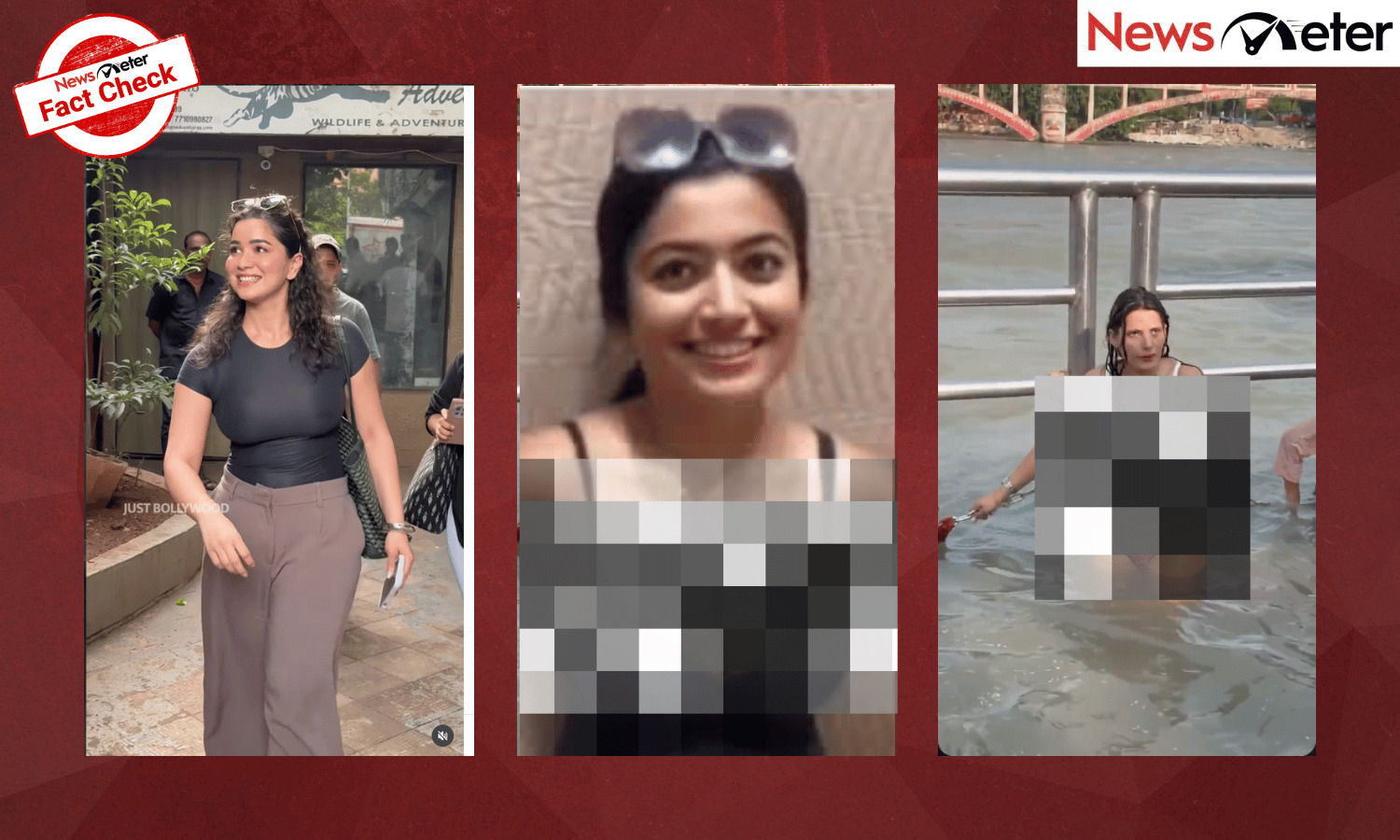
(Disclaimer: NewsMeter is merely debunking a viral claim. It is not a commentary on a personal choice of clothing. We will not be linking any social media posts of the video)
Hyderabad: A video claiming to show a woman taking a dip in the holy Ganga at Haridwar’s Har Ki Pauri while reportedly wearing a bikini or in underwear began circulating on social media.
The video drew strong reactions, with some users questioning the woman’s clothing and behaviour. The religious setting added to the outrage, as the video was presented as showing a woman behaving inappropriately while taking a dip in the Ganga.
But the video was manipulated.
A reverse image led to the original footage on Instagram. In the original video, the woman is seen wearing a Punjabi dress. The viral version had been digitally altered.
The viral video was shared on X here , while the original footage is available on Instagram .
The incident highlights a growing problem with manipulated content: a real video can be altered to create an entirely different story, while viewers react to the altered version as if it were real.
When a fake video becomes a real judgment
The Ganga holds deep spiritual and cultural significance for millions of Hindus. Taking a dip in the river is an important religious practice, particularly at pilgrimage centres such as Haridwar.
That context made the viral video more provocative.
News18 Hindi, while reporting on the video on September 15, carried reactions from social media users who believed the footage was genuine.
One post described the incident as an example of outsiders coming to Haridwar and behaving inappropriately, referring to the ‘My gender is my will, My Body My Choice’ slogan.
X user @Riya6590 called it ‘a very shameful act’ and alleged that the woman was desecrating Ganga.
Another user, @neeraj_pande, wrote, “If you want to do all this, then go to the women’s ghat.”
X user @shivdhiman201 wrote that while the world performs Ganga Aarti, “we are insulting our Ganga ji.”
Another user, @1988Dblu11745, made a derogatory remark the woman’s social class and ended the post with “Jai Ganga Maya.”
The show how quickly a manipulated video can turn into moral policing.
The woman was being judged for something that the viral video falsely portrayed.
Deepfakes are making manipulation easier
The problem extends beyond one viral video.
Deepfakes and other forms of synthetic media can make people appear to say or do things they never did. They are increasingly being used for harassment, misinformation, impersonation and fraud.
Women have been among the frequent targets.
In 2023, a deepfake video showing actor Rashmika Mandanna entering a lift went viral.
Her face had been digitally placed on another woman’s body. Delhi Police later arrested a 24-year-old engineering graduate from Andhra Pradesh in connection with the video. Police said he had created it to increase followers on an Instagram fan page.
Sara Tendulkar has also been targeted by manipulated content.
In one case, a video of her walking in Bandra was digitally altered to make her appear to be wearing gym clothes. Alt News found the original footage and documented the manipulation.
The technology makes it increasingly difficult for viewers to judge a video simply by looking at it.
The second attack is often moral policing
The harm does not always end when a manipulated video goes viral.
When the target is a woman and the fake involves clothing, intimacy or sexuality, the reaction can quickly shift from the authenticity of the video to the woman’s character.
In the Haridwar case, the religious context added another layer. Users were not only commenting on the woman’s clothing but also accusing her of disrespecting the Ganga.
This is where a manipulated video can create a second wave of harm.
The creator produces the false content. The audience can then turn that falsehood into a judgment the person shown in it.
It is becoming hard to discern reality from manipulation
Sam Gregory, executive director of WITNESS, has warned the growing ability to create realistic synthetic scenes and place real people into them.
“It’s trivially easy to generate a scene that looks pretty realistic and to place real individuals into scenes,” Gregory told The Guardian .
Women were targeted online even before AI
The misuse of women’s photographs online predates generative AI.
The Sulli Deals and Bulli Bai cases showed how photographs taken from social media could be used to target women. In the Bulli Bai case, photographs of Muslim women, including journalists and activists, were used without their consent on an online platform. Police later arrested accused persons in connection with the case.
Generative AI has made such manipulation easier and potentially more convincing.
Deepfakes are also being used for fraud
The threat is not limited to harassment and reputation.
Deepfake videos featuring politicians and other public figures are increasingly being used in financial scams.
In one 2026 case, an elderly Pune woman lost more than Rs 8 lakh after fraudsters used a deepfake video of Union Finance Minister Nirmala Sitharaman to promote a fake investment opportunity.
In another Pune case, an Army veteran was allegedly cheated of around Rs 1 crore after fraudsters used deepfake videos featuring Prime Minister Narendra Modi and Sitharaman to promote a fraudulent investment platform.
The aim is the same: make the content look credible enough for people to trust it.
Why emotional contexts make fakes powerful
The Haridwar video also shows why context matters.
A manipulated video involving an ordinary incident may attract some attention. The same manipulation, when presented as someone behaving inappropriately at a sacred site, can trigger outrage much faster.
The same applies to political rallies, communal incidents, protests, disasters and celebrity controversies.
The more emotionally charged the subject, the greater the risk that people will react before verifying.
India has strengthened its rules on paper
India has also strengthened its regulatory framework to address AI-generated and manipulated content.
In February, the government amended the IT Rules to address harms arising from synthetically generated information, including deepfakes and AI-generated content. The amendments require platforms to provide clear labelling and traceable metadata for permissible AI-generated content and take measures against unlawful synthetic content.
The government has also issued advisories covering misleading and harmful synthetically generated information and has a standard operating procedure for dealing with non-consensual intimate imagery.
But regulation alone cannot prevent a fake from spreading.
A video can reach thousands of people before its authenticity is questioned.
The first step is simple: do not believe a video simply because it looks real.
Check where it was first uploaded. for the original video. Use reverse-image on keyframes. Look closely at faces, clothing, text and other details.
Most importantly, avoid sharing suspicious content while trying to determine whether it is genuine.
In the Haridwar case, a reverse-image changed the entire story.
The viral video showed a woman apparently wearing a bikini while taking a dip in the Ganga.
The original footage showed her wearing a Punjabi dress.
Seeing is no longer believing
Deepfakes are often discussed as a technological problem. But the consequences are social too.
A manipulated video can be created quickly. The belief created by it can take much longer to correct.
For women, the consequences can include public shaming, harassment and moral policing, particularly when the fake places them in a sexually suggestive or socially sensitive situation.
The time a video appears to show someone behaving shockingly, the first question should not be, “Why did she do this?”
It should be, “Is this video even real?”
Because in the age of deepfakes, seeing something is no longer proof that it happened.
in our Fight Against Mis-Information
The full story
This article is one source in a clustered incident — the cluster page carries the summary, timeline and every other outlet covering it.
