 Back Firstpost
 Is China quietly scaling back its Gwadar Port ambitions in Pakistan?
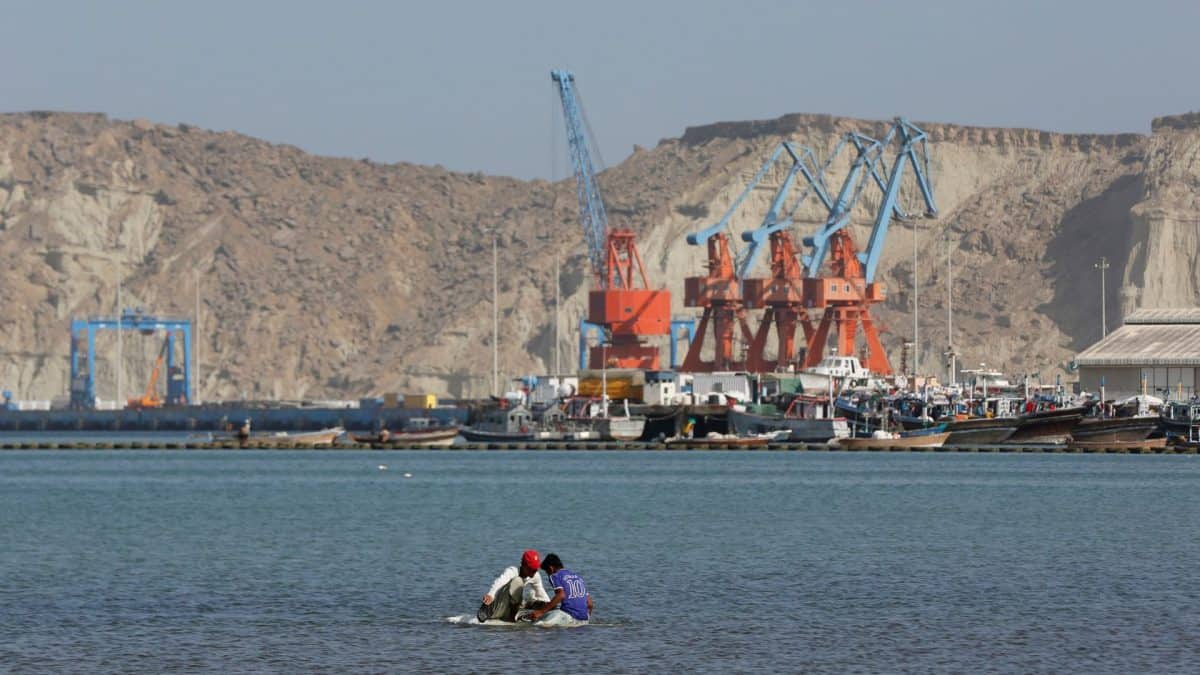
China may be recalibrating its ambitions for Pakistan’s Gwadar Port, a flagship China-Pakistan Economic Corridor (CPEC) project. Security threats, weak commercial activity, difficult geography and Beijing’s 'Small is Beautiful' investment strategy are reportedly pushing the port away from its original mega-hub vision
The future of Gwadar Port, long celebrated as the crown jewel of the $62 billion China-Pakistan Economic Corridor (CPEC), has reached an inflection point.
A surge of international analytical evaluations, including a recent widely discussed report by the Australian think tank Lowy Institute — has raised a fundamental question: Is Beijing quietly preparing to retreat from its high-stakes investment in Pakistan’s deep-sea port?
China is not orchestrating an immediate exit or abandoning its 43-year operational lease. However, the massive body of evidence indicates that Beijing is definitely executing a recalibration of its footprint.
Caught between relentless security threats from militant groups, severe geographic and logistical constraints, and its own domestic economic slowdown, China is shifting away from its original vision of transforming Gwadar into a bustling, multi-billion-dollar commercial mega-hub.
Instead, experts forecast a strategic pivot toward a heavily fortified, down-scaled naval and logistics refuelling station.
The vision vs realities of Gwadar Port
When the China-Pakistan Economic Corridor was formally unveiled in 2013 and expanded in 2015, Gwadar was presented as a game-changer for Asian trade routes.
Located in Pakistan’s southwestern Balochistan province, near the mouth of the Persian Gulf and adjacent to the strategic Strait of Hormuz, Gwadar offered a theoretical solution to China’s most daunting Malacca Strait dilemma.
Through the Malacca Strait passes nearly 80 per cent of China’s crude oil imports and a massive portion of its global trade. In the event of a naval blockade or geopolitical conflict in the Indo-Pacific, this narrow waterway could become a fatal choke point for Beijing.
Gwadar offered an enticing overland shortcut where crude oil and cargo arriving at the Arabian Sea could be offloaded at Gwadar and transported across 3,000 kilometres of Pakistani highways and railways directly into Kashgar in China’s western Xinjiang province.
To realise this dream, the Pakistani government granted the state-owned China Overseas Port Holding Company (COPHC) a 43-year lease to operate the port and its accompanying free zone.
Over the past decade, billions of dollars were pledged to build deep-water berths, desalination plants, a modern international airport, coal-fired power plants, and modern road networks connecting the port to the Pakistani mainland.
Yet, more than a decade later, the ambitious vision of Gwadar as the Singapore or Dubai of South Asia has collided with hard economic and security realities.
Why reports of a Chinese retreat are surfacing
Analysts point to three main drivers behind Beijing’s strategic retreat: escalating security risks to Chinese personnel, severe commercial underperformance, and a broader evolution in Chinese foreign investment strategy.
1. The deteriorating security environment in Balochistan
Security concerns represent the most urgent factor undermining Chinese confidence in Gwadar.
Balochistan has suffered from a decades-long separatist insurgency driven by ethnic Baloch nationalist groups who accuse Islamabad and Beijing of exploiting the province’s rich natural resources without benefiting local populations.
The Baloch Liberation Army (BLA), particularly its specialised unit known as the Majeed Brigade, has explicitly targeted Chinese projects and nationals, viewing Beijing as an imperial power assisting the Pakistani state.
High-profile attacks over recent years have created an atmosphere of fear and frustration among Chinese engineers:
In March 2024, heavily armed BLA militants attempted a daring storming of the Gwadar Port Authority complex. While Pakistani security forces repelled the assault, the incident proved that even heavily guarded infrastructure remained vulnerable.
A series of tragic bombings — including a targeted suicide attack on Chinese engineers outside Karachi’s international airport in October 2024 and recurring roadside attacks on mining and infrastructure operations — demonstrated that insurgent groups can strike well beyond Balochistan’s borders.
Security conditions worsened significantly during the January-February 2026 Balochistan attacks, when coordinated strikes by insurgents across multiple districts led to weeks of intense military counter-operations, leaving hundreds dead across the province.
Despite Pakistan establishing a dedicated Special Security Division (SSD) comprising tens of thousands of military and paramilitary personnel to protect CPEC initiatives, Beijing has repeatedly voiced dissatisfaction over the security guarantees.
Demands by Chinese officials to deploy private Chinese security personnel inside Pakistan have met resistance from Islamabad due to national sovereignty concerns, leading to an impasse that has chilled further capital injection.
2. The logistical and geographic fallacy
The assumption that Gwadar could serve as a cost-effective energy and freight corridor to mainland China overlooks extreme geographic challenges:
To reach Xinjiang, goods must be trucked along the Karakoram Highway, which traverses some of the highest and most treacherous mountain ranges in the world — the Himalayas, Karakoram, and Hindu Kush. The route is routinely disrupted by landslides, blizzards, floods, and seismic activity.
Offloading oil from tankers at Gwadar, pumping it through proposed pipelines over 15,000-foot mountain passes, or trucking containerised freight across 3,000 kilometres consumes significantly more energy and money than shipping cargo directly to China’s eastern coastal ports via sea, even with the extra distance of the Malacca Strait.
A port cannot survive on transit trade alone, it requires a thriving local industrial hinterland to generate exports. Decades of underdevelopment, acute water shortages, unreliable power grids, and weak internet infrastructure have hindered Gwadar’s ability to attract sustainable manufacturing investments.
3. China’s "Small is Beautiful" investment shift
Facing domestic economic headwinds, real estate sector restructuring, and rising public debt, Beijing has moved away from the era of BRI 1.0, characterised by multi-billion-dollar infrastructure megaprojects.
Under the current BRI 2.0 framework, often described by Chinese leadership as the "Small is Beautiful" approach, Beijing prioritises lower-risk, highly profitable, high-tech, and sustainable projects over capital-intensive, high-risk civil works.
In this context, absorbing massive ongoing maintenance and security costs for an underperforming port like Gwadar has become difficult for state planners to justify.
The gap between propaganda & reality
Official press releases from Pakistani authorities periodically highlight spikes in cargo processing.
For example, data released by trade officials noted that Gwadar handled approximately 11,000 standard shipping containers during specific peak operational months in 2026, primarily driven by government-subsidised imports of bulk fertiliser and agricultural commodities.
However, experts point out that these figures represent a fraction of commercial shipping norms. By comparison, Pakistan’s primary commercial ports in Karachi — Port Qasim and Karachi Port Trust — process millions of containers annually.
Major global container lines continue to omit Gwadar from their regular liner schedules due to the absence of commercial feeder networks, cargo volume, and integrated logistics infrastructure.
Most ships docking at Gwadar do so under direct state contracts or government mandates rather than organic commercial demand.
Attempts to establish local economic drivers have met strong community resistance. Local Baloch fishermen, who form the traditional backbone of the coastal economy, have seen their livelihoods disrupted by security exclusion zones surrounding the port and competition from industrial deep-sea trawlers.
Widespread public protests organised by rights movements under the banner of Haq Do Tehreek (Give Rights Movement) have repeatedly shut down roads and port access gates, demanding basic access to clean water, electricity, and fishing rights.
Publicly, both Chinese and Pakistani officials strongly refute claims of any retreat or slowdown, maintaining a united front.
Government representatives continuously highlight that the China-Pakistan Economic Corridor has successfully entered "Phase II," moving past initial civil infrastructure to focus on industrialisation, agriculture, technological cooperation, and Special Economic Zones (SEZs).
To counter reports of stagnation, officials point to recent bilateral agreements signed throughout 2025 and 2026.
Maritime Action Plan (2025-2029) : Joint initiatives aimed at modernising blue economy frameworks, port logistics, and marine research.
Industrial & trade collaboration : Letters of Intent signed between the Gwadar Port Authority and Chinese enterprises, such as the Shenzhen-based Optimize Integration Group, aimed at building seafood processing plants and export-oriented cold-chain facilities in the Gwadar Free Zone.
Regional transit initiatives : High-level maritime conferences in Beijing promoting Gwadar as an eventual transit trade hub for landlocked Central Asian Republics.
While these diplomatic initiatives demonstrate that the political framework of CPEC remains intact, analysts caution that there is a growing gap between high-level MoUs signed in capital cities and actual capital investment deployed on the ground in volatile security zones.
What for Gwadar Port
Gwadar’s failure to deliver rapid commercial dividends presents a severe challenge for Pakistan’s fragile economy. Islamabad incurred substantial debt to build supporting infrastructure, highways, and energy projects tied to CPEC.
With port revenues remaining modest, servicing these foreign loans places additional stress on Pakistan’s public finances and foreign exchange reserves.
For India, Gwadar has long been viewed through the lens of national security. New Delhi has traditionally monitored Gwadar as a key component of China’s "String of Pearls" strategy — a network of commercial and military facilities designed to encircle India in the Indian Ocean Region.
A shift in Gwadar’s operational profile from a commercial port to a heavily fortified naval refuelling station confirms long-held suspicions among Indian defence experts.
In response, India continues to invest in regional connectivity alternatives, including the Chabahar Port in neighbouring Iran, which provides India with a direct trade gateway to Afghanistan and Central Asia, bypassing Pakistan entirely.
For the United States and its Western allies, a permanent Chinese naval footprint at Gwadar — positioned near the oil shipping lanes of the Strait of Hormuz — would prompt closer monitoring by Western naval forces operating in the region.
Moving forward, the reality of Gwadar will likely settle into a pragmatic, low-profile middle ground.
The port will continue to handle specialised, state-directed bulk trade — such as government fertiliser shipments, coal imports, and localised fisheries trade — to justify its operational existence.
But, behind the scenes, the facility will serve its primary remaining value proposition to Beijing which is providing a quiet, reliable naval refuelling, logistical, and intelligence station for the Chinese Navy in the Arabian Sea.
With inputs from agencies
Inhaling global affairs daily, Anmol covers foreign policy & defence with the occasional piece in lifestyle and the thrilling sport of polo, to keep things light when they get too tense. He has far too many disparate interests with a constant itch for travel. You can follow him on X (AnmolSingla001); and please feel free to reach out to him at [email protected] for interviews, tips, feedback or travel recommendations.
is china scaling back its gwadar port ambitions in pakistan
Is Trump dozing off as midterms arrive? The US president’s catnaps are leaving Republicans concerned
Why has jet skier Sorn Keadsiri’s social media stunt amid Bangkok floods angered people?
How Amul is taking its Indian milk brand global without exporting milk
Kelvin wave is threatening California: What is this phenomenon?
US midterm elections 2026: How do the House and Senate differ?
The full story
This article is one source in a clustered incident — the cluster page carries the summary, timeline and every other outlet covering it.
