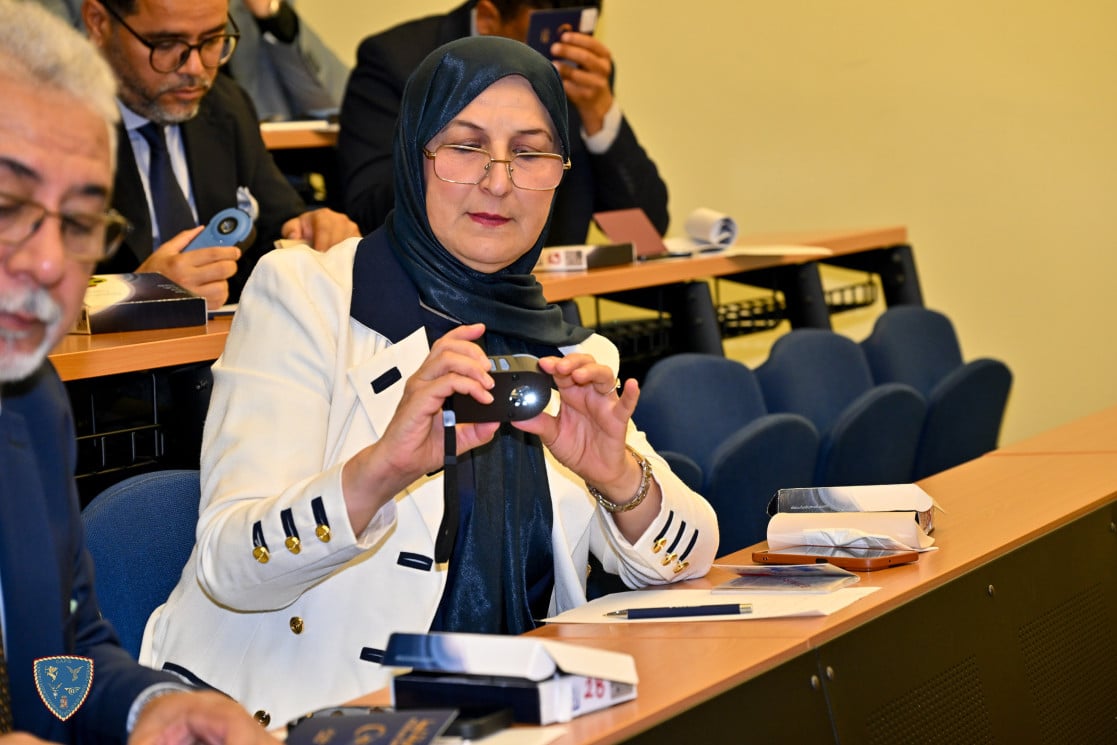
Officials from three Libyan government ministries and the country’s Customs Authority have undergone specialist training on biometrics and document security at the Italian State Police Academy (CAPS) in Cesena as part of an EU-backed initiative aimed at strengthening the country’s integrated border management.
Through the initiative, the EU Border Assistance Mission in Libya (EUBAM Libya) is supporting Libyan authorities through technical advice, specialized training and the exchange of expertise on border management. EUBAM Libya is a civilian, non-executive EU mission.
Participants from the Ministries of Interior, Defense and Foreign Affairs, together with those from the Customs Authority, received training on document production and security features, electronic documents, biometrics, and the detection of fraudulent and manipulated documents, according to EUBAM Libya .
The training was followed by a visit to Ancona International Port, where participants observed Italian authorities conducting live document and identity checks, using interoperable databases, and carrying out currency checks and risk-based customs inspections, including scanner use.
Libya is a major transit country for migrants from Africa seeking to reach Europe, including Italy, via the central Mediterranean. The training in Italy comes at a time when Tripoli is discussing the modernization of physical security and inspection infrastructure at its airports, seaports and land crossings.
During a recent visit to the United States, Libya’s Interior Minister, Maj. Gen. Imad Trabelsi, met with representatives of Rapiscan Systems and S2 Global to border and entry-point security, Libya Herald reports . Those discussions covered non-intrusive screening technologies for vehicles, containers, cargo, luggage and individuals, as well as systems for detecting explosives, narcotics, radioactive materials and contraband. They also discussed X-ray image analysis and screening data management.
The parties also discussed linking screening results with shipment information, operational data and security databases to provide a broader view of inspection operations, support risk assessment and identify cases requiring further scrutiny. The proposed approach could allow for comprehensive screening or multi-stage risk-based processes.
Libya’s efforts reflect developments in a number of countries where governments are taking measures to build integrated border management systems , including through biometrics, partnerships and coordination.
Salah Sakli, former central director of the Tunisian Border Guards, highlights the importance of coordination and cooperation across agencies and between countries in an opinion piece published by Africa Defense Forum.
Sakli argues that stronger coordination is needed to tackle terrorism, trafficking, irregular migration and other transnational threats. He also emphasizes interoperability and information sharing, modern equipment, electronic surveillance, risk prevention, coordination with neighboring states, and the need to balance security with the legitimate movement of people and goods.
These developments point to a broader shift in border management toward technology and data, with biometrics, document verification, interoperable databases, non-intrusive screening and risk assessment increasingly working together.
biometrics | border management | document verification | Europe | Libya | port security
The full story
This article is one source in a clustered incident — the cluster page carries the summary, timeline and every other outlet covering it.
