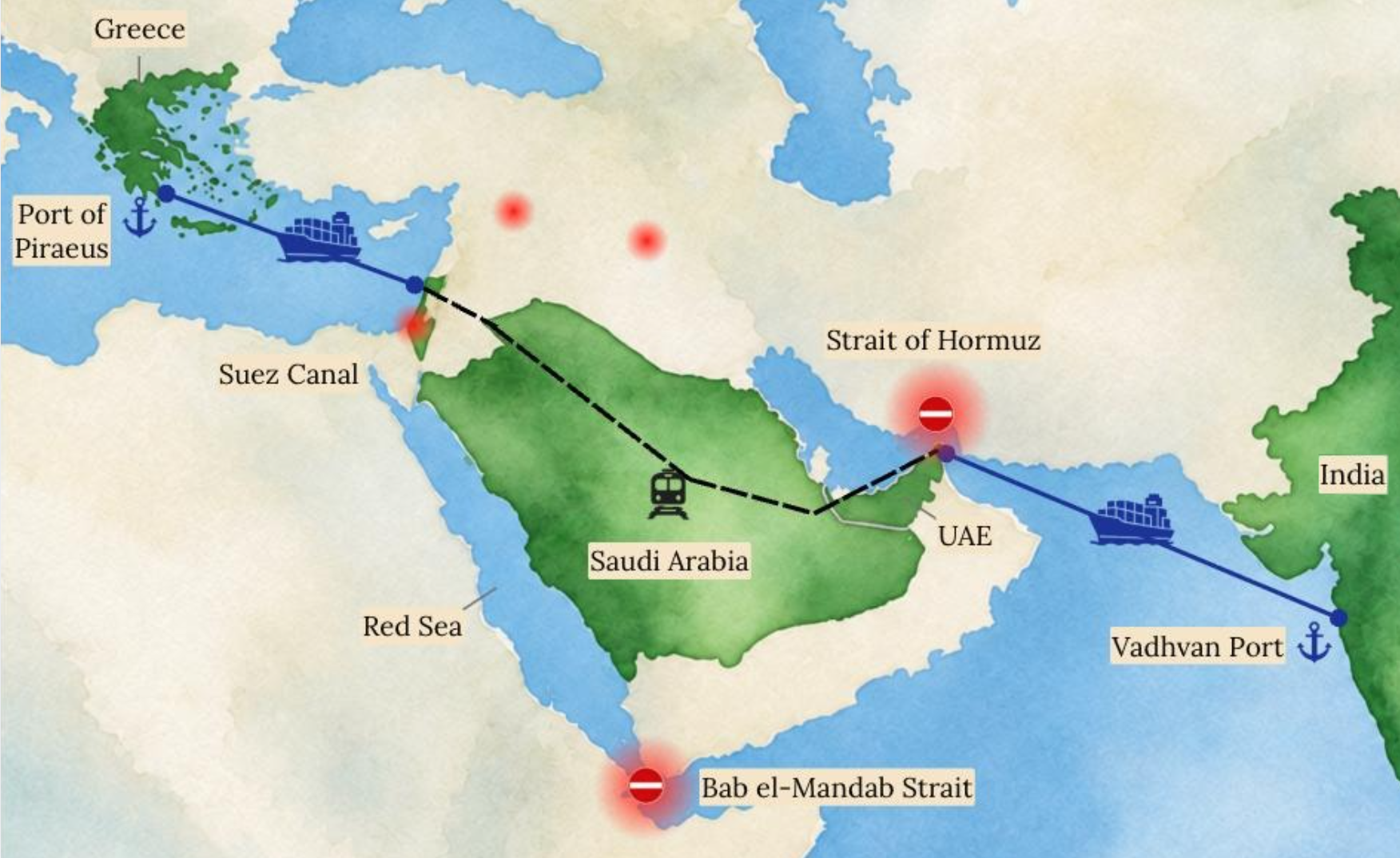
During August and September, the Houthis, the armed militant group in Yemen, hit several ships, ports, and oil installations in Saudi Arabia, disrupting oil traffic from the Red Sea. In early September, drones launched from Iraq hit and shut down the Saudi East-West pipeline, which moves part of Saudi Arabia’s oil output to Red Sea ports. Since the start of the U.S.-Iran war, which has disrupted oil flows from the Persian Gulf, Saudi Arabia has relied on the Red Sea route for a part of its oil output. The hits on the Saudis’ Red Sea oil infrastructure indicate that the back-up route is vulnerable to the same factors that make the Strait of Hormuz a risky highway for energy.
These developments may also mean a fresh impetus to IMEC, the India-Middle East-Europe Economic Corridor proposed by India in 2023, which has not developed much beyond the initial announcements and stalled due to Saudi Arabia’s objections to Israel amid the Gaza war.
Figure Source: Gateway House
The productive oil and gas fields of the West Asian countries – the UAE, Saudi Arabia, Kuwait, Iraq, Iran and Qatar – are either in the Persian Gulf or clustered around it. The most economical and natural outlet for them, therefore, is via ships from the Persian Gulf. While the risks of the Hormuz Straits becoming a choke point were well known and discussed since Iran’s 1979 revolution, these risks finally materialized in 2026 after nearly half a century. Little was done on the ground to create viable alternatives to the Hormuz chokepoint.
There is some backup oil capacity in Saudi Arabia, the UAE, and Iraq. The biggest is Saudi Arabia’s East-West pipeline that can carry up to 7 million barrels per day of oil to the Red Sea [1] , which can transport almost 70% of the kingdom’s pre-war oil production. A second pipeline, the Abu Dhabi Crude Oil Pipeline, connects Abu Dhabi’s oil fields to the port of Fujairah in the Gulf of Oman, which can transport up to 1.5 million barrels per day of oil [2] . The third pipeline, Kirkuk-Ceyhan, connects Kirkuk in Northern Iraq to the port of Ceyhan in Turkey. But this is not connected to the bigger oil fields of Iraq. It has left most of Iraq’s oil production, which moved on ship, stranded. Meanwhile, Iran’s oil exports are being blockaded by the U.S. as a part of its war against the Islamic Republic.
Consequently, the total oil output of the six energy-rich West Asian states has fallen by 11-12 million barrels per day – a whopping 11%-12% of the pre-conflict global oil production, which was over100 million barrels per day.
Table 1: Daily oil output of key West Asian Producers (million barrels/day)
Table Source: Energy Institute, OPEC
The true cost of this disruption is the extra $30 per/barrel or so that the entire world has paid for oil since March 2026. It amounts to over $1 trillion per year. Shocks in energy prices are usually followed by food price shocks, as natural gas is an ingredient in the manufacture of urea fertilizer. Many lower-income countries such as Bangladesh and Pakistan in India’s neighbourhood are also facing electricity shortages as a result of the crisis. Disruptions in energy supplies take time to work their way through supply chains, and are primarily felt in the form of higher prices.
But for other industries, disruptions are felt immediately, and have no easy workarounds. The global optic fibre cable network, which carries much of the world’s internet traffic, is one such vulnerability. The optic fibre cables connecting India with Europe pass through the Red Sea, and can be cut by something as simple as a ship dragging its anchor along the seabed.
Figure Source: TeleGeography. Submarine Cable Map.
There are some important lessons for the world economy from the U.S.-Iran war, and the subsequent escalation between Yemen-Saudi Arabia:
Conflicts/disruptions last much longer than initial (hopeful) projections. The U.S. had originally projected the war would be over in four to five weeks [3] . Instead, it is now in its seventh month and is currently projected to last beyond the U.S. mid-term polls in November.
Disruptions rarely stay confined in boxes. The war in Hormuz has spilled over into the Saudi-Yemen theatre, causing further disruptions to global energy supply. It may be a matter of time before the disruptions also hit data flow.
The global energy supply chain and data traffic require redundancies and bypasses to these choke points (Hormuz and Bab al-Mandeb).
This is where IMEC can be useful. The Persian Gulf and the Red Sea are both confined water bodies, with hostile/unstable actors that have hurt traffic. The proposed route of IMEC, which connects the interior of Saudi Arabia to the Arabian Sea on one side, and the Mediterranean Sea on the other, has immense value as a conduit for West Asian oil, as well as global data flows.
In its original form, IMEC was to connect the interior of the Arabian Peninsula to open water bodies via railway lines. This had limited utility. Putting containers on a ship from India to the UAE, then offloading them on a train, moving them across the Arabian Peninsula, and again putting them on a ship in Haifa, Israel, to ship forward to Europe through the Mediterranean Sea, would have added immediate costs for some savings over time. It would also be a logistical nightmare: a large containership can carry over 10,000 containers, whereas a train carries a fraction of it, 100 containers. Hundreds of trains would need to run every day to service a handful of ships. This may be one reason why few details of the project have been released to date.
However, as a conduit for oil and data, IMEC’s value is visible now. Oil pipelines and optic fibre cables laid along this route can reduce the threat arising from the existing choke points of , and potential mischief in, the Strait of Hormuz and the Red Sea.
The northern leg of IMEC can connect Saudi Arabia to the Mediterranean via Haifa in Israel. The lack of response to the Houthi attacks on Saudi Arabia from the latter’s partners, Turkiye and Pakistan, in the new Mecca Accord, has forced Riyadh to seek assistance from others, even Israel. This has made the IMEC plan viable again, with the U.S. persuading Saudi Arabia to normalise its ties with Israel, and has made a civilian nuclear agreement with the Kingdom conditional on such a normalisation [4] .
Apart from the nuclear deal, Saudi Arabia has another major incentive – direct access to the Mediterranean will cut down the demonstrated risk to its energy exports from Iran and its various proxies. Given this economic incentive, IMEC seems to be a better prospect now than earlier.
Amit Bhandari is Senior Fellow for Energy, Investment and Connectivity.
Support our work here .
For permission to republish, please [email protected]
[1] Hartley, Richard. “Aramco East-West Pipeline Hits 7m bpd as Hormuz Shuts.” Oil & Gas Storage News, May 11, 2026. .
[2] Essaid, Salim A. “UAE’s West-East Pipeline Expansion to Become Operational in 2027, Doubling Oil Export Capacity.” The National, May 15, 2026. .
[3] Associated Press. “Trump says Iran war could be over soon, but oil disruption would trigger harsher US strikes.” AP News , March 9, 2026.
[4] “Trump Says US-Saudi Nuclear Deal Conditional on Country Joining Abraham Accords.” Reuters, July 23, 2026. .
The full story
This article is one source in a clustered incident — the cluster page carries the summary, timeline and every other outlet covering it.
