 Back Lbc
 Putin says Russia is building non-negotiable 'security zone' in Ukraine along border
Kremlin spokesman Dmitry Peskov said the planned security zone spanned 660 km (410 miles), of which 70% was currently under Russia's control.
Russia is establishing a "security zone" inside Ukraine along their border, which will be non-negotiable in any future talks with Kyiv, President Vladimir Putin said on Friday.
Listen to this article
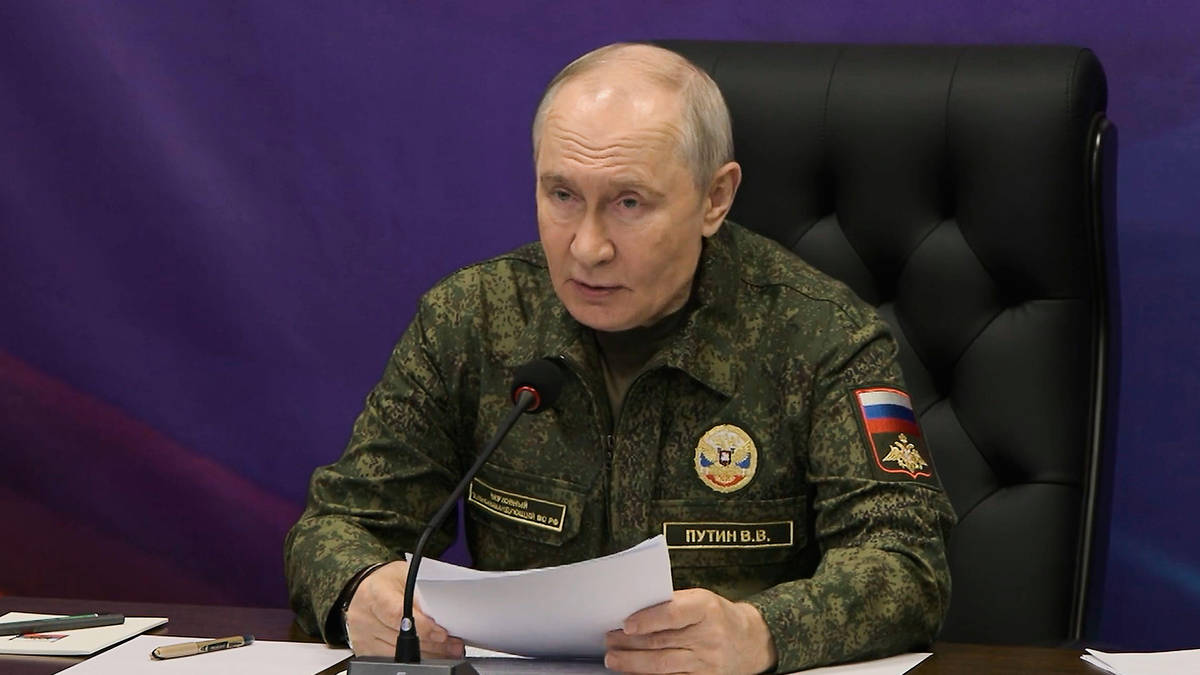
Putin, wearing a military uniform and speaking during a visit to a command post, claimed the operation was in response to Ukraine's 2024-25 incursion into the western Kursk region.
"The Russian armed forces were tasked not only with expelling the enemy from our land but also with establishing a security zone in the adjacent territory. This task is being carried out successfully," he said in televised .
"Our goal is to ensure the absolute security of Russia’s border regions for the future, and we do not plan to make this a subject for potential peace negotiations with Ukraine."
Kremlin spokesman Dmitry Peskov said the planned security zone spanned 660 km (410 miles), of which 70% was currently under Russia's control. He did not say how deep it would reach inside Ukraine.
Putin has spoken before the need for such a zone but has not previously spelt out the planned extent of it or said it would be off-limits for talks.
It requires Russia to carve out land in the Sumy and Kharkiv regions, which are not among those it has claimed as its own territory since launching the war in Ukraine in 2022.
Putin was speaking at a critical point in diplomacy over the war, one week after a deal to sell Russian diesel to the US that has won favour with President Donald Trump and prompted a new souring of the relationship between Trump and Ukrainian leader Volodymyr Zelenskyy.
Putin said Russian forces had yet to capture just over 10% of the territory of Ukraine's Donetsk region, a key objective, and 16.5% of the Zaporizhzhia region.
He praised the effectiveness of Russian strikes against Ukrainian military, industrial and logistics targets, while adding there was still room for improvement in Russia's own air defences.
Ukrainian drones have attacked several Russian data centres and a big oil refinery in the past nine days, while Russia has continued to pound Ukrainian cities, power plants and ports, among other targets.
Earlier, Putin's investment envoy Kirill Dmitriev said Russia and the US were discussing a range of new joint projects, including nuclear-powered data centres in the wake of last week's agreement on diesel.
Meanwhile, Ukraine's President Zelenskyy warned the world of looming risks from the diesel deal struck by President Trump with Russia, saying it paves the way for further sanctions relief for an aggressor that shows no desire to end its war.
Ukrainians struggling with a fifth year of Russian attacks on their power grid and other civilian infrastructure have said they are appalled by Trump's decision to open the US market for Russian diesel.
They have also condemned his attempts to blame fuel shortages caused by the Iran war on Kyiv's military strikes on Russian refineries.
"In my view, we cannot accept these diesel deals, these agreements, because gas deals will follow. I am absolutely certain of this. Sanctions will be lifted on other things as well after gas," Zelenskyy told reporters in Brussels.
"It will all come down to the banking system, individuals and the chemical industry," he added.
The full story
This article is one source in a clustered incident — the cluster page carries the summary, timeline and every other outlet covering it.
