 Back Securityaffairs
 Silent Lynx: Kazakhstan-Linked Hackers Target Russian Refinery and Government
Silent Lynx, a group likely based in Kazakhstan, targets Russian energy and government entities in espionage campaigns across Central Asia.
Researchers from Cisco Talos and Recorded Future published a detailed paper on a threat actor they call Silent Lynx (aka UAT-6275, TAG-193), a Kazakhstan nexus group conducting espionage across Central Asia.
The targets include the Orsk Oil Refinery in southern Russia, 25 kilometers from the Kazakhstan border, and the government of Nizhny Novgorod, a major city 425 kilometers east of Moscow. The city lies where the Volga and Oka rivers meet, an important waterway system connected to the Caspian Sea. This target may be significant because Kazakhstan depends on the Caspian basin.
The group has been running targeted intrusion campaigns against government bodies, diplomatic missions and civil society organizations across Central Asia since at least 2024.
“Silent Lynx (overlapping with activity tracked as UAT-6275 by Cisco Talos and as TAG-193 by Recorded Future) is a persistent threat actor that has conducted targeted intrusion campaigns against government ministries, diplomatic missions and civil society organizations across Central Asia since at least 2024.” the paper states. “The group maintains a strong focus on high-value public sector organizations in the Commonwealth of Independent States (CIS), frequently leveraging spear-phishing campaigns conducted through compromised government email accounts and malware staging through trusted public services such as GitHub to increase credibility and infection success rates.”
The group overlaps significantly with clusters previously documented under names like YoroTrooper , ShadowSilk, and Hydra Saiga, all pointing at the same underlying activity.
The toolkit is deliberately lightweight: PowerShell-based reverse shells, proprietary shells written in C++, C#, and Go, commodity tunneling tools, and spear phishing emails sent through compromised government email accounts in Tajikistan and Kyrgyzstan to add credibility. GitHub, Telegram, and hijacked legitimate servers all serve as staging platforms. Nothing it is technically flashy, which is part of why the group has stayed active for years without much public attention.
The researchers found links that go beyond technical evidence. In March 2026, a Tajik government agency contacted a Silent Lynx server, shortly after Kazakhstan’s lower house of parliament ratified a Treaty on Allied Relations with Tajikistan. In early April, a Belarusian government entity appeared on the same infrastructure, a week before Kazakhstan’s president met with the Belarusian foreign minister in Astana. These links do not prove the reasons behind the activity, but the researchers highlight them in their paper, and they are difficult to ignore.
The connection to the Orsk refinery also has a clear context. A Ukrainian drone attack in August forced the refinery to shut down for months. Russia had already asked Kazakhstan to help make up for the resulting loss of refining capacity. If a Kazakhstan-linked actor was collecting intelligence on Russian energy infrastructure at that time, it could have been assessing the economic impact or trying to understand how the disruption might affect Kazakhstan’s own export pipelines. The researchers stress that they do not have enough evidence to identify a specific motive. However, they present the facts and let readers draw their own conclusions.
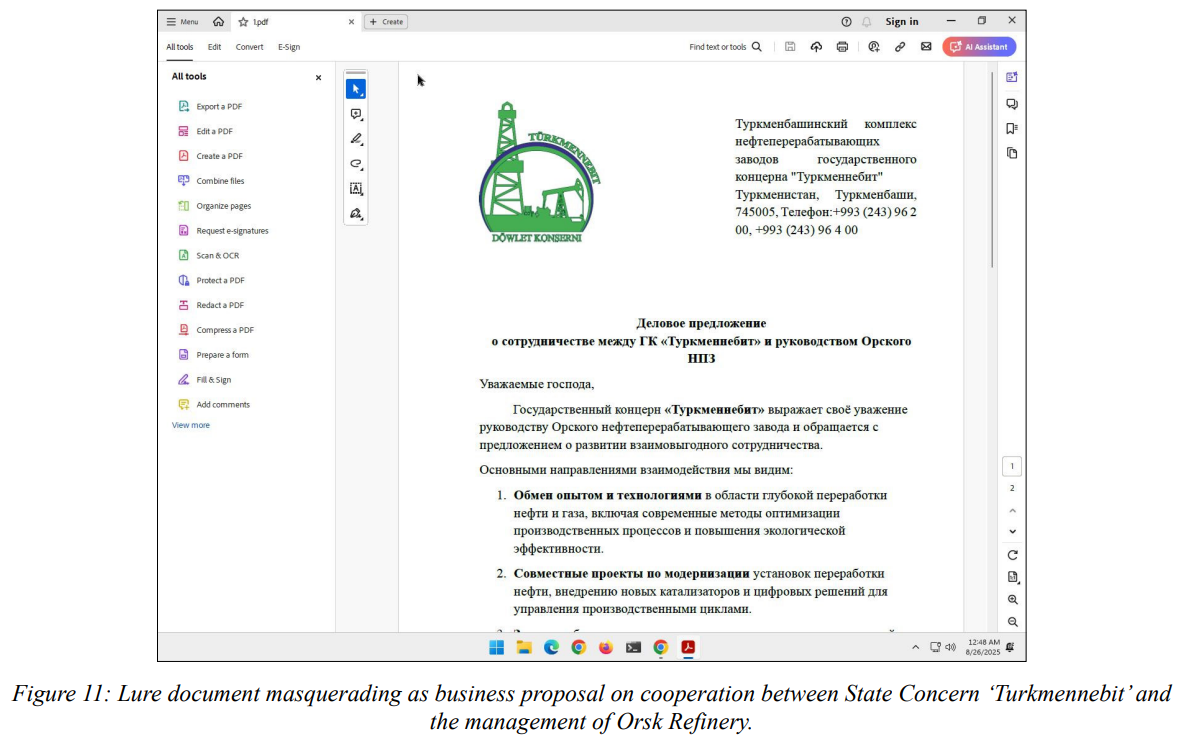
“A sample compiled in August 2025 was observed using a document titled Деловое предложение о сотрудничестве между ГК «Туркменнебит» и руководством Орского НПЗ (translated: Business proposal on cooperation between State Concern ‘Turkmennebit’ and the management of Orsk Refinery) (see Figure 11). We assess that this sample may be targeting Russia’s critical energy infrastructure, given the close integration of the Russian BREAK THE SILENCE: TRACKING SILENT LYNX THROUGH EXPOSED INFRASTRUCTURE SHEN & VÖGELE 10 VIRUS BULLETIN CONFERENCE OCTOBER 2026 and Kazakh energy sectors.” continues the report. “The document outlines proposals for developing mutually beneficial cooperation, with a particular focus on the exchange of expertise, technologies, and industry best practices. It is worth noting that the author of this PDF file is ‘pickle rick’ and the document was created just one hour after the payload was compiled. The name ‘pickle’ is aligned with the name ‘pickl’ we observed in the PickleShell PDB string3.”
What gave the group away wasn’t a sophisticated interception, it was their own operational sloppiness. They left open directories exposed on public servers containing live tooling, staged payloads, and one very incriminating shell command history showing keyboard input typed in Latin with a Russian keyboard layout active, so “whoami” came out as “црщфьш.” GitHub commit timestamps across 77 commits fit working hours in Astana, Kazakhstan, at 95 percent, compared to only 51 percent if you plot them against Moscow time. Administration connections to Silent Lynx servers came from ProtonVPN egress IPs geolocated to Kazakhstan, exclusively on weekdays between 7 AM and noon local time.
The group’s servers were also being reached from those VPN addresses, which Proton typically assigns based on geographic proximity. Two malware samples were uploaded to VirusTotal from Kazakhstan within minutes of compilation, which is classic anti-detection testing behavior and points to the operator location directly.
“We identified several additional indicators that strengthen the assessment of a Kazakhstan-based origin. The first derives from what appears to be malware detection-testing activity conducted through VirusTotal.” continues the report. “Two samples showed this pattern: an early Chvost sample12 was uploaded to VirusTotal only 86 seconds after compilation, while a second sample13 was uploaded approximately four minutes after compilation. Both samples were uploaded from Kazakhstan, and the same uploaders had submitted additional tools that were later observed in Silent Lynx campaigns.”
A researcher at Johns Hopkins School of Advanced International Studies told Reuters that the case highlights an important point: cyber espionage is no longer the domain of a few major powers. Smaller countries are also developing their capabilities and running long-term operations against neighboring states, often driven by serious geopolitical interests.
Silent Lynx is also becoming more technically advanced. In April 2026, the group used an exploit for the first time to deliver malware. It abused a WinRAR path traversal flaw ( CVE-2025-8088 ) to place malicious files directly in the Windows Startup folder, without requiring victims to enable macros. The group also stored a public proof of concept for a FortiWeb authentication bypass vulnerability on its own command-and-control (C2) server. Researchers have also found signs of growing interest in Linux systems. After relying mainly on social engineering for two years, Silent Lynx appears to be building a more advanced set of attack tools.
Full joint Virus Bulletin paper with full indicators of compromise, malware hashes, and infrastructure details is available here .
Follow me on Twitter: @securityaffairs and and Mastodon
( SecurityAffairs – hacking, SILENT LYNX)
The full story
This article is one source in a clustered incident — the cluster page carries the summary, timeline and every other outlet covering it.
