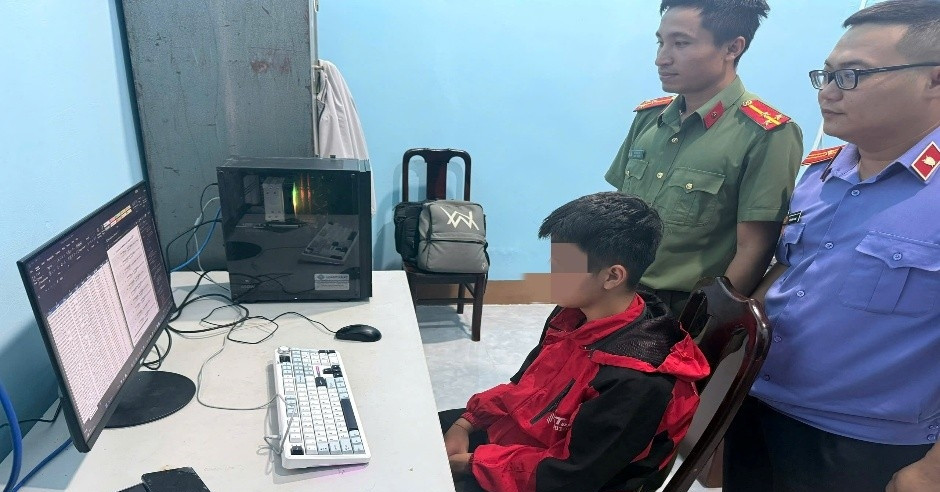
According to sources from the Cyber Security and High-Tech Crime Prevention Department of the Lam Dong Provincial Police, on June 5, 2026, the Cyber Security and High-Tech Crime Prevention Department, in coordination with the Criminal Police Department of Lam Dong Provincial Police, investigated, clarified, and prosecuted NHA (born in 2010, residing in Quan Thanh commune, Nghe An province) for the acts of "Illegally providing or using information on computer networks and telecommunication networks" and "Illegally accessing the computer network, telecommunication network, or electronic devices of others," as stipulated in Articles 288 and 289 of the Penal Code.
The investigation determined that NHA is a 10th-grade student at a high school in Nghe An province. The suspect independently acquired knowledge from the internet, wrote programming algorithms, and exploited security vulnerabilities to illegally access the National Immunization Information System managed by the Department of Preventive Medicine - Ministry of Health, in order to collect personal data of citizens nationwide.
After stealing the data, the suspect posted and offered it for sale on personal data trading groups and forums. Investigators determined that NHA had collected and sold approximately 20 million pieces of personal data, earning over 100 million VND in illicit profits.
This incident serves as a wake-up call for a segment of today's youth. Due to a lack of legal knowledge, being misled, or pursuing immediate material gain, many have engaged in the buying and selling of personal data and illegal access to information systems, simply believing it's a way to "make money online." However, all illegal activities in cyberspace leave electronic traces and will be detected and strictly dealt with by authorities in accordance with the law.
According to the law, citizens' personal data is protected, and any act of illegally collecting, buying, selling, exchanging, or publicly disclosing personal data is strictly prohibited. Depending on the nature and severity of the violation, individuals and organizations engaging in the buying and selling of personal data may be subject to administrative penalties or criminal prosecution.
Regarding the illegal dissemination or use of information on computer networks and telecommunications networks, Article 288 of the Penal Code stipulates that violators may be fined up to 1 billion VND or imprisoned for up to 7 years. In addition, offenders may also be subject to supplementary fines, prohibition from holding certain positions or practicing certain professions as prescribed by law.
Regarding the unauthorized access to another person's computer network, telecommunications network, or electronic device, Article 289 of the 2015 Penal Code (amended and supplemented in 2017) stipulates that offenders may be fined from VND 50 million to VND 300 million or sentenced to imprisonment from 1 to 5 years. In cases of organized crime, large illicit gains, serious damage, or appropriation of a large amount of data, the prison sentence can be up to 12 years.
In Vietnam, there have been many recorded cases of student hackers causing serious disruption to public systems.
In 2005, security companies discovered a virus called "Love" that had spread to computer systems in Vietnam.
If not detected early, this virus could pose a threat to computers.
When investigators got involved, they discovered that a student in Hai Phong had created this virus.
However, because the student was only 16 years old, the Inspectorate of the Ministry of Post and Telecommunications (now the Ministry of Science and Technology) only imposed an administrative penalty for this offense.
In 2006, a 12th-grade student in Vinh Long hacked into the Ministry of Education and Training's website, replacing the Minister's image with a personal photo. Although he claimed he only wanted to warn a security vulnerability, this act was still considered a violation of the law.
Specifically, at 2 PM on November 27, 2006, this teenage hacker attacked the website of the Ministry of Education and Training, replacing the minister's photo with a picture of a shirtless young man sitting in front of a computer screen.
The perpetrator of these attacks is Bui Minh Tri, a 12th-grade student specializing in Physics and Computer Science at Nguyen Binh Khiem High School for the Gifted (formerly Vinh Long).
In his statement, Bui Minh Tri wrote: "...In mid-July 2006, I accessed the Ministry of Education and Training's website and noticed some insecure points, so I tried to infiltrate it. After two days, I discovered a vulnerability... I managed to access the server and left a file to warn the website administrators, but received no response. On November 27, 2006, I returned to the Ministry of Education and Training's website to see if they had fixed the vulnerability, but it remained uncorrected. Disappointed by their irresponsible attitude, I replaced the Minister's photo with my own photo in 5 minutes, thinking that someone would see and know that the Ministry of Education and Training's website had a vulnerability and would warn those responsible on my behalf (because my warnings were ineffective. Besides the intention of warning, I had no other intention)."
In March 2017, two ninth-grade students hacked and altered the websites of five major airports: Tan Son Nhat, Da Nang, Phu Quoc, Rach Gia, and Tuy Hoa. Both claimed their purpose was to "test their skills" and show off their achievement online.
Accordingly, on March 8, 9, and 10, 2017, the website of Tan Son Nhat International Airport, along with a series of websites of Da Nang, Phu Quoc, Rach Gia, and Tuy Hoa International Airports, were attacked by hackers, their interfaces altered, and messages left behind.
At the police station, LCKD and PHH confessed honestly and admitted their wrongdoing. According to their statements, the motive for the attack stemmed from a desire to explore, show off, and boast their achievements within the hacker community.
According to the Civil Aviation Authority's leadership, the hackers did not steal data or demonstrate any intention to sabotage the information system; they only left a reminder the website's security vulnerability.
Recently, a 10th-grade student in Bac Ninh province "cracked" numerous pay-TV channels, setting up an illegal streaming system for nearly 1,000 channels.
Remarkably, this student didn't need a server or high-end hardware; they just used an old phone and learned how to crack encryption from underground tech groups on social media.
During the investigation, the young hacker admitted that he could crack the encrypted signals of major pay-TV channels in Vietnam such as K+, VNPT, etc., in just 30 seconds.
Cybersecurity experts warn that preventing this situation requires a combination of legal awareness education and digital skills training for students.
Schools, parents, and society must help children understand that every click on the internet can leave a legal trail.
Source:
The full story
This article is one source in a clustered incident — the cluster page carries the summary, timeline and every other outlet covering it.
