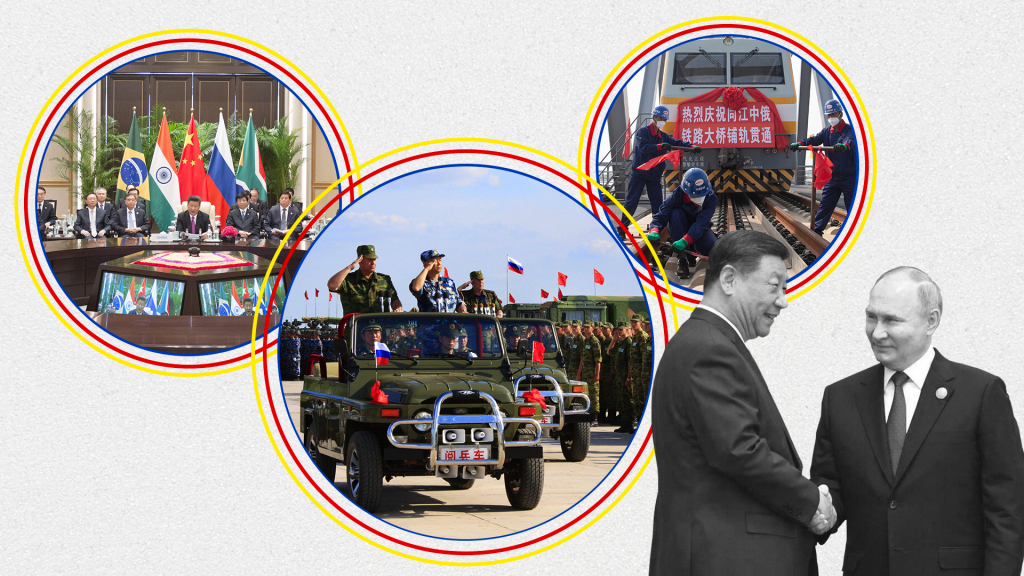
If, in 2016, an analyst had suggested that less than a decade later China would serve as the economic and logistical linchpin enabling Russia to wage a full-scale war against Ukraine, such a prediction would have struck most observers as unlikely, or even outlandish. If the same analyst had proposed that China and Russia, as part of this major war effort, could cooperate with Iran to mass-produce lethal drones and thereby kill many thousands of Ukrainians, the scenario might have seemed similarly far-fetched.
Even the bold and seemingly clairvoyant expert in this hypothetical would probably balk at the notion that thousands of North Korean troops would be fighting at the Russians’ side and learning new methods of modern warfare, and that ammunition from Pyongyang would account for roughly half of Russia’s artillery expenditure on the Ukrainian front in the second half of 2025. 1
Yet as of early 2026, all these examples of authoritarian cooperation had converged to sustain the longest and most horrific land war in Europe since World War II.
It is fair to argue that policymakers and other observers in the democratic world suffered from a failure of imagination over the past decade, dramatically underestimating the danger and destructive potential of strategic alignment among authoritarian powers, and particularly between Moscow and Beijing. 2
But there is also a risk of overcorrecting—of inflating the extent of authoritarian alignment and overlooking important imbalances and points of friction in the Sino-Russian relationship. Indeed, the muted Russian and Chinese responses to recent US military interventions in Venezuela and Iran have underscored some of the limits, at least in the short term, of authoritarian powers’ will and ability to close ranks against external threats.
The present report, part of a two-year study undertaken by the Center for European Policy Analysis (CEPA), is intended to examine both the strengths and the weaknesses of the partnership between Russia and China, with chapters focused on their joint economic, military, and global-governance activities. Such a clear-eyed assessment is crucial for the development of a well-calibrated policy response on the part of the world’s democracies.
The three chapters of this report, which represent part of a more comprehensive analysis, explore how the relationship between China and Russia has taken shape since the Kremlin’s full-scale invasion of Ukraine in 2022. That year proved pivotal not only for Moscow and Beijing, but also for geopolitics more broadly. By then, however, the Sino-Russian partnership had already been evolving and maturing for nearly a decade. The two regimes were therefore well positioned to pursue more ambitious joint activities that are now underway.
Central to understanding today’s intensified China-Russia bond is the personal relationship between Xi Jinping and Vladimir Putin. Since Xi took office as general secretary of the Chinese Communist Party (CCP) in late 2012, and Putin returned to the Russian presidency earlier the same year, their two countries’ bilateral ties have deepened from a rather distant and pragmatic association into a remarkably close and sustained leader-to-leader exchange. During this period, Xi and Putin have reportedly met—either in person or virtually—more than 70 times.
With the benefit of hindsight, it is easier to see that as Putin was planning the 2014 occupation of Crimea and infiltration of eastern Ukraine, Xi was simultaneously adopting a more assertive and confrontational posture for China in the South China Sea. It was an indication of more dramatic developments to come.
In February 2022, following a summit in Beijing, Xi and Putin issued a joint statement describing relations between China and the Russian Federation as a friendship with “no limits.” 4 . Days later, Moscow launched its attack, sending thousands of troops across the Ukrainian border and upending European and global security in a manner not seen since the first half of the 20th century. With China’s indispensable support, the Russian regime has sustained its war effort for more than four years despite unprecedented international sanctions and fierce Ukrainian resistance, inflicting immense destruction and suffering on Ukraine as well as its own people. 5
As Tamás Matura notes in his analysis, “expectations in much of the West were that these sanctions would effectively cripple the Russian economy, weaken the regime, and force a recalibration of its foreign policy. Instead, Russia has demonstrated surprising economic resilience—at least in the short run—due in part to deepening economic ties with the People’s Republic of China.” The two countries undertook a dramatic expansion of bilateral trade, which grew by roughly 70 percent over the five-year period beginning in 2021.
Far from limiting themselves to mere endurance, Xi and Putin have continued to advance broader strategic goals throughout the war. In March 2023, during a meeting in Moscow, they pledged to jointly drive global changes “the likes of which we haven’t seen for 100 years,” pairing their rhetoric with agreements to increase bilateral cooperation. 6 That same year, Beijing its recently introduced Global Security Initiative and Global Development Initiative and expanded the BRICS group—all efforts aimed at drawing developing economies and authoritarian regimes away from the United States and other democracies, while positioning Beijing at the center of an international order that better suits its needs. Ultimately, the Sino-Russian partnership seeks to eclipse the US-led alliance system and reorganize global affairs and institutions around a revisionist China-Russia axis.
Continuing along this trajectory more than two years into the full-scale war in Ukraine, Xi and Putin in May 2024 pledged a “new era” in their partnership. 7 Their joint statement emphasized deepening strategic relations, including plans to strengthen military ties and expand defense-sector cooperation, which they argued would bolster regional and global security.
The Sino-Russian relationship has clearly grown closer and more potent over the past four years, but a look beneath the surface reveals structural imbalances and strategic divergences that have and are likely to continue to impose constraints on bilateral cooperation.
Economic engagement between Beijing and Moscow is characterized by what analysts describe as “asymmetric interdependence”—a lopsided relationship in which China plays the dominant role. As Tamás Matura explains, Russia’s intensifying dependence on China carries significant trade-offs: while it provides immediate economic relief, it also reinforces Russia’s role as an exporter of raw materials and an importer of manufactured goods, potentially accelerating deindustrialization and exacerbating the existing imbalances. In this sense it is just one of many ways in which Putin is mortgaging Russia’s future.
The dynamic is viewed with growing unease among segments of the Russian elite, but the CEPA analysis cautions that the two regimes have strong incentives to stay the course. Beijing’s resolve to sustain and possibly deepen strategic cooperation with Moscow should not be underestimated, and Putin’s Russia is likely to remain committed to close ties with China even if the war in Ukraine ends, as both sides view their partnership as essential for standing up to the West.
In the global governance domain, there are also divergences. Evgeny Roshchin observes that while the leaderships in China and Russia are equally wary of external scrutiny of their undemocratic institutions and arbitrary practices—and therefore seek to develop regional and alternative global institutions outside the UN framework—Beijing’s ambition to reshape and eventually lead the international order can sometimes clash with Moscow’s narrower efforts to bypass or subvert it.
With respect to military ties, China’s support has been indispensable to Russia’s war effort against Ukraine, but neither Moscow nor Beijing seeks a formal alliance. As Mathieu Boulègue describes it in his chapter, each side is keen to avoid any extended security guarantees that might constrain the independence and flexibility of its own foreign policy.
Moreover, despite the expansion of joint military exercises, Moscow and Beijing continue to favor “parallel play” over fully integrated operations, and they lack the dense institutional connective tissue that would allow the two militaries to fight together as NATO forces do. The Kremlin also has little to gain from closer cooperation on military technology, as China is already eroding Russia’s technological edge and could overtake the Russian military industry in bilateral trade and export markets.
Still, Boulègue cautions that recognizing the limits of Sino-Russian military cooperation should not lead to complacency in the West. Thousands of Chinese firms, for instance, are reportedly supplying Russia’s war machine in ways that enable the Kremlin to continue its attacks on Ukraine. 8
A realistic assessment of the Beijing-Moscow relationship must acknowledge both its constraints and the large and genuine threat that it poses to the United States and its allies.
Analysis on the depth and durability of the relationship between Beijing and Moscow, as well as their ties with other authoritarian powers, must be regularly reassessed in today’s rapidly changing and turbulent geopolitical context. This year’s US and Israeli attack on Iran, combined with ongoing US pressure on Venezuela and Cuba, has exposed the practical isolation of the targeted regimes, despite their long-standing strategic relationships with Russia and China. But as with the Kremlin’s invasion of Ukraine, lines of support and cooperation may develop and become more visible. In early March 2026, for instance, reports suggested that Russian forces were providing Tehran with intelligence on US military assets in the region. 9
Meanwhile, Kyiv stepped forward to provide hard-won expertise on countering Iran’s drone technology, indicating a potential spiral in which the two conflicts—and their respective belligerents—become increasingly intertwined.
In any event, it would be unwise to presume that recent military developments will be decisive in dispelling the threat posed by cooperation among authoritarian regimes, and particularly between Moscow and Beijing. The attacks on their partners in the Caribbean and the Middle East could ultimately push the two regimes closer together. The United States and its democratic allies must therefore prepare for a long-term and comprehensive strategic competition with these authoritarian adversaries. The only safe assumption is that the leaders of Russia and China, both of whom prioritize regime survival above all else, will continue to adapt and challenge US interests and security.
The partnership that has emerged between Beijing and Moscow does not neatly conform to democratic observers’ familiar conceptions of a NATO-style military alliance or a European-style economic union backed by extensive institutional integration. Instead, it is highly conditional and tailored to serve the distinct and shifting interests of each party, which results in both strengths and weaknesses. Marriages too can be based on convenience or expedience, and some may be fraught with tension and unhappiness. Yet they can also be flexible, resilient, and powerful in their own way. Too often, observers in open systems project their own assumptions onto the manner in which authoritarian powers organize themselves and prioritize their objectives.
Despite obvious friction and structural asymmetries, the regimes in Beijing and Moscow have steadily developed their partnership since 2012, and especially since 2022, cooperating in ways that few anticipated. This tightening authoritarian alignment is all the more consequential given the changing and uncompromising posture of the leadership in the United States and the growing differences among democratic allies, which under present circumstances should be acting with far greater unity, purpose, and strategic coherence.
Rather than dismissing what some call the Sino-Russian “marriage” as a loose bond of convenience, democracies should regard it as profoundly dangerous for all those who value freedom, security, and prosperity, and prepare their policy responses accordingly. Free societies no longer have the luxury to suffer any further failure of imagination.
The full-scale Russian invasion of Ukraine in 2022 precipitated an extensive package of Western sanctions designed to undermine Russia’s capacity to sustain military operations by isolating and putting pressure on its economy. Expectations in much of the West were that these sanctions would effectively cripple the Russian economy, weaken the regime, and force a recalibration of its foreign policy. Instead, Russia has demonstrated surprising economic resilience—at least in the short run—due in part to deepening economic ties with the People’s Republic of China. Beijing’s economic engagement functions as a buffer that enables Moscow to weather sanctions and maintain its military effort, but the relationship also reflects asymmetric interdependence, in which China occupies the structurally dominant position. This dynamic is viewed with growing unease within segments of the Russian elite.
In contrast to Beijing and Moscow’s now-abandoned rhetoric from early 2022, which described Sino-Russian ties as a “no limits” partnership, the Chinese government has calibrated its support to preserve its own strategic autonomy and economic interests, meaning limits are imposed on areas of cooperation. This pattern indicates either that the no-limits partnership was a misnomer in the first place, or that Beijing’s calculus has changed in light of the Russian military’s failure to secure a swift victory in Ukraine.
Under sanctions, Russia’s trade pivot toward China creates both opportunities for regime survival and structural constraints that may accelerate Russia’s deindustrialization. In effect, Russian President Vladimir Putin’s strategic calculus has prioritized the endurance of his regime and the continuity of his war effort over long-term economic consequences, accepting deepening Russian dependence on Asia’s largest economy.
The concept of asymmetric interdependence helps explain bilateral relationships in which one partner is more dependent than the other, and how this shapes bargaining power, economic flows, and political leverage. Sanctions often intensify preexisting asymmetries by cutting off alternative partners, concentrating dependency, and creating shielded economic corridors through non-sanctioning states.
In the case of Sino-Russian economic relations, asymmetry is manifested in several ways: Russia’s trade and financial ties with China grew rapidly between 2022 and 2024 before plateauing in 2025, yet Russia still accounts for only a small of China’s international trade; China’s exports to Russia include capital and intermediate goods that Russia cannot easily substitute; and Beijing retains exit options if further engagement threatens its economic relationship with the West. As a result, Beijing’s economic support for Moscow functions selectively, helping to keep the Russian partner afloat but remaining insufficient to fully rescue the Russian economy or provide an open-ended bailout.
Some recent statements by Chinese officials also support the idea that Beijing is interested in maintaining Russia’s warfighting capacity, but only to a certain extent. In January 2025, Geng Shuang, the Chinese Deputy Permanent Representative to the United Nations, explained that “if China had really provided military supplies to Russia, the situation on the battleground would not have been where it is now.” 10 In July of that year, Chinese Minister of Foreign Affairs Wang Yi went a step further, reportedly telling his EU (European Union) counterpart that Beijing could not accept Moscow losing its war against Ukraine, as this could allow the United States to turn its full attention to China. 11 Such statements raise the question of how far Beijing is willing to go in the future to keep Russia in the fight.
This chapter shifts attention from descriptive accounts of trade growth to a structural analysis of how interdependence shapes both countries’ incentives and constraints. Beijing’s approach is best understood as an effort to maximize its strategic flexibility: engaging economically with Russia where profitable or geopolitically useful, while avoiding commitments that would draw severe secondary sanctions—beyond what China is able to absorb—or derail the Chinese regime’s broader industrial policy and economic strategy.
Sino-Russian economic relations had already been growing before 2022, but they remained imbalanced, despite Russia’s huge potential to export raw materials to China. In 2000, China accounted for only 3 percent of Russia’s imports; by 2023, China accounted for over a third of Russia’s purchases of foreign goods. This shift partly reflects Russia’s exclusion from Western markets after 2022 and China’s growing economic footprint globally. Since 2022, bilateral trade growth has been one of the most visible markers of the Sino-Russian economic relationship. With Russia facing sanctions from the EU, the United States, and other Western economies, trade with China has become an essential channel for Russian exports and imports. Chinese purchases of Russian energy commodities have helped generate foreign exchange for Moscow (mostly in Chinese currency), while Chinese manufactured exports have filled gaps left by Western companies that exited Russia.
Chinese exports to Russia increasingly consist of high-added-value products, while Russia’s exports to China remain heavily concentrated in energy and raw materials, amplifying structural asymmetry. 12 The export of petrochemical commodities makes up 75% of total Russian exports to China, as Beijing is willing to purchase Russian energy resources at a heavily discounted price. Meanwhile, China has replaced Western competitors to become the main supplier of automotive and electronic products and household appliances in Russia. 13 Russian producers complain the influx of Chinese industrial products, and Beijing had introduced strict import barriers against certain Russian products, such as coal and wheat, even before 2022. 14
The asymmetric trade structure means that Russia is effectively integrated into Chinese supply chains on Beijing’s terms. While trade volumes have expanded dramatically, reportedly hovering around $240 bn in recent years, Russia remains a relatively minor component of China’s global economic engagement. Yet China is indispensable to Russia’s trade network, as Moscow has few alternative options.
This pattern not only reflects asymmetric interdependence but also raises concerns the effectiveness of Russia’s official import-substitution policy and the risk of deindustrialization, as it imports finished goods that displace domestic manufacturing activity. In a sense, Russia shares the same problem with other developed countries: China has taken advantage of the relatively free global trade environment to advance a beggar-thy-neighbor industrial policy. As China must keep exporting to stave off an overcapacity-induced economic crisis, it exploits Moscow’s desperate situation by taking over Russian markets in an asymmetric manner. Beijing’s practice of sealing off segments of the Chinese market where Russian competition would be detrimental to China’s interests is a clear sign that the Chinese leadership does not intend to help Moscow beyond the level necessary to prevent the outright collapse of its northern neighbor.
Following Russia’s exclusion from Western markets, its trade with China became crucial, as Chinese energy purchases provided foreign exchange, and Chinese-manufactured goods replaced Western suppliers. However, this has exacerbated preexisting asymmetries: China exports increasingly high-value-added machinery and electronics, while Russia exports mostly discounted energy and raw materials. Russia has become deeply dependent on China, while China treats Russia as a relatively marginal partner in its global economic strategy. Such asymmetric interdependence fuels concerns Russian deindustrialization and suggests that Beijing is exploiting Moscow’s vulnerability while limiting Russian access to sectors of the Chinese market that could threaten China’s own interests.
China’s role in Russia’s financial adjustment to sanctions includes increased Russian use of the Chinese yuan and alternative payment systems, which reduces reliance on Western financial infrastructure. According to Putin, the of rubles and yuan in Sino-Russian commercial transactions exceeded 90% by 2024. This reflects a deliberate move away from Western currencies and cushions Russia from exchange-rate volatility and external pressure.
Yet Sino-Russian financial cooperation has limits. Chinese banks have shown caution with respect to transactions that could trigger secondary sanctions, and while alternative mechanisms provide some breathing room, they fall short of full integration into global financial networks. This selective engagement reflects Beijing’s desire to hedge risk and preserve ties with Western financial partners.
China has refused to fully open its capital markets to Russia, and Moscow is consequently unable to raise a meaningful amount of debt from Chinese financial institutions. Russia’s federal budget is in a difficult situation, government reserves are swiftly depleting, and rising debt cannot be financed from external sources. While the official annual budget deficit of 2.6% of gross domestic product (GDP) in 2025 does not seem extremely high, the only way to finance it without access to international financial markets is to raise taxes or print money. The first option puts a heavy burden on the already struggling private sector, and the second will inevitably lead to elevated inflation.
Earlier assessments concluded that the decline in the assets of Russia’s National Wealth Fund would not ultimately lead to full depletion, but more recent reports suggest that the fund could be emptied within a year. 15 Indeed, the value of its liquid assets has fallen to some 4% of GDP, less than half of the equivalent figure from 2022. 16
A combination of these factors will very likely force the Russian government to cap military spending in the coming years, and a protracted budget crisis is looming due to the rising cost of debt servicing. High interest rates have a detrimental impact on investment, which disadvantages Russian industrial actors and creates an uneven playing field that favors Chinese producers and exports, further accelerating Russia’s economic downturn and the asymmetry of its relationship with Beijing. 17
Even though China has helped Russia adapt to sanctions by expanding the use of the yuan and alternative payment systems, Chinese financial support remains limited, as China’s banks avoid sanction risks and Beijing has not opened its capital markets to Russian borrowing. As a result, Russia lacks access to external financing, putting severe strain on its federal budget as reserves decline. Financing deficits through higher taxes and monetary expansion burdens the private sector and fuels inflation, while high interest rates suppress investment. These constraints are likely to force cuts in military spending and further weaken Russian industry, indirectly favoring Chinese producers and accelerating Russia’s economic downturn in the long run. A further deterioration in the relationship between China and the West may trigger a policy change in Beijing. Should Chinese leaders decide to expand their financial life support for Russia, Moscow may be able to maintain its war effort at or beyond current levels. However, it is difficult to gauge how far Beijing is willing or able to go in this regard, given its own growing debt problems and concerns Russia’s ability to repay loans. Since the Chinese regime does not intend to further increase Russia’s in China’s energy imports, loan repayment in the form of oil and other raw materials would likely be unattractive to Beijing.
Beijing’s reluctance to offer unbounded economic support to Russia extends to Chinese investment in the country. As recent analyses have shown, Beijing is not willing to inject capital to staunch systemic Russian decline or high-end technology that would create direct competition for Chinese industries.
Chinese investment in Russia since 2014 has been heavily concentrated in the extractive industries (oil, gas, coal, metals) and increasingly in the agro-industrial complex, which together account for nearly two-thirds of accumulated Chinese foreign direct investment (FDI). Beijing has been willing to invest in these sectors because they secure long-term access to energy and raw materials, fit China’s strategic demand structure, and allow cooperation with politically connected Russian elites (for example through the privately owned gas company Novatek and the petrochemicals firm SIBUR), thereby minimizing political risk. There has also been gradual growth in research, technology, IT, finance, and logistics, though from a low base. By contrast, China has been cautious with investments in manufacturing and high-tech sectors. Russia, for its part, actively seeks Chinese capital not only in energy and agriculture but also in manufacturing, high-tech industries, infrastructure, and the real sector more broadly, as part of its “Turn to the East” strategy. 18 Major projects, such as proposed energy pipelines or expanded financial cooperation, have stalled or faced protracted negotiations.
Beijing’s restraint stems from multiple factors: China’s broader economic ties with the West, its sensitivity to secondary sanctions, the deterioration of Russia’s business environment, and a strategic preference for flexible engagement over formal alliance obligations. The result, in terms of Chinese investment, is a pattern in which Chinese firms already present in Russia have simply cemented their positions and, in many cases, expanded sales. There has not been a significant increase in new Chinese investment projects in Russia, and China has not replaced the Western investment that fled due to sanctions risks and geopolitical uncertainty. New Chinese greenfield investments, mergers and acquisitions, and major capital commitments have remained scarce.
Russia’s capital inflow crisis persists despite deepening trade with China. According to data published by China’s Ministry of Commerce, Chinese investment flows to Russia turned negative in 2021 and only modestly rebounded in 2022–23. Average annual Chinese FDI to Russia during that period amounted to roughly $400 m, a substantial decline from the approximately $1.2 bn per year recorded between 2011 and 2018. From a cumulative perspective, Russia’s of China’s total outward FDI has steadily decreased over the past decade, reaching just 0.4% in 2023, slightly below levels observed two decades earlier. Conversely, Chinese official statistics indicate that Russian investment in China has remained minimal for years—mostly due to lack of “China competence” and capital constraints in Russia—and totaled only $30 m in 2022–23. 19
Given the traditional drivers of Chinese FDI in developed countries, such as access to markets, brands, and technology, the lack of substantial investment in Russia in recent years makes sense. Since Russia has few alternatives, it must embrace Chinese products, therefore Beijing already has almost unimpeded access to the Russian market. Meanwhile, Russia does not have any major brands that would intrigue Chinese investors, and it lags in every major technological sector. In short, there are no clear incentives for Chinese companies to acquire their Russian counterparts, especially in light of the potential repercussions for their business positions in Western markets.
In terms of FDI, China has not replaced Western economic actors in Russia. The traditional drivers of Chinese investment—access to technology, brands, markets, or raw materials—are largely inapplicable in Russia’s case, as the country offers few technologies or brands of interest to Chinese firms, while its markets and natural resources are already accessible to China. Moreover, Beijing remains cautious further deterioration in economic relations with the West, leading Chinese companies to avoid the risk of secondary sanctions associated with large-scale investments in Russian assets. China also seeks to limit its dependence on Russian energy supplies, which further constrains investment in the energy sector of its northern neighbor. As a result, Chinese investment flows to Russia have fallen to new lows in recent years, to the detriment of Russia’s overall investment climate.
Beyond energy and trade in conventional goods, China has become an important source of technology components that support Russia’s industrial and military production. According to Western intelligence assessments, a large of Russia’s microelectronics and machine tools now originate in China, allowing the Russian regime to maintain and expand its military capacity. While Beijing, to avoid secondary sanctions, officially denies providing direct military assistance to Russia, these crucial exports bolster Moscow’s war effort. 20
Access to technology and dual-use goods has become a central pillar of Russia’s sanctions resilience. Western export controls severely curtailed Russia’s access to advanced technologies from the EU, the United States, and allied countries, creating acute bottlenecks in microelectronics, machine tools, sensors, and telecommunications equipment. In this context, China emerged as Russia’s primary external supplier of dual-use technologies, exporting components with both civilian and military applications. 21 Empirical trade data indicate a dramatic concentration of Russian imports of so-called high-priority dual-use goods from China. By 2023, Chinese suppliers accounted for an estimated 70% to 90% of Russian imports in several critical categories, including machine tools, bearings, equipment, and basic semiconductors. 22 It should be noted, however, that some of this equipment is of Western origin, and Chinese companies act merely as intermediaries. 23
While many of these goods are not weapons per se, they are essential for sustaining Russia’s production of drones, missiles, armored vehicles, and communications systems, among other uses. Beijing has refrained from supplying complete weapons systems and has emphasized that Chinese exports comply with its domestic export-control regime. Chinese authorities have also periodically tightened regulations on sensitive technologies, underscoring a strategy of selective enabling rather than full-scale military backing for Russia. This calibrated approach allows China to support Russia’s war economy while limiting exposure to secondary sanctions and reputational costs.
In addition to commercial trade, technological cooperation has continued in several dual-use civilian-military domains, notably space and satellite . Since 2022, Beijing and Moscow have expanded cooperation between China’s BeiDou and Russia’s GLONASS systems, including the establishment of ground monitoring stations to enhance interoperability. These satellite networks, like the US-based Global Positioning System, have civilian uses as well as clear military relevance, particularly for precision and weapons targeting. 24
Overall, Sino-Russian cooperation in technology and dual-use goods since 2022 illustrates the logic of asymmetric interdependence. Russia has become increasingly dependent on Chinese inputs that it cannot domestically produce or import from the West, while China retains substantial control over the scale and scope of cooperation. This relationship has enabled Moscow to sustain its war effort, but in a way that reinforces Russian technological dependency and limits the Kremlin’s strategic autonomy over the long term.
Again, China’s engagement in technology transfer is calibrated, avoiding overt arms exports or formal military-industrial integration that would draw punitive action from the West. It aligns with the broader pattern of asymmetric interdependence, in which Beijing facilitates the Russian regime’s survival but avoids deep structural commitment.
China has become a key supplier of technology and dual-use components that underpin Russia’s industrial and military production, even as the regime denies direct military assistance. After Western export controls cut Russia off from advanced technologies, Chinese firms filled critical gaps in areas such as microelectronics, machine tools, and equipment, accounting for 70–90% of Russian imports in several high-priority categories by 2023. These inputs are essential for sustaining Russia’s military-industrial complex, enabling continued production of drones, missiles, and communications systems. At the same time, Beijing has carefully calibrated its support, avoiding weapons exports and tightening controls on sensitive technologies to limit exposure to secondary sanctions. As a result, Russia’s war economy has become increasingly dependent on Chinese technology, reinforcing an asymmetric relationship that preserves China’s leverage while constraining Moscow’s long-term strategic autonomy. From Beijing’s perspective, this support not only serves as an additional means of expanding exports but also helps bind Russia more tightly into China’s technological ecosystem, which may prove difficult to exit even after the end of the war in Ukraine. Meanwhile, there is little that Moscow can offer Beijing in terms of technology transfer, aside from certain top-tier military technologies that the Russian side would likely be reluctant to , as doing so could erode Russia’s remaining areas of military advantage and facilitate China’s military-industrial development through reverse engineering.
China’s economic relationship with Russia since the 2022 invasion of Ukraine reflects a complex interplay of economic necessity, strategic calculation, and structural asymmetry. Beijing’s engagement—through expanded trade, financial linkages, and technology inputs—has undoubtedly helped Moscow with weather sanctions and sustain its war economy. The support is selective, calibrated, and constrained by China’s broader economic interests and geopolitical concerns, but it would be a mistake to underestimate Beijing’s resolve in maintaining or even enhancing its strategic cooperation with Moscow, as both sides consider their relationship essential for standing their ground vis-à-vis the West. Putin’s Russia will similarly remain committed to its partnership with China even if the war in Ukraine ends.
From the perspective of asymmetric interdependence, China holds significant leverage over Russia, enabling it to shape the terms and scope of cooperation. For Russia, deepening dependence on China comes with trade-offs: while it provides immediate economic relief, it also reinforces Russia’s role as a resource exporter and an importer of manufactured goods, potentially accelerating deindustrialization and entrenching structural imbalances.
The Kremin’s strategic choice to prioritize regime survival and the continuation of its war in Ukraine has led it to embrace this asymmetrical relationship, accepting increasing dependency in exchange for economic lifelines that Western sanctions seek to eliminate. The bilateral economic relationship has become both a buffer and a constraint; it enables and extends Moscow’s policies but draws Russia ever closer into China’s orbit.
Future research could fruitfully explore how these dynamics evolve in light of any new Western sanctions or sanctions enforcement, whether and how China’s own economic priorities shift, and how Moscow’s war in Ukraine affects global economic alignments.
This chapter provides a comprehensive overview of Sino-Russian relations in the military and security sphere. The two pillars of the military relationship in practice are joint military exercises on the one hand, and arms sales and military-technical cooperation (MTC) on the other.
As with other aspects of their bilateral relationship, Moscow and Beijing are never as close or as distant as they seem. Both regimes align on some of their threats of perceptions and seek to project an image of close and increasing military cooperation. Yet behind the performance of intensifying military ties, reality is fraught with limitations, irritants, and friction points.
Since the early to mid-1990s, the Russian and Chinese governments have been formalizing their bilateral military and security relations through structured consultation mechanisms. Beginning with agreements that addressed outstanding border disputes and demarcation, 25 Moscow and Beijing incrementally built a system of regular communication on security matters and institutional bonds between the two militaries. After the signing of the Sino-Russian Treaty of Friendship in 2001, which included a nonaggression pact, the two countries also initially used the Shanghai Cooperation Organization (SCO) as a platform for bilateral and multilateral military consultations.
Official mechanisms matured in 2004 with the creation of the bilateral Consultations on National Security Issues to common regional security challenges. Russia’s international isolation after the invasion of Ukraine in 2014 accelerated the trend toward closer Sino-Russian ties. It is around that time that the two countries’ military diplomacy peaked. 26
In 2017, they signed an ongoing roadmap that essentially established a legal framework for military cooperation and fostered enhanced MTC. The Treaty of Friendship was renewed in 2021 for an additional five years. Both regimes have also deepened relations with respect to internal security matters, including domestic surveillance and repression of dissent.
Enhanced bilateral agreements in the military and security sphere are reinforced by the fact that Moscow and Beijing similar threat perceptions. They both use military diplomacy as a practical tool against the perceived threat posed by the United States and its military presence in the Asia-Pacific region and beyond. 27 In this sense, the past, present, and future of the military relationship have always carried a strong anti-US undertone.
Sino-Russian threat perceptions are fixated on shared concerns over the deployment of US long-range strike capabilities and anti–ballistic missile defense systems, such as the Terminal High Altitude Area Defense (THAAD) system in South Korea, the Aegis Ashore missile defense system, 28 and US President Donald Trump’s “Golden Dome” plan for North American missile defense. US regional deployments prompted Moscow to informally mention in 2019 that it was helping China build an early warning missile-launch detection system. 29 Very few details have emerged since, and it remains unknown whether the project could lead to the bilateral integration of missile-launch detection systems in the Asia-Pacific. 30
As articulated by Camilla Sørensen, both regimes “see themselves as the victims of a US strategy of containment.” 31 This position of shared victimhood allows them to overlook or downplay short-term bilateral irritants and focus on long-term joint competition with the United States in the Asia-Pacific and beyond.
Competition with the United States will continue to drive Sino-Russian military relations, especially in areas of common interest where Moscow and Beijing could force multiply – for instance, in Central Asia, 32 Africa, and the Arctic. 33 Despite this motivation, it remains unclear whether Russia and China will complement each other in practice or enhance their combined strength and influence in these regions, not least because Moscow is highly territorial in Central Asia and the Arctic. The Asia-Pacific region, where the United States and its allies are also seeking to strengthen their position, will undoubtedly become a more contested space in the medium term. This situation presents both an opportunity for Moscow and Beijing to intensify their joint efforts and a number of associated risks for Washington.
Anti-US contestation does not explain the entirety of Sino-Russian military relations, in part because the two regimes hold divergent views of each other that help define the limits of their cooperation.
From Moscow’s perspective, moving closer to Beijing allows it to boost its international standing amid growing isolation. The relationship is, in other words, a means of self-aggrandizement, burnishing Russia’s credentials as a great power. It is true that many other states (including India, Pakistan, and the Persian Gulf monarchies) have continued to engage with Russia transactionally, overlooking its near-pariah status on the world stage. But the partnership with China is unique in its ability to lift Russia into the top tier of global heavyweights.
Kremlin perceives closer military relations with China as strategic leverage against Western interests, 34 especially because the military and security sphere is one in which Moscow does not feel as dwarfed by China as in economic, energy, or trade relations. Keeping close economic ties with China is essential for the Kremlin’s efforts to bypass sanctions and access critical components for military production. Overall, however, the Russian regime values the symbol of the military relationship more than the substance, as it offers effective signaling against the United States and NATO.
From Beijing’s perspective, Russia remains a potential source of weaponry and technology that could fill persistent gaps in its own capabilities, and of combat experience from which the People’s Liberation Army (PLA) is eager to learn. Beijing is likely aware, however, that Moscow may be reluctant to provide the technology it covets. Each regime also values the other as a partner that could “watch its back,” 35 effectively defending its strategic rear. 36 Beijing acknowledges the strategic stability that strong military relations with Russia offer, but for the same reasons, it deplores the dangers stemming from Moscow’s reckless actions against Ukraine.
Indeed, the Chinese leadership must calibrate proximity to Moscow so as to avoid violating US and European sanctions—for instance, by directly supporting the Russian war effort in Ukraine. 28 At the same time, Beijing is concerned that Moscow could create problems for China, especially in the Asia-Pacific region, compelling it to keep its Russian partner both close and contained.
Symbols and signaling are just as crucial as substance in Sino-Russian military relations. Moscow and Beijing must convey the idea of strong military ties without necessarily establishing a formal military alliance. Neither Moscow nor Beijing is interested in such an alliance, as neither regime needs extended security guarantees from the other, and they value the flexibility of independent action in their respective foreign policies. 37 The leaders of Russia and China do not seek to fight the United States jointly, to risk being drawn into each other’s conflicts through a collective defense pledge, 38 or to limit the maneuverability they need to pursue their own agendas.
Furthermore, a formal alliance would risk antagonizing the US and its allies, as it would be understood as inherently anti-US and anti-Western, and therefore counterproductive to Moscow and Beijing’s shared desire for strategic stability. This is particularly important for the Chinese regime, considering its current geostrategic ambitions in the Asia-Pacific region.
Beyond the importance both regimes assign to strategic flexibility and autonomy, there are inherent limits and obstacles in the bilateral relationship that preclude a military alliance.
First, as András Rácz and Alina Hrytsenko explain, there is historical reluctance on both sides to enter into any alliance that could infringe on their own sovereignty. 26 From Moscow’s perspective, adding to its existing and growing reliance on China for economic, energy, and military or dual-use goods could lead to dangerous overdependence.
Second, the two countries’ militaries lack a shared strategic culture that could foster greater integration. So far, military cooperation has focused on removing known friction points (such as those related to border issues, nonaggression, and institutional and legal frameworks) rather than on cultivating military “togetherness” or a common global mission. Indeed, Moscow remains focused on the “threat” from NATO in the West, while Beijing is focused on the Asia-Pacific region and escalation in the South China Sea.
Furthermore, Beijing’s modern strategic culture is less prone to reliance on military coercion than Moscow’s, which has built on a series of outright invasions since the war in Georgia in 2008. While Moscow values brute force, Beijing to date has preferred sharp power and sustained pressure campaigns that stop short of open warfare
Third, the relationship is constrained by caution in providing extended nuclear deterrence. Both regimes are unlikely to coordinate, let alone integrate their nuclear capabilities and operations, partly because they have differing views on nuclear escalation, nuclear use, and deterrence. 31 The two countries have made timid efforts at coordination in parallel domains, such as ballistic missile and space launch notifications, 39 as well as joint strategic aviation overflights in the North Pacific. However, extended deterrence is unlikely to happen for the time being.
There are significant obstacles and potential disadvantages that have prevented Moscow and Beijing from seeking a formal alliance, and they would remain challenges even if the two regimes’ perceived needs were to change. Rather than forcing themselves into a tighter bond despite these concerns, they have “redefined the notion of alliance,” 40 at least in the Western sense, by establishing something unique and suited to their interests. The current state of play, defined by increased drills and MTC, seems sufficient for now.
Again, Moscow’s war against Ukraine has shown Beijing the limits of the military relationship. When it comes to Ukraine, the Chinese leadership sees the Kremlin as an unstable barking dog and has been careful not to overtly support Russia militarily. Therefore, Beijing can only stand near Moscow, not with it, in the medium to long term. This wariness will continue to shape and restrain the relationship moving forward.
Bilateral drills and exercises are one of the key pillars supporting Sino-Russian military relations. Since the first antiterrorist exercise, known as Peace Mission, in 2005, the events have experienced significant growth in frequency, size, scope, geographical reach, and range of missions. Naval drills were added in 2012 with the first in a series of Joint Sea exercises. The trend continued with large-scale land exercises in 2015, joint missile defense drills in 2016, and air defense drills in 2017.
Beyond exercises, both countries exchange military personnel on a regular basis, including through attendance at the other country’s higher military education institutions. 41 Such exchanges are designed to promote trust between officers and foster greater military-technical understanding, but they remain one-sided, benefiting Beijing more than Moscow in terms of genuine military experience. 42 The Russian military has little to learn from the PLA, but Beijing finds in Moscow a crucial partner for acquiring and learning from direct military experience.
Exercises have grown more complex over time, aiming to increase Sino-Russian interoperability. For the first time in 2018, the Russian military invited the PLA to participate in the Vostok strategic command staff exercise. Vostok carried symbolic weight, as the drills were historically anti-China in nature, focusing on Russia’s defense against a “foreign invasion” from the east. By pivoting to a strategic exercise with China, the 2018 iteration represented a great communications coup for Moscow. 43 The period from 2018 to 2021, just before the Kremlin’s full-scale invasion of Ukraine, represented the peak of bilateral military exchanges.
The substance of what the Russian and Chinese militaries drill together has been extensively studied. 44 However, it remains crucial to examine the often-overlooked symbolic value of these joint exercises.
Joint drills represent the primary opportunity for both countries to display and perform their military relationship. Beijing and Moscow showcase their ability to stand united against the perceived US threat. Furthermore, the increase in drills in contested areas (such as the Sea of Japan, the South China Sea, near the Aleutian Islands, or the Mediterranean Sea) serves to advertise the existence of common threats. 45 For both parties, there is no better form of strategic communication than Western media portraying Beijing and Moscow as close allies and a menace to US interests. Joint aerial overflights and naval exercises in the North Pacific and at the fringe of the Arctic are a good illustration.
Policymakers should not feel overawed by the scope and scale of Sino-Russian military exercises. Indeed, they are designed to achieve just that: shock and awe. Instead, it is vital to look at what the exercises do not do. Bilateral drills offer only a limited sandbox in the wide range of possible joint missions. So far, they have not focused on what truly matters for genuine military cooperation: interoperability. It must be remembered that inter...
The full story
This article is one source in a clustered incident — the cluster page carries the summary, timeline and every other outlet covering it.
