 Back Ifj
 Ukraine: Drone attacks emerge as a major threat to journalists in 2026, says NUJU
The report, entitled ‘Drone Warfare and Journalist Safety in Ukraine’ , documents the evolving threat that drones pose to media professionals and sets out practical recommendations for strengthening the protection of journalists and the resilience of Ukrainian media. According to the publication, at least five media workers and newsroom staff were physically injured between January and August 2026.
The consequences of drone attacks have already proved fatal. In October 2025, three journalists were killed in two separate drone attacks while carrying out their professional work in Ukraine. French photojournalist Antoni Lallican was killed by a drone on 3 October, and war correspondent Olena Gramova and cameraman Yevgen Karmazin were killed by a drone attack on 23 October.
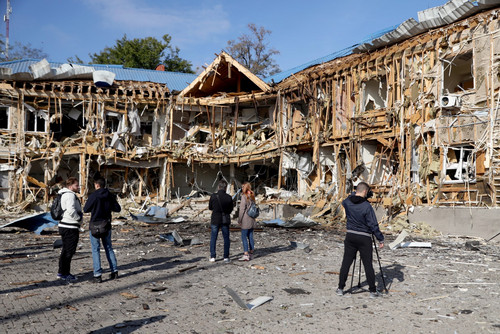
New incidents followed in September 2026. On 8 September, TV journalists from We Are Ukraine (Ми — Україна) and We Are Ukraine+ (Ми — Україна+) were broadcasting live as part of the national “United News” telethon, when a Russian airstrike hit the building and significantly damaged the premises and injured six. Three media workers were hospitalised with serious injuries, while others sustained cuts and minor injuries. Initially, three people were hospitalised.
NUJU President Sergiy Tomilenko said: “The drone threat is evolving faster than the safety protocols and equipment available to journalists. A reporter no longer needs to be on the front line to be in danger, while a single strike on a newsroom can deprive an entire community of trusted information. We urge international partners to help turn this evidence into practical protection — modern detection and warning tools, specialised training, resilient workplaces and sustained support for the Journalists’ Solidarity Centers.”
NUJU’s report shows that the threat posed by drones has changed, with the following recent developments:
The front line is no longer the boundary of the drone risk: NUJU documented FPV drone attacks on journalists as far as 17–20 km from the line of , while long-range Shahed and Geran drones pose a nationwide risk to journalists and media infrastructure;
Existing protective technology is falling behind the threat : commonly used radio-frequency drone detectors may fail to detect fibre-optic FPV drones, while radio-frequency jamming is ineffective against their fibre-optic control systems.
The changing risk-benefit balance of traditional PRESS markings : in at least six documented incidents in 2026, journalists wearing PRESS markings came under FPV attack, prompting some media workers to question whether traditional visual identification remains protective in all operational environments.
Drones increasingly affect media outlets’ ability to continue operating, not only individual journalists : repeated strikes have damaged newsrooms, broadcasting infrastructure, equipment and premises, highlighting the need for greater resilience and alternative arrangements for media outlets operating in high-risk areas.
IFJ General Secretary Anthony Bellanger said: “Drone warfare is fundamentally changing the risks faced by journalists in Ukraine. The danger is no longer confined to the front line: journalists, newsrooms and media infrastructure can now come under attack far from the battlefield. Governments and international partners must respond to this changing threat by ensuring that journalists have access to appropriate detection technology, safety training and protection. When journalists are prevented from reporting safely, communities are also deprived of reliable and independent information. Protecting journalists in Ukraine means protecting the public’s right to know.”
Download the report: here .
The full story
This article is one source in a clustered incident — the cluster page carries the summary, timeline and every other outlet covering it.
