 www.dvidshub.net
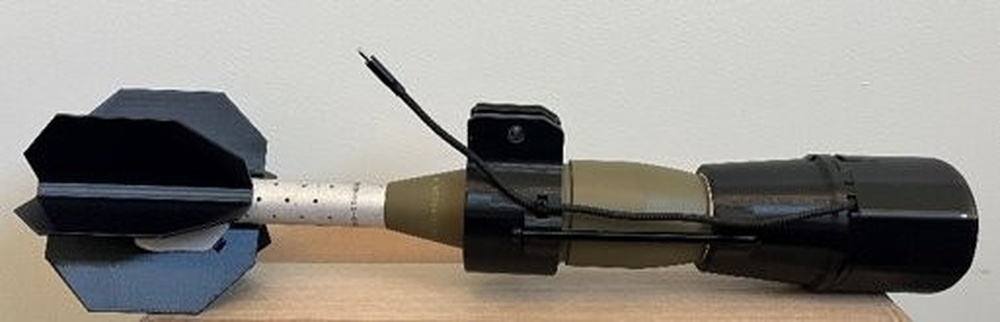
Army Unveils MALET Kit for Drone-Dropped Mortars
Article Content

- •The MALET kit converts standard mortar rounds for drone deployment.
- •Initial tests showed successful drops and detonation of live munitions.
- •The system allows for reuse of mortar rounds, enhancing operational flexibility.
On November 5, 2026, the U.S. Army announced the Munitions Air-dropped Lethal Effects Tool (MALET), enabling troops to convert standard 60mm and 81mm mortar rounds into drone-droppable munitions. This innovation allows for rapid deployment of existing munitions, enhancing operational capabilities without the need for new procurement. The MALET kit includes a clip-on fuze and fins for stability during aerial deployment, significantly extending the effective range of mortars from 3.5 miles to up to 25 miles. Initial tests demonstrated successful drops of live 60mm mortars from unmanned aerial systems (UAS), with rounds detonating accurately within target areas. The Army emphasized that the MALET system does not damage the original mortar rounds, allowing them to be reused as conventional munitions if not expended. This development comes as part of the Army's efforts to modernize its capabilities in response to evolving battlefield tactics first seen in conflicts like the Battle of Mosul in 2016-2017.
Ask AI about this cluster
Answers cite the sources they use
Timeline
More articles in this cluster (4)
Common questions
What types of mortar rounds can be converted?
How far can the mortars be dropped from drones?
Can the mortars be reused after conversion?
Continue Reading
 Critical RCE Vulnerability in Prefab UI Disclosed A critical remote code execution vulnerability, CVE-2026-120338, was disclosed on November 1, 2026, affecting Prefab UI's Generative UI sandbox. The flaw allows attackers to execute arbitrary Python code by exploiting Deno's permissions, enabling file read/write access on the host server. This vulnerability affects…
 China-Linked Hackers Exploit PHP2Shell Vulnerabilities to Breach U.S. Government Systems On October 21, 2026, the PHP development team released patches for two critical vulnerabilities in PHP, known as PHP2Shell (CVE-2026-109618 and CVE-2026-109619), which allow unauthenticated remote code execution. These vulnerabilities were actively exploited by a suspected China-linked threat actor who compromised 25…