 www.vulncheck.com
High-Risk Payment Bypass Vulnerability in Petpooja's Munshi
Article Content

- •CVE-2026-119731 allows payment bypass via unauthenticated webhook access.
- •Organizations using hosted subscription services are most at risk.
- •Immediate mitigation steps include disabling the webhook callback and verifying signatures.
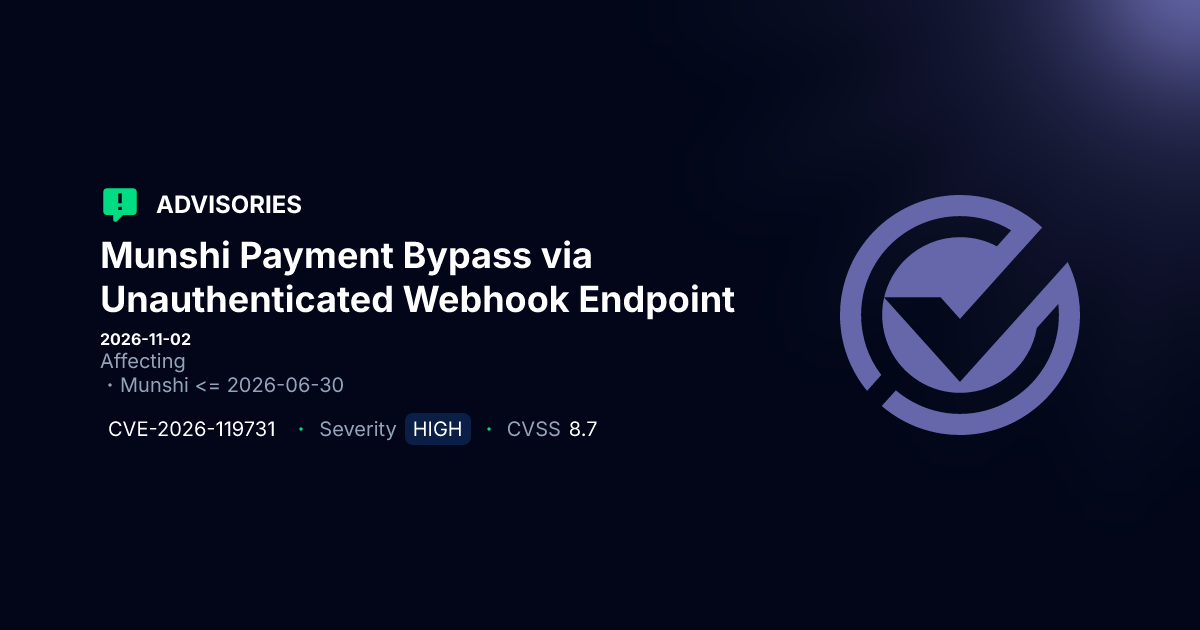
A payment bypass vulnerability identified as CVE-2026-119731 was discovered in Petpooja's Munshi before June 30, 2026. The flaw allows unauthenticated remote attackers to exploit the subscription payment webhook, enabling them to falsely mark subscriptions as paid without actual payment. This vulnerability poses a high risk to organizations using hosted subscription services reliant on webhook-driven entitlement activation. The CVE was published on November 2, 2026, with a CVSS score of 8.7, indicating a high severity. Organizations are advised to implement immediate mitigations, including disabling the callback or requiring verified signatures until a fix is applied. The vulnerability's exploitation could lead to significant revenue loss and damage customer trust. No active exploitation has been reported as of the latest updates.
Ask AI about this cluster
Answers cite the sources they use
Timeline
More articles in this cluster (3)
Following this threat?
Track Petpooja and CVE-2026-119731 in your own feed — you're alerted when they show up in new reporting, leak sites or exploitation.
Free account · no card needed
Common questions
What systems are affected by CVE-2026-119731?
What should organizations do to mitigate this vulnerability?
Is there any evidence of active exploitation?
Continue Reading
 Critical Zero-Day Exploited in BeyondTrust Remote Support by China-linked Group A critical vulnerability in BeyondTrust Remote Support, tracked as CVE-2026-102764 with a CVSS score of 9.3, has been exploited by the China-linked espionage group Armory Castle since August 29, 2026. This flaw allows unauthenticated remote attackers to perform file operations, gaining root control and access to…
 Critical RCE Vulnerability in Prefab UI Disclosed A critical remote code execution vulnerability, CVE-2026-120338, was disclosed on November 1, 2026, affecting Prefab UI's Generative UI sandbox. The flaw allows attackers to execute arbitrary Python code by exploiting Deno's permissions, enabling file read/write access on the host server. This vulnerability affects…