 Notebookcheck
 OpenCode Security Breach Exposes User API Keys
Article Content

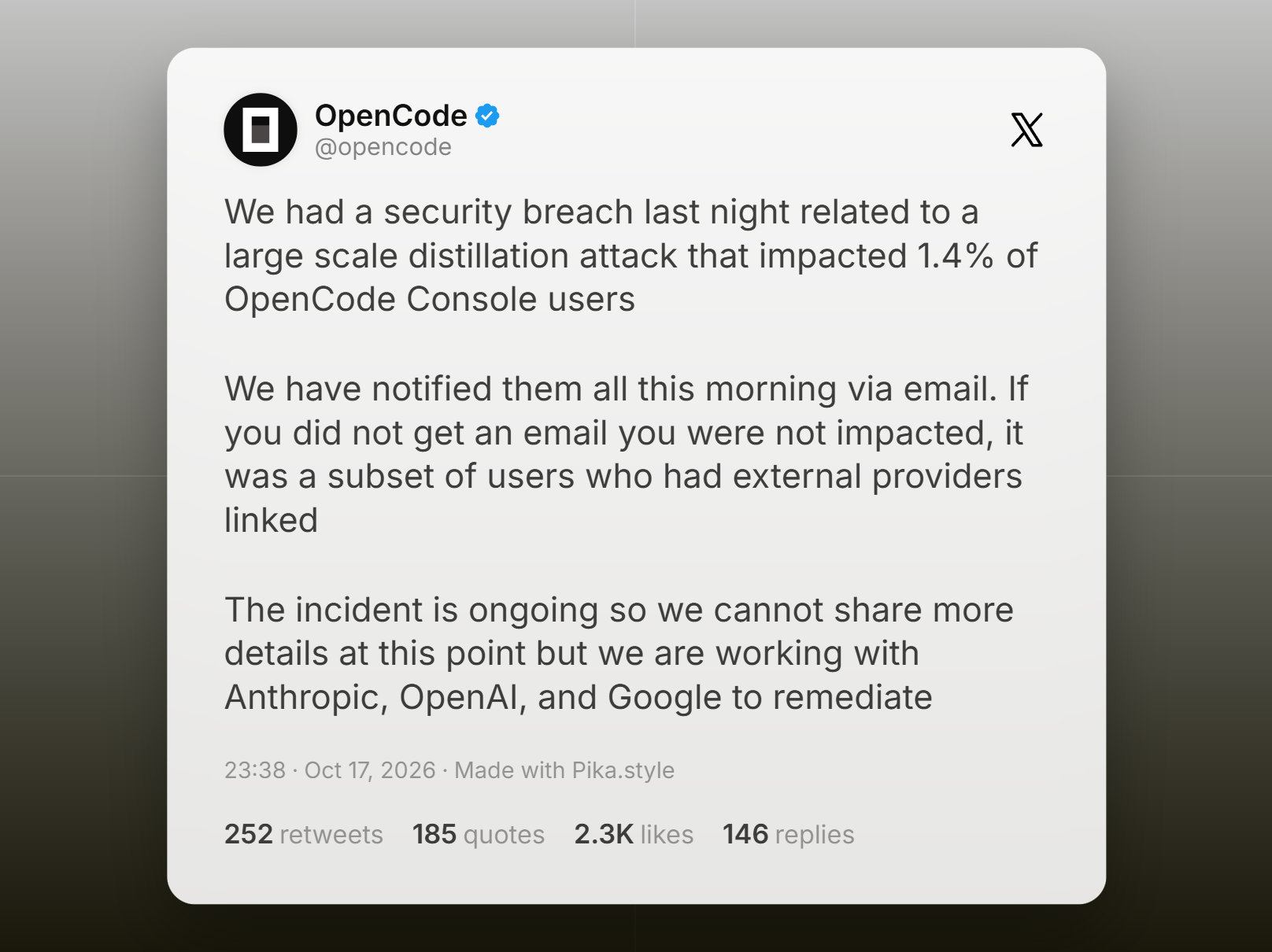
- •1.4% of OpenCode Console users affected by a security breach.
- •Unauthorized access linked to a large-scale distillation attack.
- •Users advised to revoke API keys and monitor account activity.
OpenCode reported a security breach on October 17, 2026, affecting 1.4% of its Console users. The breach was linked to a large-scale distillation attack, which compromised third-party API keys stored in user workspaces. Users have reported unauthorized charges on their accounts, with one user noting $400 in charges linked to Anthropic. OpenCode has notified all affected users via email and is working with Anthropic, OpenAI, and Google to address the incident. Users are advised to revoke and replace their API keys and review their account activity for any unauthorized usage. Access issues have also been reported by some users trying to log in. The situation remains ongoing as OpenCode investigates the breach further.
Ask AI about this cluster
Answers cite the sources they use
Timeline
More articles in this cluster (2)
Common questions
How many users are affected?
What should I do if I am affected?
What is a distillation attack?
Continue Reading
 Critical Zero-Day Exploited in BeyondTrust Remote Support by China-linked Group A critical vulnerability in BeyondTrust Remote Support, tracked as CVE-2026-102764 with a CVSS score of 9.3, has been exploited by the China-linked espionage group Armory Castle since August 29, 2026. This flaw allows unauthenticated remote attackers to perform file operations, gaining root control and access to…
  Silent Lynx Targets CIS Governments via WinRAR Exploit The threat actor Silent Lynx has launched a series of attacks against government organizations in the Commonwealth of Independent States (CIS) from June 2025 to August 2026. These attacks exploit a vulnerability in WinRAR (CVE-2025-8088) to deploy reverse shells, including FoalShell and PickleShell, facilitating…