 www.vulncheck.com
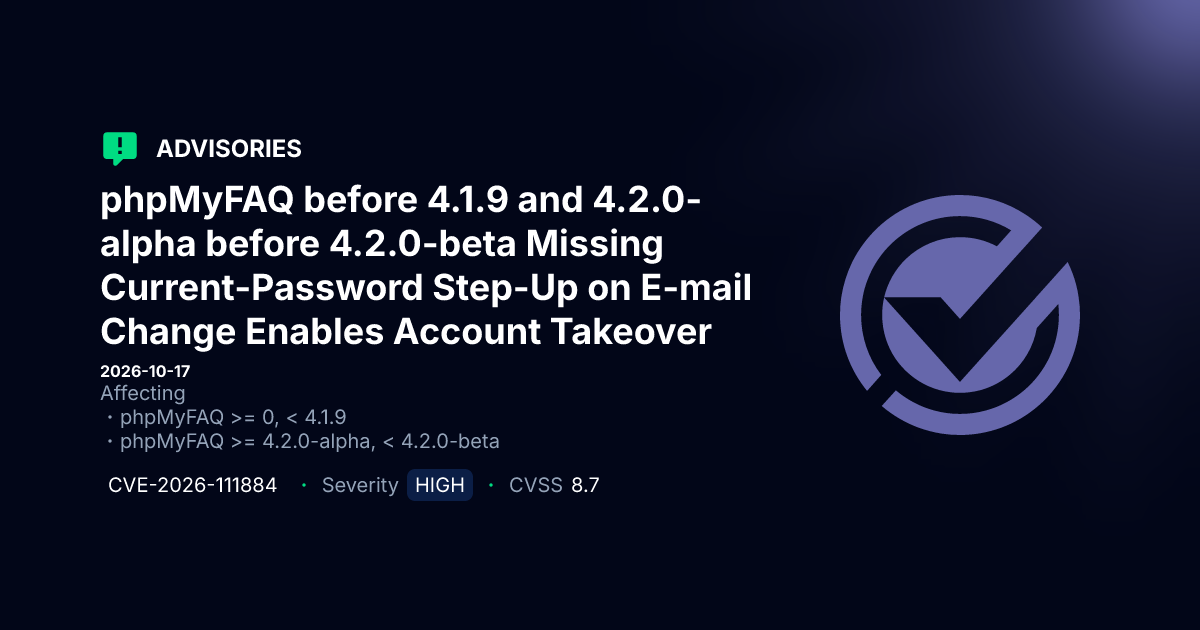
phpMyFAQ Vulnerability Enables Account Takeover via Email Change
Article Content

- •Vulnerability allows email change without current password, leading to account takeover.
- •Affected versions include phpMyFAQ before 4.1.9 and 4.2.0-alpha.
- •Attackers can exploit this flaw using a stolen session and CSRF token.
A vulnerability in phpMyFAQ versions before 4.1.9 and 4.2.0-alpha allows attackers to change a user's email without requiring the current password, enabling account takeover. An attacker with a stolen session can change the email to their own, then reset the password using the platform's password reset feature. This flaw circumvents protections added in previous advisories, particularly affecting accounts without two-factor authentication (2FA). While 2FA accounts are less vulnerable, the attacker can still gain control over the account by resetting the password and email. The vulnerability has been confirmed in versions 4.1.8 and 4.2.0-alpha. A patch is expected in version 4.1.9, but until then, users are at risk. The issue has been assigned CVE-2026-XXXX, and GitHub has published a security advisory (GHSA-7554-gx6g-xx77) detailing the flaw.
Ask AI about this cluster
Answers cite the sources they use
Timeline
More articles in this cluster (2)
Common questions
Which versions are affected?
Is this vulnerability being exploited in the wild?
What should I do if I'm using an affected version?
Continue Reading
 Critical Zero-Day Exploited in BeyondTrust Remote Support by China-linked Group A critical vulnerability in BeyondTrust Remote Support, tracked as CVE-2026-102764 with a CVSS score of 9.3, has been exploited by the China-linked espionage group Armory Castle since August 29, 2026. This flaw allows unauthenticated remote attackers to perform file operations, gaining root control and access to…
 Silent Lynx Targets CIS Governments via WinRAR Exploit The threat actor Silent Lynx has launched a series of attacks against government organizations in the Commonwealth of Independent States (CIS) from June 2025 to August 2026. These attacks exploit a vulnerability in WinRAR (CVE-2025-8088) to deploy reverse shells, including FoalShell and PickleShell, facilitating…