 zou-group.github.io
Study Reveals Rapid Expiration of LLM Claims
Article Content

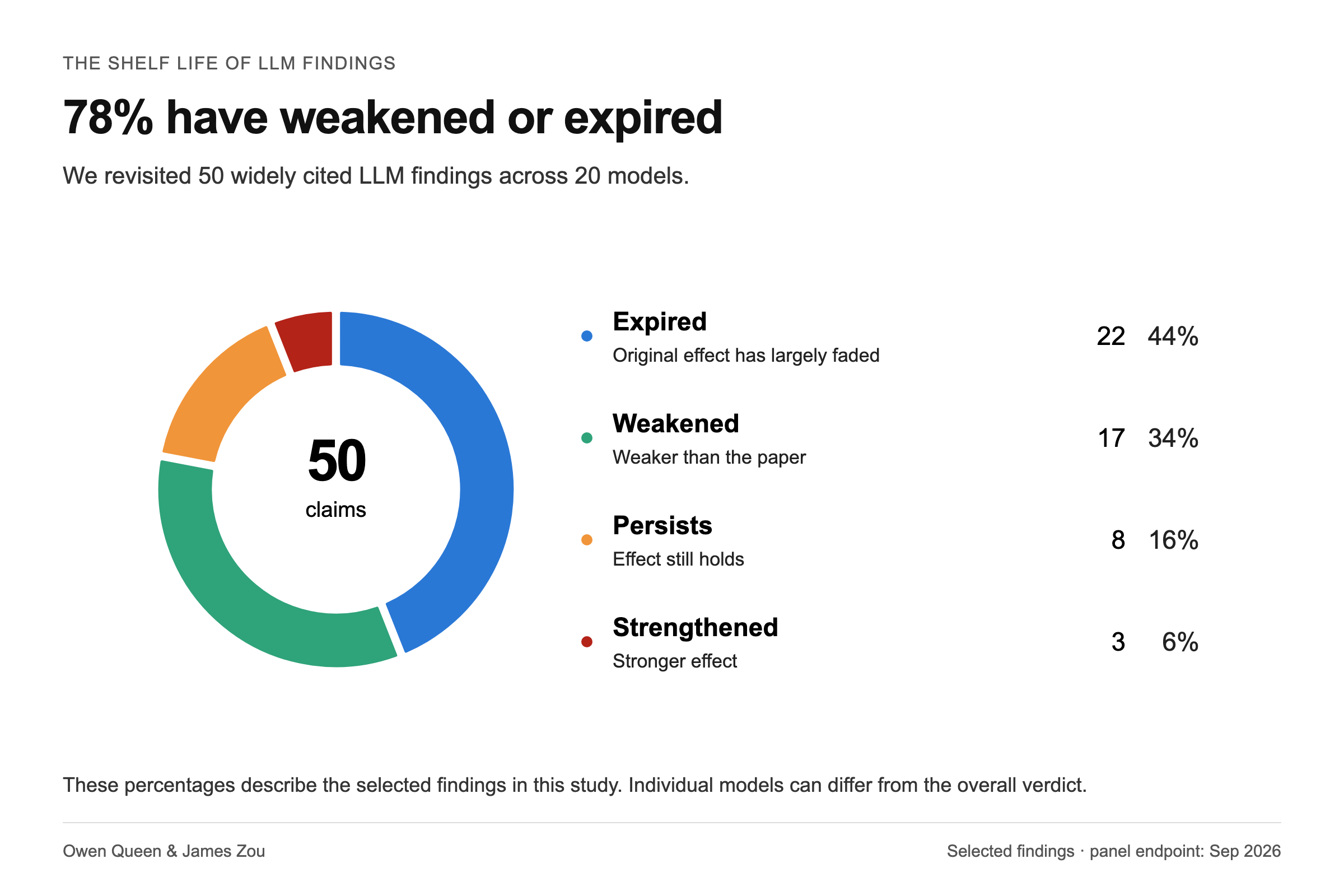
- •44% of widely cited LLM claims have expired within 15 months.
- •Claims about LLM limitations expire faster than those about behavior.
- •Fabricated citations in LLM outputs have drastically decreased.
A study by Stanford researchers Owen Queen and James Zou found that 44% of widely cited claims about large language models (LLMs) have already 'expired' within a short timeframe, with an average lifespan of just 15.7 months. The research tested 50 claims across 20 models released between July 2024 and September 2026. Claims regarding the limitations of LLMs expired the fastest, particularly those related to reasoning errors, while claims about model behavior showed more longevity. The study also highlighted a significant reduction in fabricated scientific citations, dropping from 55% to nearly 0% in newer models. However, some models still struggle with complex queries. The findings indicate that assumptions based on older models may no longer be valid for current iterations, emphasizing the need for ongoing evaluation of LLM capabilities.
Ask AI about this cluster
Answers cite the sources they use
Timeline
More articles in this cluster (2)
Common questions
What claims about LLMs have expired?
How reliable are current LLM outputs?
What should developers consider about LLM claims?
Continue Reading
 Critical Zero-Day Exploited in BeyondTrust Remote Support by China-linked Group A critical vulnerability in BeyondTrust Remote Support, tracked as CVE-2026-102764 with a CVSS score of 9.3, has been exploited by the China-linked espionage group Armory Castle since August 29, 2026. This flaw allows unauthenticated remote attackers to perform file operations, gaining root control and access to…
 Critical RCE Vulnerability in Prefab UI Disclosed A critical remote code execution vulnerability, CVE-2026-120338, was disclosed on November 1, 2026, affecting Prefab UI's Generative UI sandbox. The flaw allows attackers to execute arbitrary Python code by exploiting Deno's permissions, enabling file read/write access on the host server. This vulnerability affects…