 doi.org
Advancements in Quantum Defects for Next-Generation Technologies
Ask AI about this cluster
Analyzing cluster data...
Referenced clusters:
Something went wrong. Please try again.
Cluster AI
Ask questions about this threat cluster with AI-powered analysis.
Get Researcher $29.99/moArticle Content
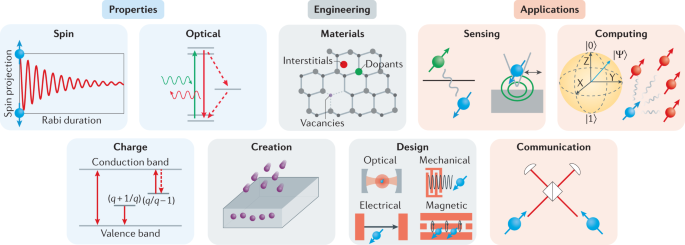
Recent reviews highlight significant advancements in quantum defects, which are crucial for quantum technologies such as sensing, communication, and computation. Research focuses on diverse host materials, including wide-band-gap semiconductors and two-dimensional materials, to optimize defect properties. Key examples include nitrogen-vacancy centers in diamond and divacancies in silicon carbide, which have shown potential for applications like spin qubits and single-photon emitters. Theoretical methods, including machine learning, are being employed to predict defect properties and facilitate the discovery of new quantum defects. Despite progress, challenges remain in experimental benchmarking and modeling, emphasizing the need for systematic discovery and inverse design approaches. The field is rapidly evolving, with implications for scalable quantum technologies.
Key Points: • Quantum defects are essential for advancements in quantum sensing, communication, and computation. • Research is focusing on diverse host materials to optimize defect properties for specific applications. • Machine learning methods are being utilized to predict and discover new quantum defects.