 Bitget
 AI-Driven Market Manipulation Causes $19 Billion Crypto Crash
Article Content

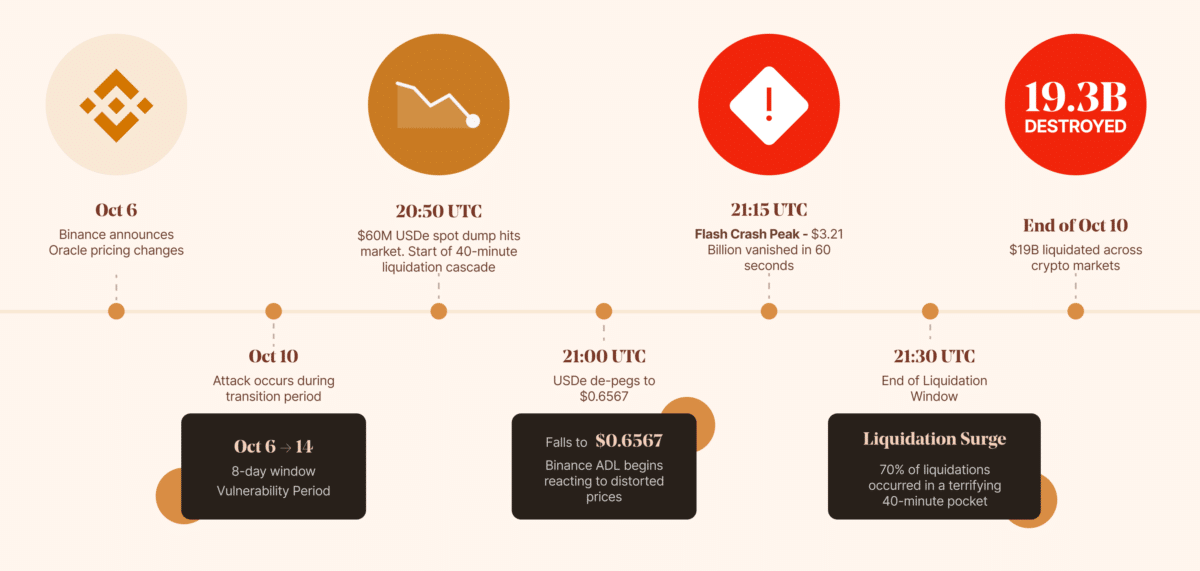
- •The crypto market experienced $19 billion in liquidations on October 10, 2025.
- •A structural vulnerability known as the 'Oracle Loop' was central to the crash.
- •Binance's Automatic Deleveraging system mispriced assets, triggering widespread panic selling.
On October 10, 2025, a significant crypto market crash occurred, resulting in $19 billion in liquidations. The collapse was triggered by a structural vulnerability known as the 'Oracle Loop' during a transition period initiated by Binance. A $60 million dump of the synthetic dollar $USDe caused it to de-peg, leading Binance's Automatic Deleveraging (ADL) system to liquidate over-leveraged accounts based on a phantom price. This liquidation cascade affected multiple platforms relying on Binance's ADL, leading to panic selling and drastic price drops, such as Cosmos (ATOM) falling from $4 to $0.001. The event highlighted the risks of algorithmic trading and systemic vulnerabilities in the crypto market. Analysts noted that the lack of market pauses in crypto exacerbated the situation, allowing rapid price movements to spread across exchanges without intervention.
Ask AI about this cluster
Answers cite the sources they use
Timeline
More articles in this cluster (2)
Following this threat?
Track Binance in your own feed — you're alerted when they show up in new reporting, leak sites or exploitation.
Free account · no card needed
Continue Reading
 Critical WSO2 API Manager Vulnerability Under Active Exploitation A critical vulnerability (CVE-2026-5430) in WSO2 API Manager is being actively exploited, allowing unauthenticated attackers to forge admin tokens via JWT authentication bypass. This flaw, which has a CVSS score of 10.0, affects multiple WSO2 products including API Manager, Universal Gateway, Traffic Manager, and API…
  Critical Linux Kernel Vulnerability CVE-2025-39682 Under Active Exploitation A critical vulnerability (CVE-2025-39682) in the Linux kernel allows remote code execution through mishandling of zero-length TLS records. This flaw affects kTLS-enabled hosts running vulnerable kernel versions, exposing them to attackers without authentication. CISA added this vulnerability to its Known Exploited…