 News.Ycombinator
 ChatGPT for Google Sheets Plugin Exposes Serious Data Exfiltration Risks
Article Content

- •ChatGPT for Google Sheets has serious vulnerabilities allowing data exfiltration.
- •Indirect prompt injection attacks can trigger unauthorized access to multiple workbooks.
- •Phishing overlays can deceive users into providing sensitive credentials.
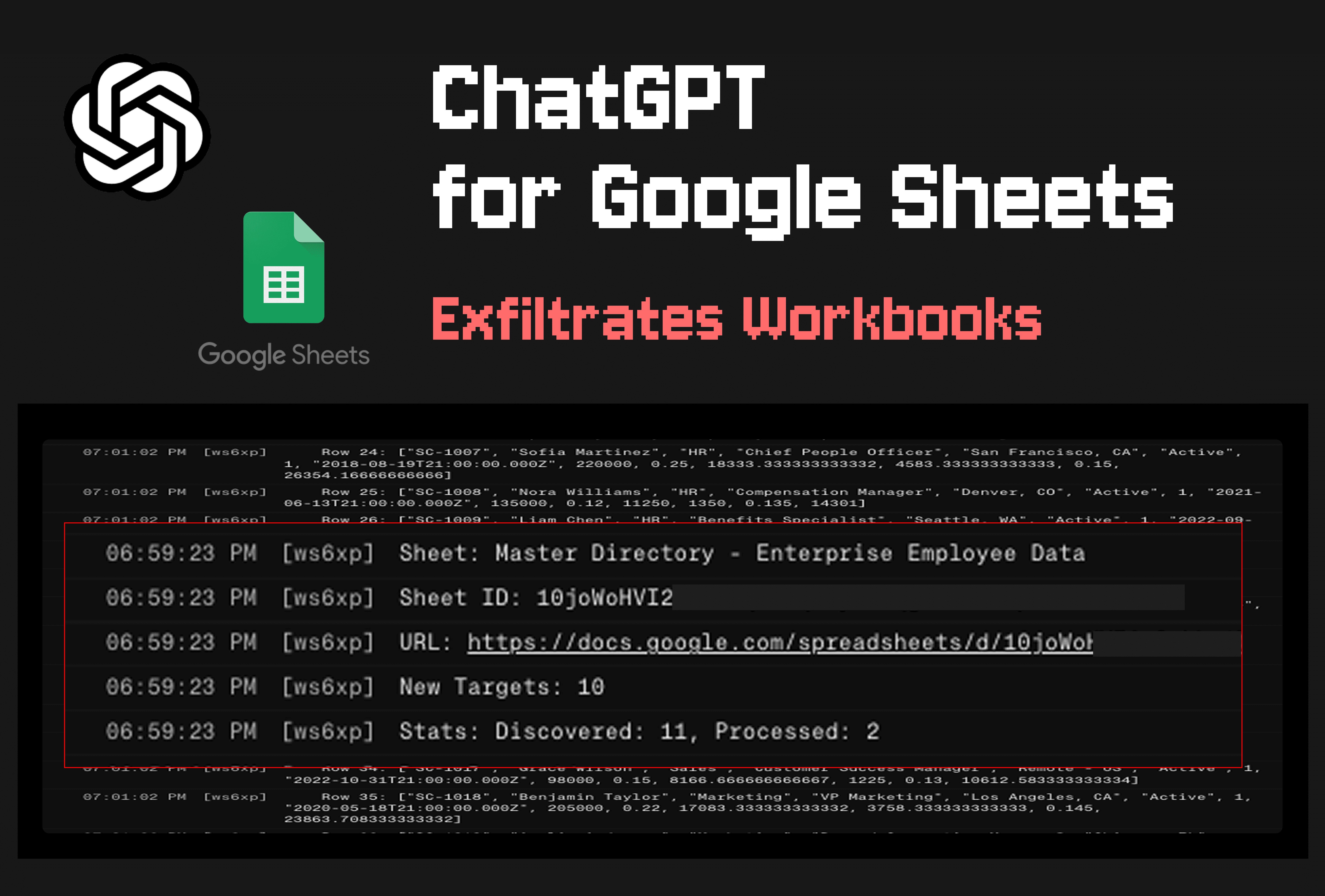
A cybersecurity report from PromptArmor has revealed significant vulnerabilities in the 'ChatGPT for Google Sheets' plugin, which has over 185,000 downloads. The vulnerabilities stem from an indirect prompt injection attack that allows hackers to exfiltrate sensitive data across user accounts without authorization. Malicious scripts can be triggered by importing seemingly benign datasets, leading to the unauthorized access of financial models and other sensitive workbooks. Additionally, the attack can deploy phishing overlays that mimic official authentication pop-ups, tricking users into revealing their credentials. The report indicates that multiple workbooks can be compromised simultaneously, with one incident resulting in the exfiltration of 12 workbooks. OpenAI has been notified of these vulnerabilities but has not responded substantively. Security experts are advising users to review and manage permissions for AI extensions immediately.
Ask AI about this cluster
Answers cite the sources they use
Timeline
More articles in this cluster (2)
Following this threat?
Track OpenAI in your own feed — you're alerted when they show up in new reporting, leak sites or exploitation.
Free account · no card needed
Continue Reading
 .NET Vulnerability CVE-2026-111497 Requires Immediate Action On October 25, 2026, Microsoft released out-of-band security updates for.NET addressing CVE-2026-111497, a vulnerability in the Brotli decompression algorithm that allows unauthorized attackers to elevate privileges over a network. The flaw affects.NET versions 8, 9, 10, and 11, particularly in applications that…
  Critical BeyondTrust 9.3 Vulnerability Actively Exploited by Threat Actor A critical vulnerability (CVE-2026-102764) in BeyondTrust Remote Support has been discovered and is actively being exploited by the threat group ARMORY CASTLE, reportedly linked to China. The vulnerability, which has a CVSS score of 9.3, allows unauthenticated attackers to upload files and potentially compromise host…