 dx.doi.org
 Quantum Randomness Amplification Enhances Data Security
Article Content

- •Quantum randomness amplification addresses flaws in traditional random number generators.
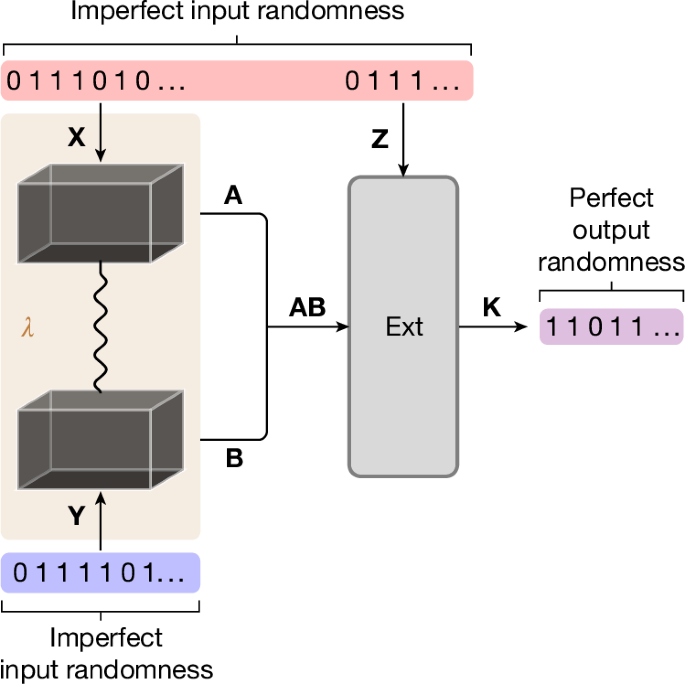
- •The experiment involved entangled qubits to ensure true randomness for cryptographic applications.
- •This advancement could enhance data security significantly against potential cyber threats.
Researchers have demonstrated a new method for enhancing randomness in quantum systems, crucial for cryptographic applications. This method, known as randomness amplification, addresses the imperfections in traditional random number generators that can lead to predictable patterns. The experiment involved entangling qubits at near absolute zero temperatures in a 30-meter-long tube, ensuring that external variables did not influence the results. The findings suggest that quantum systems can provide true randomness, which is essential for secure data encryption. The study emphasizes the limitations of classical devices in generating unpredictable values, which are critical for maintaining data security. The research was published in Nature and highlights a significant advancement in quantum information processing. This breakthrough could have far-reaching implications for cybersecurity, particularly in protecting sensitive information from adversaries.
Ask AI about this cluster
Answers cite the sources they use
Timeline
More articles in this cluster (10)
Continue Reading
 Critical Zero-Day Vulnerability in Cisco Secure Email Gateway Exploited On September 14, 2026, Cisco disclosed a critical SQL injection vulnerability (CVE-2026-76461) in its Secure Email Gateway, allowing unauthenticated remote attackers to execute arbitrary commands with root privileges. This vulnerability arises from insufficient validation in the email parsing logic. Cisco confirmed…
  Critical WSO2 API Manager Vulnerability Under Active Exploitation A critical vulnerability (CVE-2026-5430) in WSO2 API Manager is being actively exploited, allowing unauthenticated attackers to forge admin tokens via JWT authentication bypass. This flaw, which has a CVSS score of 10.0, affects multiple WSO2 products including API Manager, Universal Gateway, Traffic Manager, and API…