 doi.org
Quantum Dots Achieve Telecom Wavelengths with High Photon Emission Rates
Ask AI about this cluster
Analyzing cluster data...
Referenced clusters:
Something went wrong. Please try again.
Cluster AI
Ask questions about this threat cluster with AI-powered analysis.
Get Researcher $29.99/moArticle Content
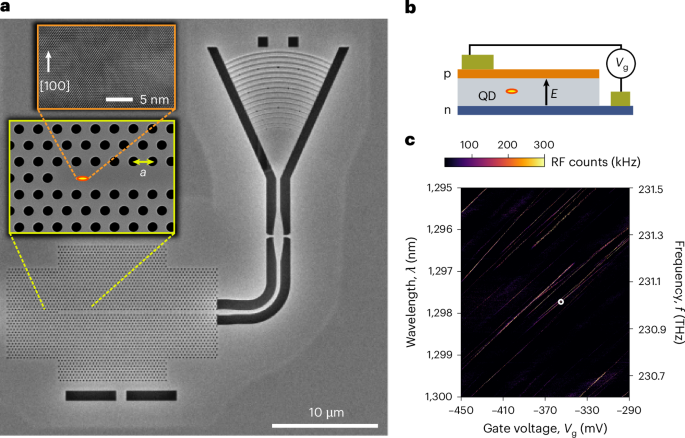
Recent advancements in quantum dot technology have enabled the production of single photons at telecom wavelengths, specifically in the O-band (1260-1360 nm). Researchers demonstrated a quantum-coherent photon-emitter interface that delivers over 40 million single photons per second, significantly improving the coherence and quality of emitted photons. This breakthrough addresses previous challenges in integrating quantum dots with existing fiber-optic infrastructure. The work was conducted using self-assembled indium arsenide quantum dots embedded in gallium arsenide, marking a significant step towards scalable quantum networks. The findings were published in a Nature Nanotechnology paper on August 3, 2026, and highlight the potential for secure quantum communication applications. The implications of this technology extend to quantum key distribution and photonic quantum computing, both of which rely on high-quality single photon sources.
Key Points: • Quantum dots now emit over 40 million single photons per second at telecom wavelengths. • The breakthrough addresses previous limitations in integrating quantum technology with fiber-optic systems. • This development enhances the potential for secure quantum communications and photonic computing.