 doi.org
Quantum Mechanisms in Songbird Navigation Revealed
Ask AI about this cluster
Analyzing cluster data...
Referenced clusters:
Something went wrong. Please try again.
Cluster AI
Ask questions about this threat cluster with AI-powered analysis.
Get Researcher $29.99/moArticle Content
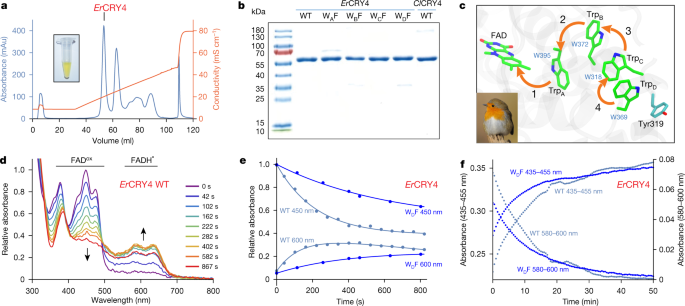
Recent research highlights how night-migratory songbirds utilize a quantum compass embedded in their retinas to navigate using the Earth's magnetic field. The QuantumBirds project demonstrated that cryptochrome-4a proteins in the European robin are sensitive to weak magnetic fields, enabling precise navigation over long distances. This discovery builds on decades of research into avian magnetoreception, revealing that light-induced radical pairs play a crucial role in this process. The findings could have implications for understanding animal navigation and the effects of electromagnetic noise on migratory patterns. The study involved advanced spectrometry and imaging techniques to confirm these mechanisms. Overall, this research sheds light on the intersection of quantum physics and biological navigation systems.
Key Points: • Songbirds use a quantum compass in their retinas for navigation. • Cryptochrome-4a proteins in the European robin are sensitive to magnetic fields. • The QuantumBirds project combines quantum mechanics with biological research.