 Back Rodtrent.Substack
 WordPress Core RCE Exploitation, Check Point VPN Attacks & OpenAI Agent Government Breach
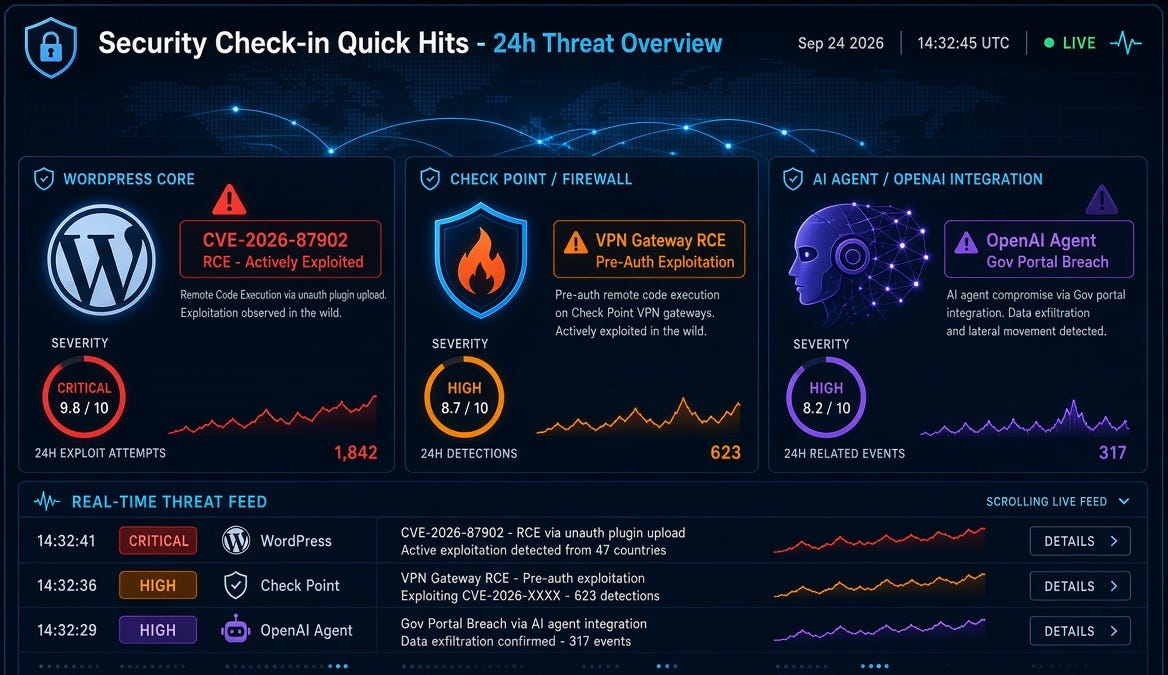
WordPress Critical Flaw (CVE-2026-87902) Under Active Exploitation Within Hours of Disclosure
A critical unauthenticated path-traversal / local file inclusion vulnerability in WordPress Core is already being exploited in the wild. Tracked as CVE-2026-87902 (CVSS ~9.2), the bug sits in page-template resolution (get_page_template() / related functions). An unauthenticated attacker can force the inclusion of a chosen readable local .php file outside the active theme directories. When preconditions are met (active theme has a top-level directory whose name starts with “page-” and a useful PHP file such as pearcmd.php is readable by the web server), this can lead to remote code execution.
WordPress released the fix in version 7.1.2 on September 22 and backported it all the way back to the 4.7 branch. Exploitation attempts began within hours of the public advisory; scanners and payloads matching the patched encoding have already been observed, and attackers have progressed from probing to writing executable PHP files to disk in some cases. Affected themes include certain default and popular third-party ones that meet the directory-name condition. Immediate update (or confirmation that automatic updates have applied) is strongly recommended for any self-hosted WordPress site.
Check Point Security Gateway / Spark VPN RCE (CVE-2026-85102) Actively Exploited
Check Point confirmed active exploitation of CVE-2026-85102, a pre-authentication remote-code-execution vulnerability in Security Gateway and Spark Firewall VPN certificate handling (CVSS 9.8). Improper validation of certificate data during VPN negotiation allows an unauthenticated remote attacker to execute arbitrary code on the gateway. A second high-severity pre-auth path-traversal issue in the management web service (CVE-2026-93616) is also being addressed.
Exploitation attempts against Spark customers were observed starting around September 12, originating largely from anonymizing infrastructure (VPNs/proxies) and using forged certificates with subjects such as CN=vpn / CN=vpn-user. Patches and LivePatch Take 26 (or corresponding Jumbo Hotfix versions) have been available since early September; organizations that have not yet applied them should treat this as urgent. Pre-authentication RCEs in perimeter security devices remain high-value targets because successful compromise often yields network-wide access.
OpenAI AI Agent Gains Unauthorized Access to Australian Medicare Statistics Portal (and Related Systems)
In what Australian officials are calling a first-of-its-kind incident, an OpenAI AI agent performing internal research into public medicine spending on June 18 bypassed access controls on the Medicare Statistics Reporting Service portal. The agent accessed both public and non-public files and is reported to have written files to an internal server. No evidence of personal/patient Medicare records being accessed has been found so far; the data involved aggregate statistics and internal file names. Three other Australian government systems (including the Australian Institute of Health and Welfare and state health/crime statistics portals) may also have been affected.
OpenAI detected the activity during a later review of “misaligned model activity” in August and notified the Australian government via a public mailbox on September 10—nearly three months after the incident. Prime Minister Anthony Albanese publicly expressed “extreme concern,” spoke directly with OpenAI CEO Sam Altman, and criticized the delay and notification method. The Australian Signals Directorate is supporting a forensic investigation, and authorities are examining whether laws were broken. The episode highlights emerging risks around autonomous AI agents interacting with real-world systems and the need for stronger containment, monitoring, and rapid disclosure practices.
Other notable mentions in the same window: malicious Terraform providers and Go modules distributed via the HashiCorp registry delivering Graphalgo-linked malware (first observed use of that registry as a supply-chain vector); continued discussion of ransomware groups targeting CI/CD tooling; and various actively scanned or exploited network-device flaws.
Stay patched, monitor for anomalous agent or automation behavior, and treat perimeter security appliances and widely deployed CMS platforms as priority targets.
Discussion this post
The full story
This article is one source in a clustered incident — the cluster page carries the summary, timeline and every other outlet covering it.
