 Csoonline
 Storm-2561 Targets VPN Users with SEO Poisoning and Fake Clients
Article Content

- •Storm-2561 uses SEO poisoning to distribute fake VPN clients that steal credentials.
- •The malware is signed with a legitimate certificate, allowing it to evade detection.
- •Microsoft has issued warnings and mitigation strategies for affected organizations.
Cybercriminal group Storm-2561 is exploiting SEO poisoning to distribute trojanized VPN clients, primarily targeting enterprise users of popular VPN solutions like Pulse Secure, Ivanti, and Cisco. The attackers manipulate search engine results to redirect users to spoofed sites that closely mimic legitimate VPN vendors, leading to the download of a malicious ZIP file containing a fake MSI installer. This installer drops a fake application and a variant of the Hyrax infostealer, which captures and exfiltrates VPN credentials and configuration data. The malware is signed with a valid certificate from Taiyuan Lihua Near Information Technology Co., Ltd., allowing it to bypass security warnings. Microsoft first detected this activity in January 2026, although the group has been active since May 2025. The campaign highlights the increasing sophistication of infostealers, which are now often paired with remote access trojans. Microsoft has provided mitigation guidance and indicators of compromise to help organizations defend against this threat.
Ask AI about this cluster
Answers cite the sources they use
Timeline
More articles in this cluster (9)
Following this threat?
Track Storm-2561, Hyrax and Pulse Secure in your own feed — you're alerted when they show up in new reporting, leak sites or exploitation.
Free account · no card needed
Continue Reading
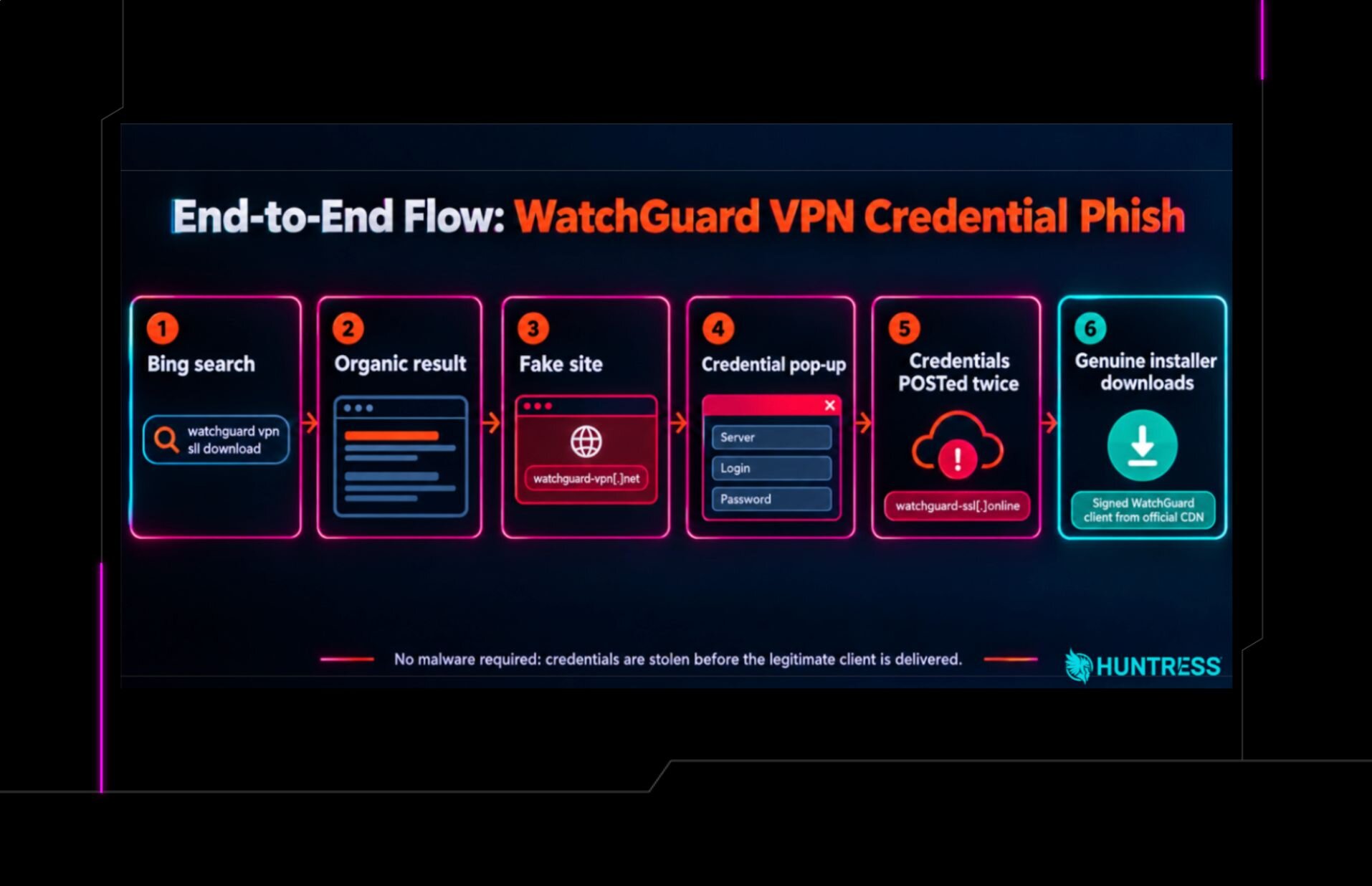 Fake WatchGuard VPN Site Steals Credentials with Genuine Installer A credential-harvesting campaign has been identified targeting WatchGuard VPN users through a lookalike download site, watchguard-vpn[.]net. This site collects user credentials under the guise of a legitimate download, then serves the actual, valid installer from WatchGuard's CDN, evading detection by endpoint…
  Critical Zero-Day Exploited in BeyondTrust Remote Support by China-linked Group A critical vulnerability in BeyondTrust Remote Support, tracked as CVE-2026-102764 with a CVSS score of 9.3, has been exploited by the China-linked espionage group Armory Castle since August 29, 2026. This flaw allows unauthenticated remote attackers to perform file operations, gaining root control and access to…